
Saperavi Wine: The Complete Guide to Georgia's Greatest Red Grape
Saperavi is the most important red grape in Georgia and one of the most distinctive red grapes in the world. It is not well known in the West — not yet — but among the community of wine drinkers who have found it, there is a near-universal reaction: this is something completely different, and completely compelling.
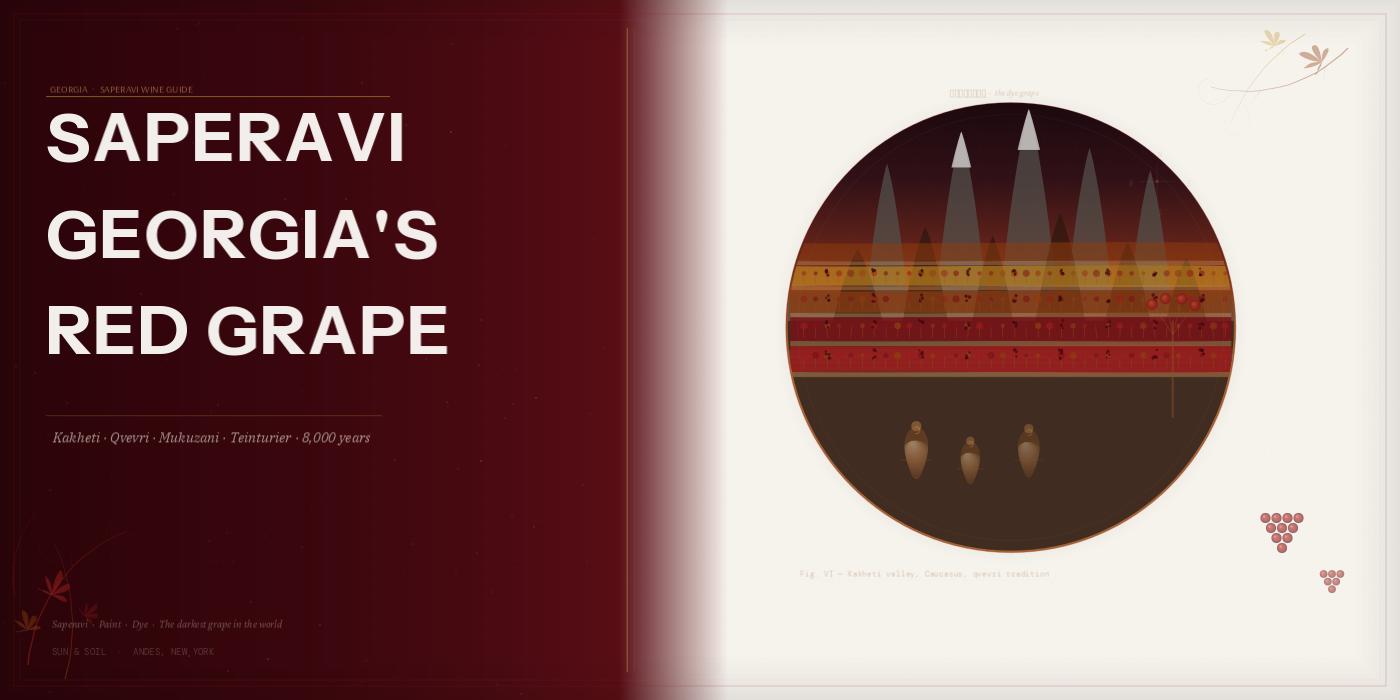
The name means "dye" or "paint" in Georgian. It was chosen deliberately. Saperavi is one of the rare teinturier grapes in existence — a variety with red flesh as well as red skin. Crush a Saperavi berry and the juice that runs out is not the pale grey-pink of most red grape varieties. It is a deep, saturated purple-crimson that stains everything it touches. The colour of the wine it produces is correspondingly intense — almost opaque in youth, the kind of deep garnet-black that makes you hold the glass up to the light just to see the edges glow dark ruby.
But Saperavi is not just about colour and power. At its best — and its best is very good indeed — it is a wine of genuine complexity and age-worthiness, with a flavour profile that combines dark fruit, high natural acidity, savoury depth, and a distinctly Georgian character that no amount of Cabernet Sauvignon or Syrah can replicate. Understanding Saperavi means understanding something ancient and irreplaceable in the story of wine.
The Grape: What Makes Saperavi Unique
Saperavi is native to the Kakheti region of eastern Georgia and has been cultivated there for at least 4,000 years. Its genetic ancestry places it among the earliest domesticated wine grapes in the world — along with Rkatsiteli and a handful of other ancient Georgian varieties, it is thought to represent one of the first deliberate selections of wild Vitis vinifera for systematic winemaking.
Several things make Saperavi botanically unusual among wine grapes. The teinturier characteristic — red-fleshed as well as red-skinned — is shared by only a small number of other varieties worldwide, including Alicante Bouschet in southern France and Duras in Gaillac. This pigmentation means that Saperavi produces wines of exceptional colour intensity without needing extended maceration: the colour comes from the juice itself, not just from the skins.
Fig. A — The teinturier characteristic: why Saperavi produces uniquely deep, inky wine with colour in the flesh, not only the skin
Saperavi is also naturally high in acidity — unusually so for a red grape, particularly one that produces such concentrated, dark-coloured wines. This combination of colour depth and high acid is what gives the wine its particular character and makes it so age-worthy. The tannins are firm but not harsh in good examples, and the alcohol level is typically moderate (12.5–14%) relative to the wine's apparent intensity. Saperavi keeps longer than almost any other red wine from the Caucasus — the great qvevri-aged examples can improve in bottle for a decade or more.
The grape ripens late in the season, which in Kakheti means October harvests are common. It is hardy and disease-resistant — adapted to the continental climate of eastern Georgia, where hot summers and cold winters require a vine that can handle extremes. These characteristics have made Saperavi one of the most successfully exported Georgian varieties: small plantings exist in Russia, Ukraine, Moldova, Bulgaria, Australia, and even California, though none produces results comparable to Kakheti.
How Saperavi Tastes
The flavour profile of Saperavi is distinctive and once encountered, unmistakable. The core fruit is always dark: blackberry, black plum, black cherry, and dark pomegranate — the pomegranate note is particularly Georgian, a reflection of the fruit that grows throughout the Caucasus. There is almost always a savoury, earthy quality beneath the fruit — something between dark chocolate, tobacco, and dried Mediterranean herbs — and frequently a violet or dried flower note on the nose that provides an unexpected elegance.
The acidity is the key structural element. It is what separates great Saperavi from merely good Saperavi, and it is what gives the wine its particular freshness and food-friendliness despite its depth of colour and concentration. Young Saperavi has the acidity fully present and sometimes slightly raw; aged Saperavi — five, ten, fifteen years — integrates it into something layered and complex, with the fruit darkening toward dried plum and leather and the savoury notes deepening into something almost truffle-like.
Saperavi aged in qvevri — the traditional Georgian clay vessel buried underground — tastes completely different from Saperavi aged in oak barrels, and different again from Saperavi aged in stainless steel. The qvevri style is the oldest and the most distinctively Georgian: extended skin contact in the clay vessel, sometimes for six months or more, produces wines of considerable tannin, dried fruit, earth, and mineral depth. The clay vessel breathes very slowly, producing a gentle micro-oxidation that shapes the wine's character without imparting wood flavours. The result is a wine that tastes of its place rather than of any production technique — which is precisely why the natural wine world has embraced Georgian qvevri Saperavi so enthusiastically.
The Great Saperavi PDOs
Georgia's wine appellation system designates several Protected Designation of Origin zones for Saperavi-based wines. Understanding these is the fastest route to understanding the stylistic range of the grape.
Mukuzani — the benchmark dry Saperavi
Mukuzani is the most internationally recognised Saperavi appellation and the standard by which dry Georgian Saperavi is judged. The PDO covers a micro-zone in the Alazani Valley in Kakheti, where the river deposits of alluvial soil combined with the mountain climate create ideal conditions for Saperavi. By law, Mukuzani must be aged in oak for a minimum of three years before release — the result is a structured, serious red wine with dark fruit, firm tannins, and genuine aging potential. It is the Georgian red that wine professionals reach for when they want to explain why Saperavi deserves serious attention.
Kindzmarauli — the naturally semi-sweet
Kindzmarauli is the most famous Georgian wine after Mukuzani — a naturally semi-sweet Saperavi made from late-harvested grapes in the Kindzmarauli micro-zone, whose fermentation is stopped early to retain residual sweetness. The result is a wine that is simultaneously rich and refreshing: dark fruit, sweetness, and Saperavi's characteristic high acidity in balance. It is not a dessert wine — the sweetness is moderate and the acidity is high enough to keep it lively at the table. Kindzmarauli was reputedly a favourite of Stalin, who had it shipped from Georgia to Moscow throughout his rule.
Akhasheni — the richer semi-sweet
Akhasheni is another naturally semi-sweet Saperavi PDO, softer and more velvety than Kindzmarauli. The micro-zone sits on richer soils and produces wines of greater plushness and body — closer to a ripe, fruit-forward style than the more structured Kindzmarauli. For those who want to understand semi-sweet Georgian wine at its most immediately enjoyable, Akhasheni is the starting point.
Napareuli — the complex dry red
Napareuli is a PDO for dry red wines from the village of the same name in Kakheti. Saperavi from Napareuli tends toward complexity and finesse rather than sheer power — the micro-terroir here produces wines with more aromatic nuance, violet and dried flower notes, and a silkier tannin structure than the more muscular Mukuzani style. It is the Saperavi for those who want elegance alongside intensity.
Kvareli — the structured estate red
Kvareli, near the mountain town of the same name in eastern Kakheti, produces Saperavi of distinct mineral character — shaped by the limestone and clay soils and the cooler temperatures at higher elevation. These are wines of firm structure and good aging potential, typically with a more restrained fruit character than the valley-floor PDOs and a stronger mineral backbone.
Saperavi and the Qvevri Tradition
The most distinctive expression of Saperavi for the natural wine community is the qvevri style — and it is the style that Georgia's most serious small-scale, low-intervention winemakers are increasingly using.
Qvevri (also spelled kvevri) are large clay vessels shaped like amphora, sealed with beeswax on the inside, and buried in the ground up to their necks. The burial regulates temperature — the clay stays at a consistent cool temperature year-round — while the vessel's microscopic porosity allows very slow, gentle gas exchange. Grapes are crushed into the qvevri, skins and all, and fermentation begins spontaneously with wild yeasts. After fermentation, the wine remains in contact with its skins, seeds, and stems for weeks or months before being pressed and moved to a second qvevri for ageing.
Fig. B — Qvevri cross-section: Saperavi fermenting in traditional buried clay vessel — the 8,000-year method of Kakheti
The result is a Saperavi of a completely different character from the oak-aged PDO wines. Extended skin contact in clay produces wines of considerable tannic structure — sometimes formidable in youth — with dried fruit, earth, mineral, and a fermented quality that is simultaneously ancient and thrilling. These are the wines that the natural wine world has seized on as evidence that Georgia is not just historically important but currently relevant: Saperavi made by small family producers in qvevri, with nothing added and nothing removed, represents the original expression of what Georgian winemaking looks like when it is not trying to impress a Western market.
The distinction between conventional qvevri winemaking and natural qvevri winemaking is subtle but real. The former uses sulphur and sometimes commercial yeasts even within the traditional clay vessel framework. The latter uses neither — the wine lives entirely on its native microbiology, with all the character and occasional unpredictability that implies. It is this natural qvevri tradition that the producers in our Georgian selection represent.
Saperavi and Food
Saperavi was made for Georgian food — and Georgian food is among the most wine-friendly in the world. The combination of dark, structured red wine and the herb-rich, walnut-sauced, slow-cooked meat dishes of Kakheti represents one of the great regional food-and-wine pairings.
Beyond Georgian cuisine, Saperavi's high acidity and dark fruit make it exceptionally versatile at the table. The specific pairings that work best reflect the wine's character: its acidity cuts through fat, its tannins handle protein, and its dark fruit complements rather than competes with bold flavours.
Lamb — the classic match. Slow-roasted lamb shoulder, Georgian-style with herbs and pomegranate, or simply roast lamb with garlic and rosemary. The pairing is elemental.
Game meats — venison, wild boar, and duck all find their match in the dark, earthy complexity of aged Saperavi. The wine's savouriness amplifies rather than contrasts with game's intrinsic character.
Georgian cuisine — khinkali (Georgian dumplings), chakapuli (lamb stew with tarragon), and mtsvadi (grilled pork skewers) are the natural companions to a young Saperavi from Kakheti. The spices and herbs of these dishes find direct counterparts in the wine's aromatic profile.
Hard and aged cheeses — the acidity and tannin of Saperavi handle the fat and salt of aged cheese superbly. Sulguni (Georgian cheese), aged manchego, and parmesan all work well.
Mushroom dishes — the earthy depth of aged qvevri Saperavi has an extraordinary affinity with mushrooms: wild mushroom risotto, mushroom and walnut pâté, or simply sautéed porcini.
Dark chocolate — one of those rare red wines that genuinely pairs with dark chocolate (70%+ cacao), particularly the semi-sweet Kindzmarauli style.
Saperavi from Our Cellar
These three bottles represent the full stylistic range of what Saperavi can be — from a traditional Mukuzani PDO blend to a decade-aged Kakheti red to a wild-fermented natural wine from one of Georgia's most interesting small producers.
From Our Georgian Cellar
Our broader Georgian selection focuses on the natural, qvevri tradition across the full range of Georgia's indigenous varieties — the context that surrounds and explains the Saperavi story.
Qvevri amber from Kakheti — the traditional method
Casreli "Erekle's Wine" Qvevri Dry Amber, Kakheti 2021 — $31 · Georgia (Kakheti)
Casreli was founded in 2017 by a group of friends in the medical community who wanted to return to the traditions of Georgian natural wine. Named after Erekle II — the 18th-century king of Kakheti who united the region — this qvevri amber is aged in buried clay vessels in the traditional Kakhetian method: skins, seeds, and stems in contact with the wine throughout fermentation and extended maceration. Almonds, orange peel, butterscotch, mineral depth. This is Kakheti's ancient winemaking tradition made with genuine care and zero additions. The same cellars that would once have made Saperavi by this method.
Wild fermentation from Kakheti's heartland
Ocho "Who r u?" Rkatsiteli–Mtsvane 2022 — $27 · Georgia (Kakheti)
While not a Saperavi, the Ocho philosophy represents exactly how great natural Kakheti winemaking works: qvevri fermentation, wild yeast, zero additions, indigenous varieties grown in the same region where Saperavi has been cultivated for millennia. Rkatsiteli is Saperavi's great white companion in Kakheti — these two varieties have coexisted in the same vineyards for 4,000 years. Understanding this wine deepens your understanding of what Kakhetian terroir feels like.
Georgia's western red — Saperavi's counterpart
Martvilis Marani Ojaleshi Samegrelo Red 2020 — $25 · Georgia (Samegrelo, Western Georgia)
Ojaleshi is to western Georgia what Saperavi is to Kakheti — the great indigenous red of its region. Light, perfumed, high-acid, and made with the same natural winemaking principles that define the best of Georgian viticulture. Drinking Ojaleshi alongside Saperavi is one of the most revealing exercises in Georgian wine: same country, same philosophy, completely different character. The contrast shows you exactly how specific and regional these ancient varieties are.
Kakheti amber — Nasrashvili family tradition
Nasrashvili Family Winery "Red Horn" Rkatsiteli Amber — $27 · Georgia (Kakheti)
A boutique family winery in Kakheti producing traditional amber wines from Rkatsiteli in qvevri — the style of winemaking that has shaped Kakhetian wine culture for thousands of years. Saperavi and Rkatsiteli grow side by side throughout Kakheti; understanding the amber tradition of this region is essential context for understanding why Saperavi from the same cellars tastes the way it does.
Western Georgia's rare indigenous wines
Gelovani "Whisper" Racha — $22 · Georgia (Racha, Western Georgia)
The Gelovani family has been making wine in the Racha region of western Georgia since the 19th century, working with the rare indigenous varieties of their specific place. Western Georgia is genetically distinct from Kakheti — different grape varieties, different soils, different traditions — and these wines provide crucial context for understanding Georgia's extraordinary viticultural diversity beyond the Saperavi heartland.
Frequently Asked Questions
What does Saperavi wine taste like?
Saperavi produces deeply coloured, full-bodied dry red wines with flavours of blackberry, black plum, dark pomegranate, and black cherry, underpinned by high natural acidity and savoury, earthy depth. The acidity is the wine's defining structural feature — unusually high for such a dark, concentrated red — which gives Saperavi exceptional freshness and food-friendliness despite its intensity. Qvevri-aged Saperavi develops additional dried fruit, mineral, and clay character from the traditional clay vessel fermentation.
Is Saperavi a natural wine?
Saperavi can be made conventionally or naturally — the grape itself does not determine the winemaking approach. However, the traditional Georgian method of fermenting and aging Saperavi in qvevri (buried clay vessels) with wild yeasts and no additions is inherently aligned with natural wine philosophy, and many of Georgia's most important small-scale producers make Saperavi this way. Qvevri Saperavi with no additions is among the most genuinely ancient and natural wine experiences available anywhere in the world.
What is the difference between Saperavi and Mukuzani?
Mukuzani is a PDO (Protected Designation of Origin) zone within Kakheti, Georgia, where Saperavi is grown and aged in oak for a minimum of three years. All Mukuzani is Saperavi, but not all Saperavi is Mukuzani — the PDO designation indicates both geographic origin and minimum aging requirements. Mukuzani is typically the most structured and internationally recognised expression of dry Saperavi.
How long does Saperavi age?
Good Saperavi ages exceptionally well. The combination of high natural acidity, firm tannins, and concentrated fruit gives the wine the structure to develop in bottle for a decade or more. Mukuzani and other oak-aged dry Saperavi PDOs are best opened five to ten years after vintage; qvevri-aged natural Saperavi can also develop beautifully with age, the tannins softening and the fruit deepening toward dried plum and leather. Basic young Saperavi can be drunk immediately but rewards a few years' patience.
What food pairs with Saperavi?
Saperavi's natural pairing partners reflect the food traditions of Georgia: lamb in any form is the classic match, followed by game meats, slow-cooked beef and pork, Georgian dumplings (khinkali) and grilled skewers (mtsvadi), mushroom dishes, and aged hard cheeses. The wine's high acidity and firm structure make it versatile with rich, fatty, and protein-heavy foods. It is one of the best red wines in the world for the table rather than for sipping alone.
Where is Saperavi grown outside Georgia?
Saperavi is grown in small quantities in Russia, Ukraine, Moldova, Bulgaria, Australia, and the United States (particularly California and New York). These plantings produce interesting wines but rarely — if ever — achieve the character and complexity of Georgian-grown Saperavi. The grape evolved in Georgia over thousands of years and is shaped by the specific soils, climate, and microbiology of Kakheti in a way that cannot be fully replicated elsewhere.
Go deeper: Georgian wine — the complete guide to the ancient birthplace of wine · The encyclopedia of Georgian grapes — 20 indigenous varieties explained · Orange wine — the ancient qvevri tradition and how it shaped modern skin-contact wine · What is natural wine? The complete beginner's guide