

Article: The Complete Guide to Georgian Wine: 8,000 Years of the World's Greatest Wine Culture
The Complete Guide to Georgian Wine: 8,000 Years of the World's Greatest Wine Culture
My wife is from Georgia. Not the state — the country. The one tucked between the Caucasus mountains and the Black Sea, where the air smells of walnut trees and bread baking in a clay tone oven, where every family has a grapevine climbing the wall of the house and a grandmother who knows exactly what to do with what it produces.
She didn't grow up there, but she travelled back to Georgia with her father as a child — visiting relatives in Kakheti, sitting at long tables that seemed to materialise out of nowhere with food and wine already on them, watching the adults pour from clay jugs into simple glasses and raise them in toasts that lasted longer than the meal. Her father knew the names of the grapes, the names of the villages, the names of the winemakers. He spoke about wine the way others speak about family history — because in Georgia, it is family history.
I'm from Kosovo. We have our own relationship with land and table and the generosity that flows from both. But Georgian wine — the first time I tasted a proper qvevri-fermented amber wine at a gathering with her family, poured from a clay jug into a simple glass — I understood immediately what those childhood journeys had given her. It tasted like somewhere. It tasted like time.
This guide is our attempt to share that with you.
The Birthplace of Wine — This Is Not Marketing Language
When you uncork a bottle of Cabernet Sauvignon or pour a glass of Chardonnay, you are participating in a global tradition. When you pour a glass of Georgian wine, you are doing something far more profound: connecting with the very origins of winemaking itself.
For decades, the world looked to France, Italy, and Spain as the titans of the vine. But long before the Romans planted their first vineyard or the Greeks began worshipping Dionysus, the people of the South Caucasus were already mastering fermentation.
Georgia is the archaeologically verified, scientifically confirmed birthplace of wine. That is not a marketing slogan. It is an 8,000-year-old legacy that has survived empires, wars, and industrialisation to emerge as one of the most exciting stories in the modern wine world.
The Archaeological Evidence
In 2017, a groundbreaking study published in the Proceedings of the National Academy of Sciences settled the debate. An international team excavated two Neolithic villages south of Tbilisi — Gadachrili Gora and Shulaveris Gora — and found fragments of massive clay jars containing tartaric acid, the unmistakable chemical fingerprint of grapes, carbon-dated to between 6,000 and 5,800 BCE.
To put that into perspective: Georgians were making wine 3,000 years before the Great Pyramids were built, and 5,000 years before Rome was founded. The residue also contained tree resin and pollen — proof this was a deliberate, technological craft, not an accident of rotting fruit.
The method used to make that ancient wine — fermenting grape juice in buried clay vessels — is still practiced in the same country today. The continuity across 8,000 years is almost incomprehensible.
The Qvevri — Wine's Original Vessel
The history of Georgian wine is inseparable from the vessel in which it is born: the qvevri (sometimes spelled kvevri).
A qvevri is a large, egg-shaped terracotta vessel, lined with beeswax, buried in the earth up to its neck and sealed with a lid. Grapes are pressed and the juice — together with the skins, seeds, and stems — is poured directly in. Fermentation happens naturally, driven by wild yeasts on the grape skins. The vessel is then sealed and left underground, where the constant temperature of around 14°C allows slow, stable fermentation and extended maceration over months.
Unlike European winemaking, which evolved from clay amphorae to wooden barrels and eventually stainless steel, the Georgian method has remained essentially unchanged for eighty centuries.

More Than a Vessel
The shape of the qvevri is not accidental — it resembles a womb. In Georgia, winemaking is spoken of in human terms: the wine is not made, it is born. The Marani — the wine cellar where the qvevris are buried — was historically the holiest part of a Georgian home, the place where weddings and baptisms were sometimes held in villages without a nearby church.
My wife remembers visiting relatives as a child and being taken down to see the Marani — the cool darkness of it, the huge clay shoulders of the qvevri just visible above the floor. Her father would talk about what was inside, when it had been sealed, what that year's harvest had been like. It was spoken about the way other families speak about photographs.
In 2013, UNESCO added the traditional qvevri winemaking method to its Intangible Cultural Heritage list. It belongs to humanity. But it belongs to Georgia first.
Why the Skin Contact Matters
The months of contact between juice and grape skins inside the qvevri is what produces the amber or orange colour you see in traditional Georgian white wines. It also extracts tannins, phenolics, and a textural depth that conventional white winemaking cannot replicate. This is the original orange wine — the technique the modern natural wine movement has spent two decades rediscovering.
If you've read our ultimate guide to orange wine and wondered where skin-contact winemaking truly begins, the answer is Georgia. If you've read our encyclopedia of natural wine and been curious about which country embodies every principle it describes — wild yeast fermentation, no additives, minimal sulphur, unfiltered — the answer is again Georgia. The country didn't adopt these principles from the natural wine world. The natural wine world learned them from Georgia.
Faith, War & Survival: 8,000 Years of Georgian Wine History
St. Nino and the Grapevine Cross
In the 4th century AD, Christianity arrived in the Kingdom of Iberia (eastern Georgia) through the missionary St. Nino of Cappadocia. According to tradition, she forged her cross from vine branches, binding them with strands of her own hair. The Grapevine Cross remains the central symbol of the Georgian Orthodox Church to this day, fusing faith and viticulture into a single inseparable identity.
Monasteries became the guardians of viticulture. Monks catalogued grape varieties, maintained the Marani, and pressed wine for the Eucharist. Because the liturgy required wine, even during the darkest periods of invasion, the vines could not be abandoned without abandoning the faith itself.
Survival Through Destruction
Georgia's position at the crossroads of Europe and Asia made it a target for successive empires — Romans, Persians, Arabs, Mongols, Ottomans. Each understood that to break Georgian identity, you cut the vines. Stories from the Timurid invasions of the 14th century recount soldiers slashing grapevines and smashing qvevris.
The response was always to replant. A Georgian proverb from this era: a guest is a gift from God. Even in times of scarcity, the last drop of wine was saved for the visitor. This resilience is why over 500 indigenous grape varieties still exist in Georgia today — saved, cutting by cutting, by families who refused to let them disappear.
The Soviet Era: Quantity Over Quality
The greatest modern threat came not from ancient swords but from 20th-century bureaucracy. After the Soviet annexation in 1921, Georgia was designated the "winery of the Soviet bloc" and forced to produce industrial volume. The qvevri method was deemed inefficient. Stainless steel replaced clay. Thousands of unique varieties were abandoned. Sugar was added to mask imperfections.
For decades, "Georgian wine" in Russian markets meant sweet, cheap, mass-market red. But the ancient traditions didn't vanish — they went underground. In villages across Kakheti and Imereti, families continued making qvevri wine for their own tables, keeping the old ways alive in the shadow of the Soviet system.
The Modern Renaissance
The turning point came via geopolitical crisis. In 2006, Russia imposed a total embargo on Georgian wine. Nearly 90% of Georgia's exports vanished overnight. The disaster became a catalyst: winemakers returned to their families' cellars, revived traditional methods, and turned to new markets in Europe, the US, and Japan — arriving exactly as the global natural wine movement was reaching its peak. The timing was not luck. It was 8,000 years of practice meeting its moment.
The Supra — Why Georgian Wine Is About More Than Wine
To understand Georgian wine, you must understand the supra — the Georgian feast.
Every significant gathering in Georgia is organised around the supra: a table laden with food, presided over by a tamada (toastmaster), who leads a succession of toasts throughout the meal. Each toast is a small speech — to peace, to family, to absent friends, to the land — and each is honoured with a shared drink. The tamada reads the room, knowing when a toast should be brief and when it should be long enough to make someone weep.
My wife remembers these supras from childhood visits with her father — the way the table would seem to grow longer as more people arrived, the way the tamada's voice would change as the evening deepened, the way wine was never a side note but the thread that connected everything said around the table.
Wine at a Georgian supra is not accompaniment. It is a participant. There is no shortcut to understanding Georgian wine without knowing this.
The Grapes: Georgia's 500+ Indigenous Varieties
Georgia has over 500 registered indigenous grape varieties — more than any other country of comparable size. Most will never leave the country. Several have become international ambassadors for a culture the rest of the world is finally beginning to understand. For a deeper dive into the full breadth of Georgian varieties, read our Encyclopedia of Georgian Grapes: 20 Indigenous Varieties of the Cradle of Wine. Below are the essential four to know first.
Rkatsiteli — One of the World's Oldest White Grapes
Rkatsiteli (pronounced r-KAT-si-teli) is Georgia's most widely planted grape, with DNA evidence suggesting continuous cultivation for at least 3,000 years. In traditional qvevri-fermented form it produces an amber wine of extraordinary character: dried apricot, quince, tea, walnut, and a tannic structure capable of ageing for decades. In a fresher stainless-steel style it shows apple, citrus, and florals — pleasant, but a shadow of the original. Always try the qvevri expression first.
Saperavi — Georgia's Great Red
Saperavi means "dye" or "paint" in Georgian — a reference to its extraordinary pigmentation. It is one of the few teinturier varieties in the world: both skin and flesh are deeply coloured, producing wines of near-black intensity. Properly made Saperavi is one of the great red wines of the world: dark, brooding, structured, with blackberry and plum on the nose, graphite and iron on the palate, and firm tannins that give serious examples an ageing potential of 20 years or more.
Mtsvane Kakhuri
Georgia's second most important white variety, often blended with Rkatsiteli. Mtsvane means "green" — a reference to the grape's colour at harvest. It adds floral lift, freshness, and aromatic complexity, with apricot, white peach, and herb notes in solo expressions.
Chkhaveri
A rare pink-skinned grape of western Georgia, producing delicate, aromatic rosé and light red wines with a refreshing acidity and red fruit character. Predominantly grown in the Adjara and Guria regions. One of Georgia's most food-friendly varieties — and one we stock.
Ojaleshi
A red grape from the Samegrelo region of western Georgia, producing wines of deep colour, plum and dried cherry fruit, and a distinctive earthiness. Rare outside Georgia and genuinely exciting when you find it.
The Regions: Where Georgian Wine Comes From
Kakheti — The Heart
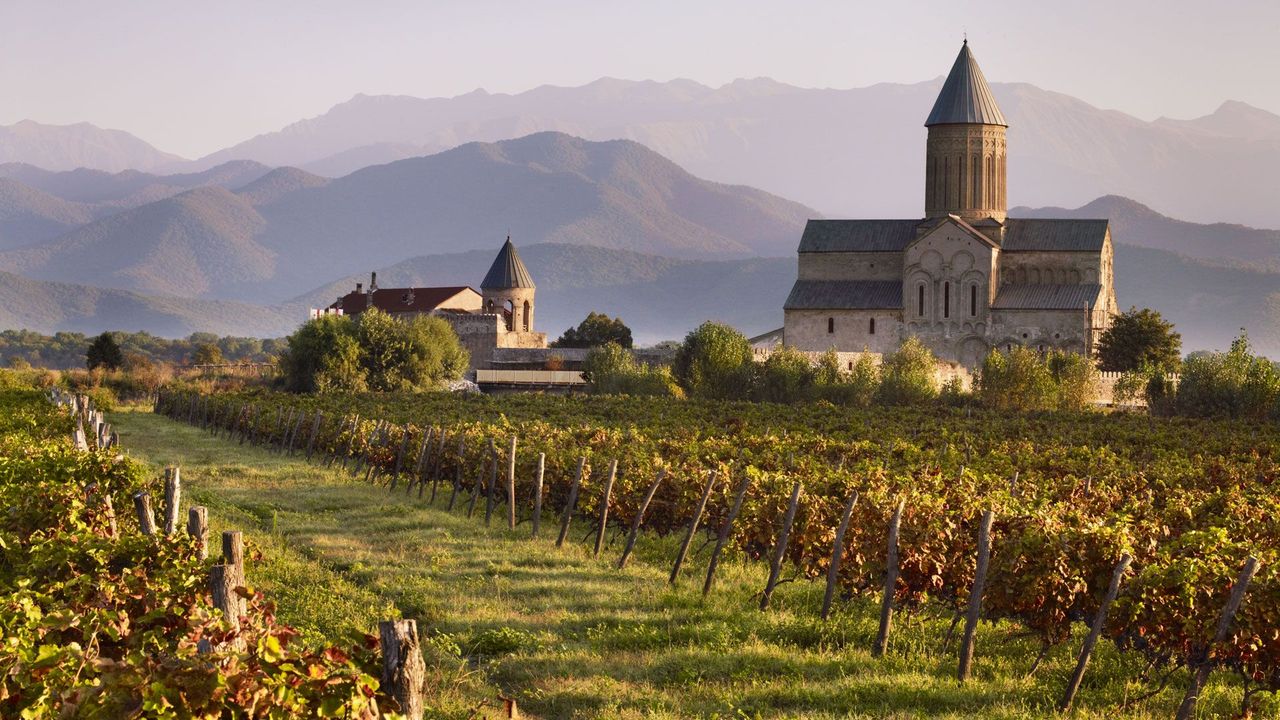
Roughly 70% of Georgia's wine comes from Kakheti — a broad, fertile valley along the Alazani River, framed by the Greater Caucasus to the north and the Gombori Range to the south. This is the heartland of the traditional qvevri method. Key appellations: Mukuzani (serious dry Saperavi), Kindzmarauli (celebrated semi-sweet Saperavi), Tsinandali (the classic white blend of Rkatsiteli and Mtsvane), Akhasheni.
This is where my wife's family is from. She travelled here with her father as a child — through villages where the vines came right up to the road and the smell of fermentation hung in the autumn air. Driving through Kakheti for the first time myself felt, to use the only accurate word, like a homecoming.
Kartli — The Lighter Style
The central region around Tbilisi. Cooler climate, lighter and more elegant wines — fresher acidity, more florality, less tannin. Known for Chinuri sparkling wine made in the traditional method.
Imereti — The Middle Way
Western Georgia's own qvevri tradition uses shorter skin contact than Kakheti (10–30 days rather than months), producing amber wines of lighter colour and more approachable tannin. Often the best entry point for drinkers new to Georgian wine.
Samegrelo & Western Georgia
Home to Ojaleshi and Chkhaveri. Wetter, more maritime climate. Wines of distinctive character and real rarity — few make it outside the country.
From Our Cellar: Georgian Wines We Stock
Every bottle below is in stock and ready to ship. These are wines we've chosen specifically because they represent what Georgian winemaking truly is — not industrial production, but living tradition.
Ocho "Who r u?" Rkatsiteli–Mtsvane 2022 — $27
The perfect introduction to traditional Georgian amber wine. A blend of Rkatsiteli and Mtsvane made with extended skin contact in the classic Kakhetian style — apricot, quince, dried herbs, and that characteristic walnut finish. The name is cheeky; the wine is serious. Start here if Georgian wine is new to you.
Mukado Saperavi-Khikvi, Mukuzani, Kakheti 2020
This is Saperavi as it should be — grown in the Mukuzani appellation, one of Kakheti's most celebrated DOCs, known for producing the most structured and age-worthy dry reds in Georgia. Deep, near-black in colour with blackberry, plum, and iron minerality on the nose, and the kind of firm, food-hungry tannins that make you want a slow-cooked lamb dish within arm's reach. If you want to understand why Saperavi is considered one of the world's great red grapes, this is the bottle.
Martvilis Marani Ojaleshi Samegrelo Red 2020 — $25
Ojaleshi is one of Georgia's rarest red varieties, grown almost exclusively in the Samegrelo region of western Georgia. Deep ruby colour, plum and dried cherry fruit, earthy and structured. A genuinely unusual bottle that shows the breadth of what Georgian red wine can be beyond Saperavi.
Bibineishvili Chkhaveri Dark Rosé 2019 — $33
Chkhaveri is a rare pink-skinned grape of western Georgia and one of the country's most elegant varieties. This dark rosé is aromatic, refreshing, and deeply food-friendly — red berries, floral notes, and a lively acidity that makes it endlessly versatile at the table. Genuinely unlike any rosé you've had before.
How to Taste Georgian Wine
Start with a Rkatsiteli amber wine. The colour will surprise you — deep gold to amber. The nose will be unfamiliar: dried fruits, tea, walnut, sometimes an oxidative quality that is intentional and correct. The palate will have tannin — a sensation you associate with red wine, not white. Give it time. Let it breathe. Serve at cellar temperature (around 14°C), never fridge-cold.
Try it with food. Georgian wine was never designed to be tasted in isolation. The tannins and texture are built for the table — for fatty cheeses, roasted meats, walnut sauces. A glass of amber Rkatsiteli with a plate of cheese is a completely different experience from the same glass alone.
Don't panic about cloudiness. Unfiltered Georgian wine is often hazy. This is correct. It is alive. Sediment in an older bottle is a feature, not a fault.
Be open to something genuinely new. A great Georgian wine should make you feel something you haven't felt from a glass before — a sense of age, of history, of somewhere ancient and alive. The first time my wife poured me a glass and said simply "now you understand", I did.
Georgian Wine & Food Pairing
Georgian cuisine and Georgian wine evolved together over millennia. The pairings feel inevitable rather than designed.
- Khachapuri (cheese-filled bread) — Rkatsiteli amber or a light Chinuri. The richness of the cheese needs the tannic grip of the amber, or the freshness of the white to cut through it.
- Mtsvadi (grilled meat skewers) — Saperavi, always. Dark fruit and firm tannins were made for meat over an open flame.
- Badrijani nigvzit (aubergine with walnut paste) — Amber Rkatsiteli. The bitterness of the walnut, the richness of the aubergine, and the tannic depth of the wine create a harmony that takes your breath away.
- Lobiani (bean-filled bread) — A younger Mtsvane or an Imeretian amber. Earthy beans need lift and acidity.
- Grilled fish or seafood — Chkhaveri rosé. The delicacy of the grape matches the delicacy of the dish.
Frequently Asked Questions
What is Georgian wine known for?
Georgia is known for its amber wines made using the traditional qvevri method — buried clay vessels in which grape juice ferments with the skins for months, producing wines of deep colour, tannic structure, and extraordinary complexity. It is also the archaeologically confirmed birthplace of wine, with evidence of winemaking dating to 6,000 BCE.
What does Georgian wine taste like?
Traditional Georgian amber wine is unlike most white wine you have encountered: deep gold to amber in colour, with dried fruit, tea, walnut, and subtle oxidative notes, and a firm tannic structure on the palate. Georgian reds — particularly Saperavi — are dark, concentrated, and structured, with blackberry, plum, iron, and graphite character. Both reward pairing with food rather than solo sipping.
Is Georgian wine natural wine?
The traditional qvevri method aligns entirely with natural wine principles: wild yeast fermentation, no additives, no filtering, minimal or zero sulphur. Many Georgian producers working in the traditional style are considered founding figures of the modern natural wine movement. Georgian wine didn't adopt these principles from the natural wine world — the natural wine world learned them from Georgia.
What is Saperavi wine?
Saperavi is Georgia's most important red grape variety and one of the world's great indigenous reds. A teinturier variety — both skin and flesh are deeply pigmented — it produces wines of near-black colour, intense dark fruit, firm tannins, and ageing potential of 20 years or more. The name means "dye" in Georgian.
What is the best Georgian wine for beginners?
The Ocho Rkatsiteli–Mtsvane is our recommendation for first-timers — it shows the traditional amber style with skin contact and real character, at an accessible price point. If you want to start with red, the Martvilis Marani Ojaleshi is something genuinely different from anything else you'll find.
Where can I buy Georgian wine in the US?
We carry a curated selection of Georgian wines at Sun & Soil, available for delivery across the US. Browse the full collection here.
The Takeaway
Georgian wine is not a trend. It is not a category. It is a civilisation's relationship with its land, expressed through 8,000 years of unbroken practice, poured into a glass and offered with open hands.
My wife is from Georgia but grew up elsewhere — and yet those childhood trips back with her father left a mark that never faded. She travelled to Kakheti with him, visiting relatives, absorbing a knowledge of wine that wasn't academic — it was simply part of what the country was. I grew up in Kosovo, where hospitality is also woven into the fabric of daily life, where food and drink and the opening of a door to a stranger carry a weight that people from elsewhere sometimes don't immediately recognise.
When I first sat at a Georgian table and wine was poured before anything else was said, I felt that weight. I recognised it from home. Two different cultures, one shared understanding of what it means to offer something from your land to someone you've just met.
That is what is in the glass. Not just grapes and time and clay. The whole of a culture that has been offering this to the world since before the world had a name for it.
Continue exploring: Encyclopedia of Georgian Grapes · Encyclopedia of Natural Wine · Ultimate Guide to Orange Wine · Low-Intervention Croatian Wines · Istrian Wine Guide: Malvazija & Teran

