
Istrian wine guide: Malvazija, Teran & the Adriatic’s hidden gem
Istrian Wine Guide: Malvazija, Teran & the Adriatic's Best-Kept Secret
There's a small, triangular peninsula dangling into the northern Adriatic that most wine drinkers have never heard of — and that's exactly why you should care about it. Istria, shared between Croatia, Slovenia, and a sliver of Italy, produces wines that can stop you mid-sip. Aromatic whites that smell like a coastal herb garden in summer. Brooding, earthy reds that taste of ancient iron-rich soil. And a natural wine scene so vibrant it's quietly become one of the most exciting regions in all of Europe.
This is wine country that hasn't been over-explained yet. And that is a rare and wonderful thing.
This guide covers everything you need to know about Istrian wine: the land, the two defining grapes — Malvazija Istarska and Teran — the other varieties worth knowing, and the best bottles to seek out. Whether you're new to Croatian wine or already a fan of our broader definitive guide to Croatian wine, Istria deserves its own deep dive.
Istria: Geography, Terroir & Why This Place Is Special
Istria is Croatia's westernmost region — a peninsula roughly the size of Luxembourg that juts into the Adriatic between the Gulf of Trieste and the Gulf of Kvarner. Geographically and culturally, it has always been a crossroads. Historically Venetian, then Austro-Hungarian, then Italian, then Yugoslav, and finally split between Croatia and Slovenia after 1991, Istria carries all of these identities simultaneously. You hear Italian spoken in the markets. The architecture is Venetian. The food — truffles, prosciutto, olive oil — feels more Tuscany than Zagreb. And the wine? It reflects every layer of that layered history.
What makes Istria viticulturally distinct is its terrain. The peninsula is geologically divided into two main zones:
Red Istria (the interior) sits on terra rossa — the deep, iron-rich red clay-limestone soils that give this zone its name and give Teran, the great red grape of the region, its signature savageness. These are old, mineral-laden soils that stress the vine in productive ways.
White and Grey Istria (the coastal and hilly areas) is dominated by flysch — a layered sedimentary rock of alternating limestone and marl — which gives wines made here a different character: more saline, more textural, often more floral. This is where some of the most expressive Malvazija comes from.
The Adriatic to the west and the mountains to the northeast create a moderating microclimate that is both warmer than you'd expect this far north and reliably breezy. The bora and jugo winds keep disease pressure low, meaning many growers can farm with minimal intervention — which, in part, explains why Istria has become such fertile ground for natural and low-intervention winemaking.
Malvazija Istarska: Croatia's Signature White Wine
If you ask an Istrian winemaker what defines their region, the answer is almost always the same: Malvazija. Not as an afterthought — as an identity.
It's Not the Malvasia You Think
Here's the thing that trips most wine drinkers up: Malvazija Istarska is not the same grape as the Malvasia you might know from Madeira, Sicily, or the Spanish islands. The name "Malvasia" is an umbrella shared by a large, loosely-related family of grape varieties spread across the Mediterranean. Malvazija Istarska is its own distinct variety — genetically separate, stylistically unique, and deeply tied to this specific corner of the Adriatic. It's related to Malvasia di Candia Aromatica, but the two are not identical.
Istrian Malvazija has been grown on this peninsula for centuries. DNA evidence suggests it likely arrived from Greece via the Venetian trade routes — "Malvasia" itself is thought to be a corruption of Monemvasia, the Greek port town from which so much ancient wine was shipped. But whatever its origins, Malvazija Istarska has evolved into something entirely its own here.
What Does Malvazija Taste Like?
In its classic, unoaked, early-harvested style — which is the most common style you'll encounter — Malvazija Istarska is:
- Aromatically expressive: stone fruit (peach, apricot, nectarine), citrus blossom, fresh herbs (sage, fennel), and a distinctive almond-bitter note on the finish
- Medium-bodied: not a lightweight, but not heavy either — it sits comfortably in the middle
- Naturally refreshing: high natural acidity gives it a clean, crisp backbone
- Saline and mineral: especially in coastal and flysch-soil expressions, there's a sea-breeze quality that's genuinely distinctive
Think of it as a more interesting, more textured alternative to Pinot Grigio. Where Pinot Grigio in its mass-market form tends toward neutral and lean, Malvazija brings aromatic personality and a sense of somewhere-ness. If you've been reaching for Vermentino or Greco di Tufo and want to explore further east, Malvazija is the natural next step.
Malvazija vs Pinot Grigio
This is one of the most common comparisons, and it's a useful one. Both are Adriatic whites (Pinot Grigio dominates northeastern Italy, just across the water). Both are food-friendly, versatile, and relatively approachable. But Malvazija consistently offers more: more aroma, more texture, more finish. A well-made Malvazija from Istria will outperform a decent Pinot Grigio in almost every sensory category except familiarity. That's the only advantage Pinot Grigio has, and it's a shrinking one.
Two Styles of Malvazija: Fresh vs. Aged
The fresh, stainless-steel style is how most Malvazija is made and what most people will encounter first. But increasingly — and this is where things get exciting — producers are pushing Malvazija into extended maceration and barrel-aged territory.
Skin-contact Malvazija (amber/orange wine style) involves leaving the grape juice in contact with the skins during fermentation, extracting tannin, colour, and texture. The result is a completely different wine: deeper gold to amber in colour, more structured, with dried apricot and chamomile notes, a tannic grip, and extraordinary ageing potential. This style bridges directly into the natural wine world — and if you've read our ultimate guide to orange wine, you'll know that Istria is one of the heartlands of this style globally. Producers like Roxanich have become internationally celebrated for their skin-contact Malvazija.
Barrel-aged Malvazija takes a different approach — oak fermentation and ageing without extended maceration, producing wines with vanilla and toasty notes layered over the grape's natural peach and herbal character. Kabola is one of the producers who executes this style with particular elegance.
Both styles reward cellaring far more than most white wines from this part of the world. Don't be afraid to give a serious Malvazija five to ten years.
Food Pairing
The aromatic freshness of unoaked Malvazija makes it a brilliant match for:
- Grilled or baked white fish (branzino, sea bream)
- Istrian seafood pasta and brodetto (fish stew)
- Fresh goat and sheep's milk cheeses
- Prosciutto and air-dried meats (the salinity cuts beautifully through fat)
- Light herb-based pasta dishes
The richer, skin-contact and barrel-aged styles can handle more:
- Grilled vegetables with olive oil
- Aged hard cheeses
- Truffle-based dishes (Istria is truffle country — this pairing is extraordinary)
- Roasted chicken and pork
Teran: Istria's Brooding, Unapologetic Red
If Malvazija is Istria's calling card, Teran is its soul — darker, wilder, and considerably less immediately charming. Teran is not a wine that flatters you. It challenges you. And once you've learned its language, you'll understand why its fans are so devoted.
The Grape — and the Dispute
Teran is a grape of ancient lineage, thought to be closely related to Refosco dal Peduncolo Rosso from neighbouring Friuli (just across the Italian border). This relationship has led to one of European wine's more heated naming disputes: Slovenia has argued that "Teran" should be a protected designation belonging exclusively to Slovenia's Karst region, where the grape also thrives on its distinctive red Karst limestone soils. The EU has been adjudicating this back and forth for years, which is worth knowing not just as wine trivia but because you may see the same grape labelled differently depending on which side of a very blurry border it comes from.
In Croatia, and in Istria specifically, the grape has been grown for centuries and the name Teran is embedded in local identity. Croatian producers have fought hard to protect their right to use it — and today, Istrian Teran remains Croatian Teran.
What Does Teran Taste Like?
Teran from Istria's red iron-rich soils is a distinctive wine by any measure:
- Colour: deep ruby to purple, often with a violet edge — the colour is striking
- Nose: dark forest fruits (blackberry, plum, black cherry), iron and blood notes, earthy forest floor, sometimes violets
- Palate: high acidity, firm grippy tannins, a savoury, almost rustic quality — this is not a polished, fruit-forward red
- Finish: long, mineral, sometimes with a bitter-herbal edge
The iron quality is worth dwelling on. Teran grown in terra rossa soils genuinely tastes of minerals in a way that few red wines do — it's not a metaphor, it's almost literal. The grape extracts iron from its soils and you can perceive it. Old books on Istrian wine used to recommend Teran to anaemic patients. Whether or not that holds up scientifically, the sensory impression is real.
Food Pairing
Teran's acidity and iron-rich savouriness make it ideal for:
- Istrian truffles (especially black truffle pasta — a regional classic)
- Game meats: venison, wild boar, duck
- Prosciutto and aged cured meats
- Fuži (hand-rolled Istrian pasta) with meat ragù
- Rich, slow-cooked stews
- Strong, aged hard cheeses
What Teran struggles with: delicate fish, light salads, anything that needs a gentle wine. This is food-aggressive wine and it needs food that can hold its own.
Other Istrian Varieties Worth Knowing
Malvazija and Teran get the headlines, but Istria's vinous landscape is more varied than those two grapes alone suggest.
Muškat Momjanski is the region's rare aromatic white — a Muscat variant grown almost exclusively around the village of Momjan in northern Istria. It produces wines that are intensely floral and honeyed, sometimes vinified dry and sometimes as a sweet dessert wine. Production volumes are tiny and it's rarely seen outside the region, which makes finding a bottle feel like a genuine discovery.
Borgonja is the local Istrian name for Refosco — a grape that goes by different names across the Adriatic/Adriatic hinterland region. In Istria it produces wines that are softer and more approachable than Teran, with red cherry fruit and lighter tannins. A useful introduction to Istrian reds if Teran feels too intense.
Malvazija Rosula is a pink-skinned mutation of Malvazija Istarska that produces a naturally rosé-hued wine. It is a genuinely unusual and rare wine, made only by a handful of producers, and well worth seeking out if you encounter it.
International varieties — Chardonnay, Pinot Blanc, Sauvignon Blanc, Merlot, Cabernet Sauvignon — are also grown in Istria, primarily in the inland areas and often blended with local grapes. The best of these are honest, well-made wines. The most interesting are blends that use the international varieties as a frame for local character rather than as a substitute for it.
Natural & Low-Intervention Wine in Istria
Istria has become one of Europe's most significant natural wine regions — arguably the most important in the eastern Adriatic — and the reasons are structural rather than fashionable.
The combination of limestone soils, coastal breezes, and a long tradition of minimal-intervention farming means many of Istria's winemakers were already farming in ways that overlap significantly with natural wine principles long before "natural wine" became a global movement. The shift toward certified organic and biodynamic farming, zero-added-sulphur bottlings, and indigenous yeast fermentations was, in many cases, a formalisation of existing practice rather than a radical departure.
The skin-contact tradition is particularly deep here. Malvazija Istarska, with its naturally high aromatic oils and extraction-friendly skins, is ideally suited to extended maceration — and producers who work this way are making wines that have attracted serious international attention. Roxanich, Kozlović, Coronica, Kabola and Giorgio Clai are names that appear regularly in serious natural wine discussions, and all of them are Istrian.
If you're interested in this intersection of Istrian wine and natural production, our guide to low-intervention Croatian wines covers the broader Croatian natural wine landscape, and our orange wine guide explains the skin-contact winemaking tradition that Istria has done so much to bring back into global conversation.
Best Istrian Wines to Try
Here are some producers and styles that represent the best of what Istria — and its Slovenian Karst neighbour — has to offer across a range of price points.
For your first Malvazija Istarska — look for a young, stainless-steel-fermented Malvazija from Kozlović or Coronica. Both are serious producers with international distribution, and both make Malvazija that perfectly expresses the fresh, aromatic, herb-and-stone-fruit style of the grape at its most accessible. Expect to pay £14–18 in the UK, $18–25 in the US.
For a serious, ageworthy Malvazija — seek out Roxanich's skin-contact expressions. This producer makes some of the most compelling amber wines in Croatia, full stop. The extended maceration style won't be for everyone on first encounter, but for anyone interested in textural, complex white wine with real substance, it's revelatory.
For a Slovenian take on Malvasia — and one you can buy right now — we stock the Rodica Malvasia 2023, and it's a bottle we keep coming back to. Rodica is based just across the border in Slovenia's Karst region, where the limestone soils and Adriatic-influenced climate are effectively a continuation of the same terroir that defines Istria. Their Malvasia is the variety at its most expressive: citrus blossom, ripe peach, and that characteristic herbal-almond finish, all framed by lively, clean acidity. If Malvazija Istarska is new to you, this is an ideal starting point — and a reminder that great wine doesn't always respect borders.
For something genuinely unexpected — try the Rodica Yellow Muscat 2022 — also from Rodica Winery and also from the Slovenian Karst, this is Yellow Muscat (Rumeni Muškat) at its most joyful: intensely aromatic, all orange blossom and ripe apricot, with a natural sweetness on the nose that the palate delivers on. It comes in a 500ml bottle, which makes it a perfect match for a cheese course or a long afternoon aperitivo. If you've read the section above on Muškat Momjanski and been intrigued by the aromatic Muscat tradition of this corner of the Adriatic, this is exactly where to start — and you don't have to hunt for it.
For the finest expression of Red Istria — and one we stock — try the Clai Ottocento Crni 2020 from Giorgio Clai, blend of Refosco and Merlot. If you've read the natural wine section above, you'll recognise the name: Clai is one of Istria's most revered producers, farming organically on the red terra rossa soils that define the interior of the peninsula. Ottocento Crni ("800 black") is his flagship red — a wine grown on vines over a hundred years old, made with zero compromise. Expect deep, brooding dark fruit, that signature iron-rich minerality, and a structure that rewards patience in the glass. This is the bottle to open when you want to understand what Red Istria is truly capable of.
For a value pick under €20 — Vina Laguna produces widely available, well-made Malvazija and Teran at accessible prices. These won't be the most complex bottles you'll ever open, but they're honest expressions of the region and a good starting point for anyone new to Istrian wine. You can find both in our best Croatian wines under $25 selection.
Frequently Asked Questions
What is Malvazija wine?
Malvazija Istarska is a white wine grape variety native to the Istrian peninsula in Croatia. It produces aromatic, medium-bodied white wines with notes of stone fruit, fresh herbs, citrus blossom, and a characteristic almond finish. It is unrelated to most other Malvasia varieties found in the Mediterranean and represents one of Croatia's most distinctive indigenous white grapes.
Is Istrian wine good?
Istrian wine has attracted serious critical attention over the past two decades and is widely considered among the most interesting wine regions in southeastern Europe. The combination of indigenous grape varieties, diverse soils, a natural-wine-forward producer community, and a long winegrowing tradition makes Istria a region that consistently produces wines of genuine quality and character.
What grape is Istria known for?
Istria's signature grape is Malvazija Istarska for white wine and Teran for red wine. Malvazija in particular is so closely associated with the region that it functions almost as a regional identity marker — the wine most visitors to Istria encounter first and most local producers make with the greatest pride.
How is Malvazija different from Malvasia?
Despite sharing a name, Malvazija Istarska is genetically distinct from most other Malvasia varieties. It is a different grape from Malmsey (Madeira), Malvasia di Candia, Malvasia delle Lipari, and other Mediterranean Malvasias. The name "Malvasia" was historically applied loosely to many aromatic white grapes traded through Venetian ports, which is why so many unrelated varieties share it. Malvazija Istarska is indigenous to the Istrian peninsula and should be understood as its own variety, not as a regional style of a single grape.
Can Malvazija age?
Fresh, unoaked Malvazija is best consumed young — within two to three years of vintage. However, serious skin-contact and barrel-aged Malvazija expressions can age beautifully for five to ten years or more, developing complexity and depth while retaining the grape's characteristic aromatic signature.
What food pairs with Teran wine?
Teran is a food wine through and through. Its high acidity, firm tannins, and iron-rich, savoury character suit it to rich, earthy dishes: truffle pasta, game meats, slow-cooked stews, aged hard cheeses, and prosciutto. It is the ideal companion to Istrian cuisine, which is itself built around exactly these flavours.
The Takeaway
Istria is the kind of wine region that tends to convert people. You arrive curious, you leave evangelical. The wines are genuinely distinctive — rooted in place in a way that is increasingly rare in a globalised wine world — and the region's embrace of natural winemaking means there's a diversity of style and philosophy that rewards exploration.
Malvazija Istarska is one of Europe's great unheralded white grapes. Teran is one of its most compelling, challenging reds. Together they make an argument for Istria that no amount of marketing could improve on: these wines taste like nowhere else. That's enough.
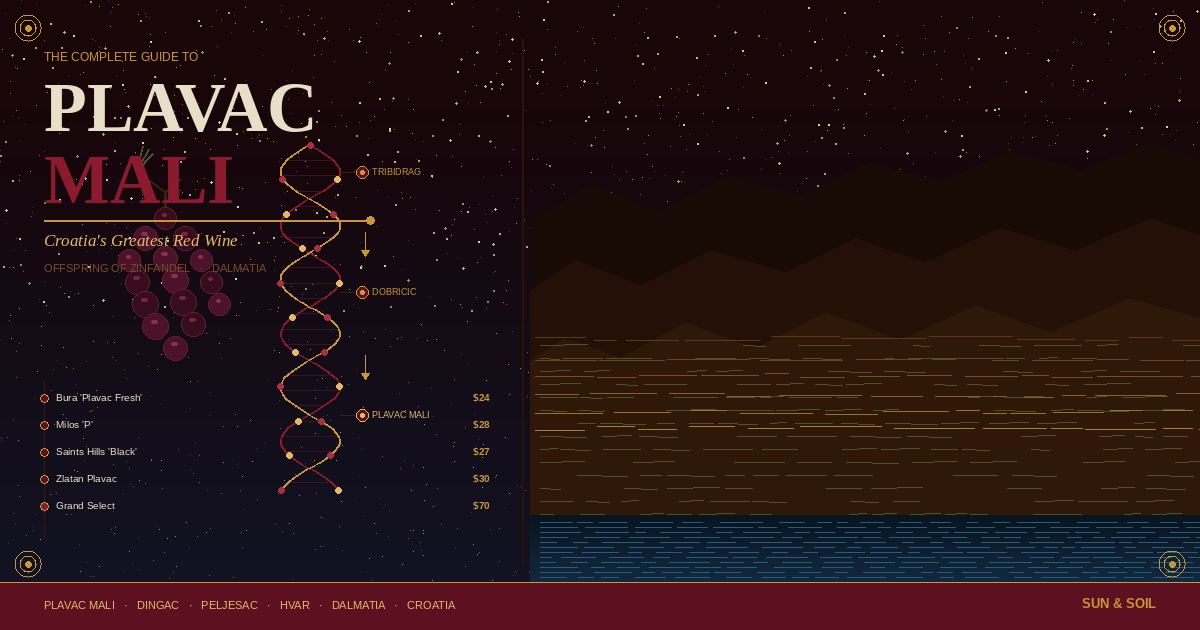
Explore more from our Croatian wine series: Definitive Guide to Croatian Wine · Plavac Mali: Croatia's Greatest Red · Low-Intervention Croatian Wines · Ultimate Guide to Croatian Varieties · Best Croatian Wines Under $25