
The Complete Guide to Slovenian Wine: Malvasia, Rebula & Europe's Best-Kept Secret
Growing up in Kosovo, the Adriatic was a kind of promise — the direction you pointed when summers got too hot and too still. Slovenia was never far from that mental map. It sat at the edge of the Balkans and the beginning of something else: the Alps, the Italian border, the sea. A country small enough to hold in one hand but with more layered identity than most nations three times its size.
I didn't know much about Slovenian wine until we started stocking Rodica. The first bottle I opened — their Malvasia, from the limestone Karst plateau just inland from the Adriatic — reminded me immediately of the Istrian wines my wife and I had fallen for: aromatic, coastal, alive with herbs and stone fruit and something you can only call place. Which makes sense. The Karst doesn't care about the border between Slovenia and Croatia. The limestone runs right through both countries, and the wine tastes like it.
Slovenia deserves a guide of its own. This is it.
Why Slovenian Wine Is One of Europe's Best-Kept Secrets
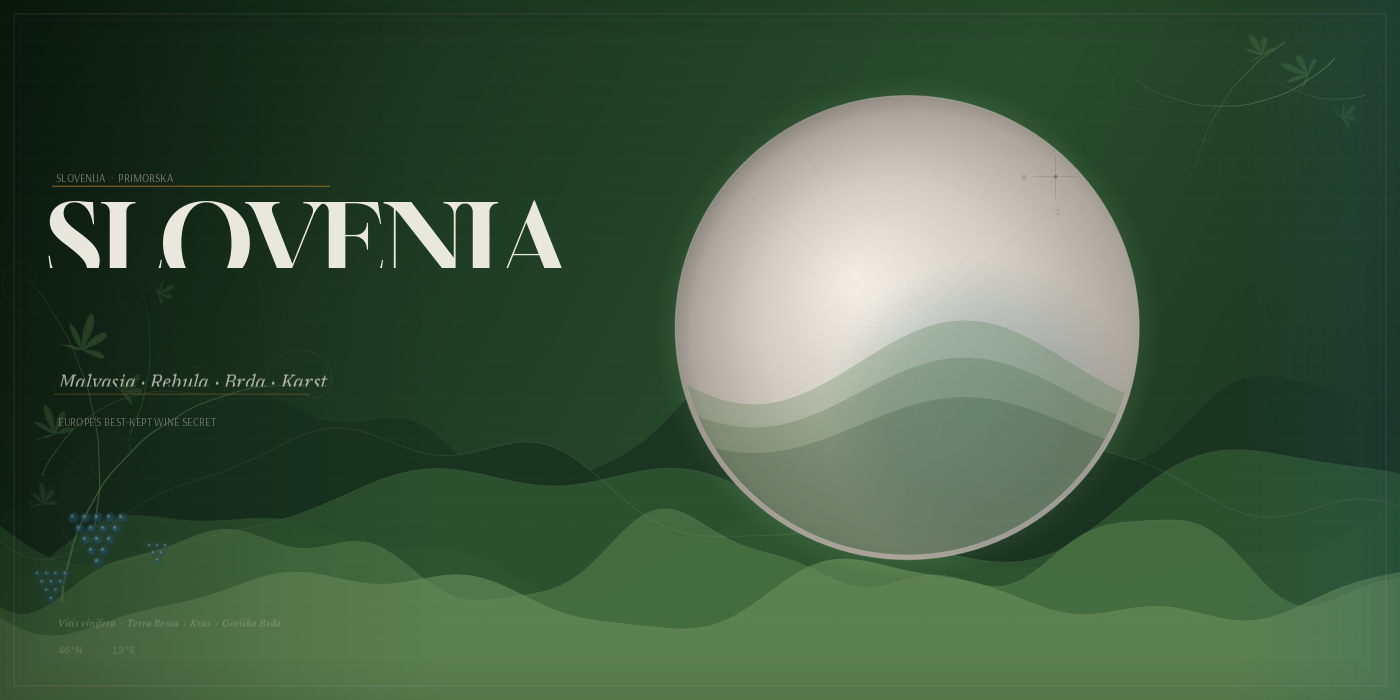
Slovenia is a country of two million people sandwiched between Italy, Austria, Hungary, and Croatia. It has been making wine since at least the time of the Celts — over 2,000 years of continuous viticulture compressed into a land area smaller than the state of New Jersey. In that compact geography, three completely distinct wine regions produce wines that range from the crisp, Alpine whites of the northeast to the rich, skin-contact amber wines of the west — wines that have quietly become some of the most sought-after bottles in the international natural wine world.
For decades, most Slovenian wine never left the country. Locals drank it at home, at the table, in the tradition of a culture that has always treated wine as an extension of the meal rather than a standalone experience. Then the natural wine movement happened, and the world started paying attention. Producers from the Vipava Valley and the Brda hills and the Karst plateau were suddenly being poured at the best wine bars in London, Paris, and New York — not as exotic curiosities, but as benchmarks for what low-intervention winemaking could achieve.
The rest of the world is catching up to what Slovenians have always known. This guide will help you get there faster.
Slovenia's Three Wine Regions
Primorska — The Adriatic West
This is where the story gets most interesting for our purposes. Primorska, Slovenia's western wine region, borders Italy's Friuli-Venezia Giulia to the west and Croatia's Istrian peninsula to the south — and it shares terroir with both. The same limestone soils, the same Adriatic-influenced climate, the same ancient winemaking traditions that produce the great Malvazija wines of Istria produce equally compelling wines just across the border in Slovenia.
Primorska itself is divided into four sub-regions:
The Karst — A dramatic limestone plateau above the Gulf of Trieste, swept by the bora, the powerful cold wind that blasts down from the north and keeps humidity low, disease pressure minimal, and wines intensely concentrated. The Karst is best known for Teran (made from the Refosco grape — the same Teran we wrote about in our Istrian wine guide) and for skin-contact Malvasia of extraordinary quality. This is where Rodica Winery is based. The soils here are literally red — terra rossa, iron-rich limestone clay, the same geology that defines the greatest terroirs of the Adriatic region.
Brda — Slovenia's answer to Tuscany. Rolling hills on the Italian border, shared with Friuli's Collio appellation — the two regions are geologically and culturally one, divided only by a border drawn after World War Two. Brda produces some of Slovenia's most elegant and internationally celebrated wines: Rebula (known as Ribolla Gialla in Italy), Pinot Gris, Chardonnay, and Merlot of genuine quality. The natural wine scene here is world-class — producers like Movia, Klinec, and Aci Urbajs are names known in every serious wine bar on earth.
Vipava Valley — A dramatic valley carved by the Vipava River, with a unique microclimate shaped by warm Adriatic air and cold Alpine winds. Home to indigenous varieties like Zelen and Pinela found almost nowhere else in the world. Freshness and minerality define Vipava whites; the reds, particularly from Merlot and local varieties, have a distinctive savoury, herbal character.
Koper (Slovenian Istria) — The narrow coastal strip along the Adriatic, where Malvasia and Refosco reign. Geographically and stylistically this is Istria — the wines share the same character as the Croatian bottles on the other side of the peninsula.
Podravje — The Alpine Northeast
Slovenia's largest wine region by area, running along the Drava River valley toward the Austrian and Hungarian borders. The climate here is continental — cold winters, warm summers, significant day-night temperature swings that produce wines of high natural acidity and aromatic intensity. This is the home of Šipon (Furmint), the great grape of the region, producing dry whites of extraordinary mineral complexity. Also important: Laški Rizling (Welschriesling), Renski Rizling (Rhine Riesling), and Traminec (Gewürztraminer). These are wines in the Austrian mould — precise, taut, built for ageing.
Posavje — The Southeast
The smallest and least internationally known of Slovenia's three regions, running along the Sava River toward the Croatian border. Best known for Cviček — a light, high-acid red blend unique to this area, made from a mix of indigenous and international varieties. An acquired taste, but deeply embedded in Slovenian food culture.
The Grapes: Slovenia's Indigenous Varieties
Malvasia (Malvazija)
The same grape that defines Istrian wine — Malvazija Istarska — grown here in the Karst and Slovenian Istria. In traditional Karst winemaking, Malvasia is often made with extended skin contact, producing an amber wine of dried apricot, herbs, citrus blossom, and that characteristic almond finish. In fresher styles it is aromatic and medium-bodied, with peach and floral notes and a saline, mineral quality that comes directly from the limestone. This is the grape that defines Rodica Winery, and it is the entry point we recommend for anyone new to Slovenian wine.
Rebula (Ribolla Gialla)
One of Slovenia's most important white grapes, grown primarily in Brda. Ancient variety — mentioned in Slovenian historical records as far back as 1289. In conventional style it produces a crisp, aromatic white with citrus and floral notes and good acidity. In skin-contact form — as made by some of Brda's most celebrated natural wine producers — Rebula becomes one of the great amber wines of the world: golden, structured, complex, with dried fruit, chamomile, and the kind of textural depth that makes conventional whites seem thin by comparison. It is closely related to, and may be identical to, the Ribolla Gialla of Friuli just across the Italian border.
Šipon (Furmint)
Known in Hungary as Furmint — the grape of Tokaji — but Slovenians would argue that Šipon found its home in the Podravje hills long before Hungary claimed it. Dry Šipon is one of the most exciting white wines in central Europe: intensely mineral, high acid, with apple, citrus, smoke, and a stony quality that rewards cellaring. A grape that genuinely improves with age in a way that most whites do not.
Zelen
Found almost exclusively in the Vipava Valley. The name means "green" in Slovenian, a reference to the grape's colour at harvest. Zelen produces wines of extraordinary aromatic complexity — elder blossom, herbs, white peach, and a distinctive mineral quality — with a refreshing acidity that makes it one of the most food-friendly whites in the country. Tiny production, rarely seen outside Slovenia. When you find it, buy it.
Teran
The great red of the Karst — made from the Refosco grape on the iron-rich limestone soils of the plateau. High acidity, dark fruit, iron and blood minerality, firm tannins. We covered Teran in depth in our Istrian wine guide — the cross-border naming dispute between Slovenia and Croatia is one of wine's more entertaining ongoing dramas. In Slovenia, on the Karst, Teran finds some of its most compelling expressions.
Frankinja (Blaufränkisch)
Known across Central Europe by many names — Blaufränkisch in Austria, Lemberger in Germany, Kékfrankos in Hungary — in Slovenia it goes by Frankinja, and it is one of the country's most important and versatile red grapes. Grown primarily in Primorska and Podravje, Frankinja produces wines of deep colour, vibrant acidity, and a signature peppery, spiced character that places it somewhere between the freshness of Pinot Noir and the structure of a young Syrah. Dark cherry, plum, black pepper, and violets on the nose; firm but not aggressive tannins; a long, mineral finish. It ages well and pairs brilliantly with the kind of rich, slow-cooked food that Slovenian winters demand. If you've been exploring Blaufränkisch from Burgenland in Austria and want to see what the same grape does across the border, Frankinja is the answer — and it often comes at a fraction of the Austrian price.
The Natural Wine Scene: Why Slovenia Matters
Slovenia is not new to natural winemaking. It has been doing it for centuries — the tradition of extended maceration, wild yeast fermentation, and minimal intervention in the cellar was simply the way wine was made in these villages before industrial winemaking offered an alternative. What changed in the 1990s and 2000s was that a new generation of winemakers — many of them trained in Italy and France — returned to Slovenia and formalised these traditions into a conscious philosophy.
The result is that Slovenia now has one of the highest concentrations of world-class natural wine producers relative to its size of any country in Europe. Brda in particular has become a pilgrimage destination for serious wine lovers — producers like Movia, whose patriarch Aleš Kristančič has been making zero-sulphur, single-vineyard wines since the 1970s, long before "natural wine" had a name.
The skin-contact tradition is especially deep. Rebula and Malvasia, with their aromatic, extraction-friendly skins, were always natural candidates for extended maceration — and the orange wines produced in Brda and the Karst are some of the finest expressions of the style in the world. If our orange wine guide sent you looking for the best examples, you'll find many of them here.
Rodica Winery — Our Featured Slovenian Producer
Rodica Winery is based in the Karst — that windswept limestone plateau above the Gulf of Trieste, just inland from the Adriatic coast. The soils here are terra rossa: deep red, iron-rich clay over limestone, the same geology that makes the Karst one of the most distinctive wine terroirs in Europe. The bora wind keeps the vines clean and healthy. The Adriatic moderates the temperature. And the limestone gives the wines a mineral salinity that is entirely its own.
What draws us to Rodica is the clarity of their winemaking — wines that taste unmistakably of where they come from, made without unnecessary intervention, expressing the character of the Karst limestone in every glass. Their Malvasia and their Yellow Muscat are wines we keep coming back to, both for the quality and for the story they tell about this remarkable corner of the Adriatic.
From Our Cellar: Slovenian Wines We Stock
Slovenia is one of the regions we stock most carefully — the quality-to-discovery ratio here is extraordinary. Below are the bottles we're most excited about right now, organised by style.
Whites & Aromatic
Rodica Malvasia 2023 — Karst
The Karst Malvasia at its most expressive — aromatic and medium-bodied, with citrus blossom, ripe peach, fresh herbs, and that characteristic almond finish that marks great Malvazija Istarska. Bright, clean acidity gives it length and makes it endlessly food-friendly. The ideal introduction to Adriatic Malvasia. Serve slightly chilled with seafood, light pasta, or local cheese.
Edi Simčič Duet 2021 — Brda
Edi Simčič is one of Brda's most celebrated producers, farming the rolling hills on the Slovenian-Italian border with a precision and commitment to quality that puts him in the same conversation as the finest estates in Collio across the border. The Duet is his signature white blend — Rebula and Pinot Gris working in harmony, with stone fruit, floral lift, and the clean mineral acidity that defines great Brda whites. Elegant, precise, and seriously food-worthy.
Rodica Yellow Muscat 2022 — Karst, 500ml
Yellow Muscat (Rumeni Muškat) grown on Karst limestone — intensely aromatic, with orange blossom, ripe apricot, and white peach, and a natural richness on the palate that makes it feel almost generous. The 500ml format makes it a perfect match for a cheese course, a long aperitivo, or a dessert you haven't decided on yet. One of the most purely joyful bottles we stock.
Amber & Skin Contact
Eazy Oranzna 2022 — Primorska
This is skin-contact winemaking done with extraordinary delicacy. A blend of Malvazija, Pinot Blanc, Chardonnay, and Muscat — floral and almost perfumed on the nose, with jasmine leading into orange blossom, hints of pineapple, and soft guava. The texture is what gets you: like biting into the skin of a ripe apricot or peach — that slight fuzz before the fruit underneath. If you think orange wine is always heavy or tannic, this will change your mind entirely.
Reds
Movia Cabernet Sauvignon 2022 — Brda
Movia needs no introduction in serious wine circles — Aleš Kristančič's family has been making wine on this estate for over three centuries, and his approach is unlike anyone else's. Extraordinarily long maceration in old Slovenian oak (years in some cases), no racking, no fining or filtering except as governed by lunar cycles. The result is a Cabernet of opaque ruby depth and multi-layered complexity: dark red and black fruits wrapped in fine oak, dry and structured on the palate with ripe acidity and tannins that are built unambiguously for cellaring. This is not a wine you drink lightly. It is a wine you open for a reason.
Pikasi Barbera — Primorska
Barbera in Slovenia might raise an eyebrow — but on the limestone soils of Primorska, just across from where this grape originates in Piedmont, it finds a compelling new voice. Aged 12 months in oak, then on lees in stainless steel before bottling — it shows impressive depth for its relative youth: dark fruit, good structure, and the high natural acidity that makes Barbera such an instinctively food-hungry wine. A genuinely interesting bottle at a very fair price.
Slovenian Wine & Food Pairing
Slovenian cuisine sits at the crossroads of Italian, Austrian, and Balkan cooking — hearty, seasonal, and built around the same ingredients that grow in the vineyards. The pairings feel natural because they evolved together over centuries.
- Karst Malvasia — Prosciutto (Kraški pršut, the Karst's own air-dried ham), fresh sheep's milk cheese, grilled branzino, light pasta with herbs and olive oil. The salinity of the wine echoes the salinity of the ham — one of those pairings where you wonder why you'd ever eat one without the other.
- Rebula amber wine — Rich dishes: chicken liver, aged hard cheese, slow-roasted pork, mushroom risotto. The tannins and texture need fat and umami to show their best.
- Šipon — Smoked fish, fresh water fish from the Alpine rivers, light vegetable dishes. The minerality and acidity cut beautifully through delicate flavours.
- Teran — Kraška pancetta, aged sheep's cheese, lamb, venison. Iron-rich wine, iron-rich food.
- Yellow Muscat — Fresh fruit, soft cheeses, light desserts, or simply on its own as an aperitivo. The aromatics do the work.
Frequently Asked Questions
What is Slovenian wine known for?
Slovenia is best known internationally for its skin-contact and orange wines — particularly from the Brda and Karst sub-regions of Primorska — and for its concentration of world-class natural wine producers relative to its size. Indigenous white varieties like Rebula, Malvasia, and Šipon (Furmint) are the country's most distinctive grapes. The country's wines have become highly sought-after in the international natural wine world over the past decade.
What does Slovenian wine taste like?
It depends strongly on the region. Primorska whites — Malvasia, Rebula — are aromatic, medium-bodied, and mineral, often with stone fruit, herbs, and a saline coastal quality. Skin-contact expressions add tannin, texture, and dried fruit complexity. Podravje whites — Šipon, Riesling — are crisper and more mineral, in an Alpine style. Reds tend toward high acidity, dark fruit, and earthy mineral character.
Is Slovenian wine the same as Croatian wine?
They share terroir — the limestone Karst plateau and the Istrian peninsula run across both countries — so the wines from border regions taste remarkably similar. Malvazija Istarska, grown in both Slovenian Istria and Croatian Istria, is essentially the same grape on the same soils. But Slovenia has its own distinct varieties (Rebula, Šipon, Zelen) and its own winemaking culture, particularly in the Brda hills and Vipava Valley, that has no direct Croatian equivalent.
What is Rebula wine?
Rebula is an ancient Slovenian white grape, grown primarily in Brda on the Italian border. In conventional styles it produces crisp, aromatic whites with citrus and floral notes. In skin-contact form it is one of the great amber wines of the world — golden, structured, complex, with extraordinary ageing potential. The same grape is called Ribolla Gialla in Friuli, Italy, just across the border.
Where can I buy Slovenian wine in the US?
We stock a curated selection of Slovenian wines at Sun & Soil — including bottles from Rodica Winery (Karst), Movia (Brda), Edi Simčič (Brda), and other Primorska producers. Browse the full collection here.
What is the Karst wine region?
The Karst (Kras in Slovenian) is a limestone plateau in southwestern Slovenia, above the Gulf of Trieste. Its defining features are deep red terra rossa soils, the powerful bora wind, and an Adriatic-influenced climate. It produces some of Slovenia's most distinctive wines: skin-contact Malvasia with extraordinary mineral depth, and Teran — a high-acid, iron-rich red made from the Refosco grape on the region's unique red limestone soils.
The Takeaway
Slovenia is a country that rewards curiosity. It sits at one of Europe's great cultural and geographical crossroads — where the Alps meet the Mediterranean, where Germanic precision meets Adriatic warmth, where centuries of Italian, Austrian, and Slavic influences have produced a wine culture that borrows from all of them and belongs entirely to itself.
The wines are not trying to be anything they're not. The Malvasia from the Karst tastes like the Karst — the wind, the red soil, the limestone, the sea just visible in the distance. The Rebula from Brda tastes like those rolling hills on the Italian border, where the distinction between Slovenian and Friulian starts to feel like a technicality.
That's what good wine does. It makes geography make sense.
Continue exploring: Istrian Wine Guide: Malvazija & Teran · Ultimate Guide to Orange Wine · Encyclopedia of Natural Wine · Definitive Guide to Croatian Wine