
The Dalmatian Wine Guide: Plavac Mali, Pošip, Babić & the Adriatic's Greatest Coast
Growing up in Kosovo, the sea was a direction more than a destination — south and west, past the mountains, somewhere beyond what you could easily reach. But when you did reach it, when you finally came over the last ridge and the Adriatic opened up below you, it always felt like a reward disproportionate to the journey. Blue beyond blue. Islands scattered like someone had dropped them and didn't bother to pick them up. And vineyards, impossibly, on every slope that faced the water.
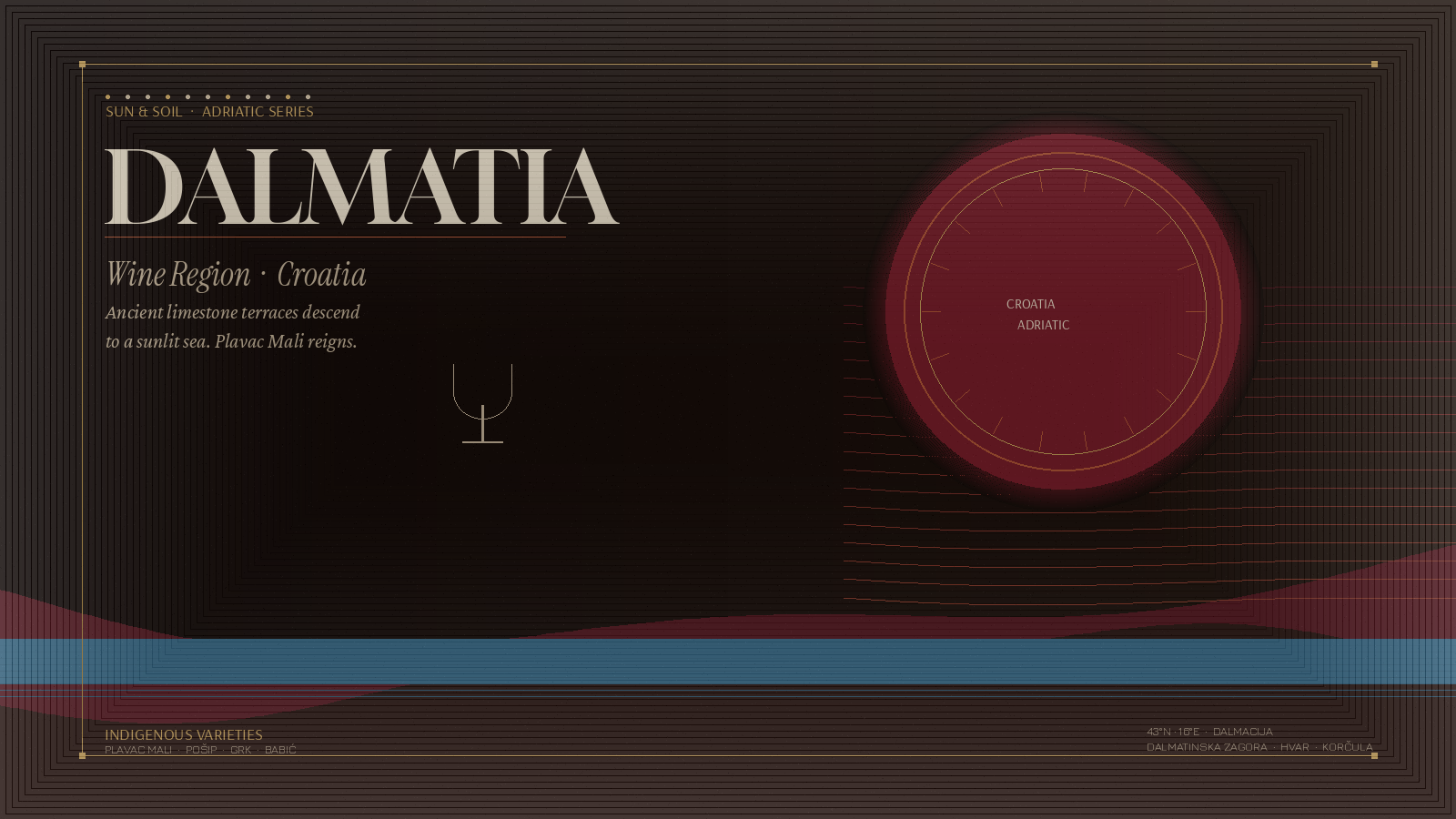
Dalmatia does that to people. It is a coastline that has been producing wine since Greek settlers planted vines on the island of Hvar in the 4th century BCE — more than 2,400 years of unbroken viticulture on the same limestone terraces, facing the same Adriatic light. The wines it produces today carry all of that history in them. They taste like the place in a way that very few wine regions in the world still manage.
This is your complete guide to Dalmatian wine — the geography, the grapes, the legendary producers who have defined this coast, and the bottles you should know. If you've read our definitive guide to Croatian wine and want to go deeper on its most exciting region, this is where to go next.

The island of Hvar — 2,700 hours of sunshine a year, limestone terraces falling to the Adriatic. Photo: Wikimedia Commons (CC BY-SA)
Why Dalmatia Produces Such Extraordinary Wine
The answer is geology, climate, and the stubbornness of the people who have farmed here for two and a half millennia.
Limestone. The entire Dalmatian coast and its islands sit on a karst limestone foundation — the same rock that defines the great terroirs of Burgundy, Chablis, and Champagne. Limestone drains freely, stresses the vine, forces roots deep in search of water and minerals, and gives the wines a mineral quality you can taste in every glass.
The Adriatic microclimate. Summers are long, hot, and dry — ideal for ripening Plavac Mali to full phenolic maturity. The bura, the cold north wind that blasts down from the Dinaric Alps, keeps humidity low, disease pressure minimal, and vineyards healthy with almost no chemical intervention. Many of Dalmatia's best producers farm organically not out of ideology but because the climate makes it straightforward.
The islands. Hvar, Brač, Korčula, Vis, Šolta — each island is a distinct microclimate and a distinct expression of the same grape varieties. Hvar averages over 2,700 hours of sunshine per year, making it one of the sunniest places in Europe. Plavac Mali from Hvar has a warmth and richness that the same grape grown on the north-facing slopes of Pelješac cannot replicate. The geography is endlessly specific and the wines reflect it.
The Regions: Mapping Dalmatian Wine Country
Northern Dalmatia — Šibenik & Primošten
The northern stretch of the coast, centred on the city of Šibenik, is home to one of Croatia's most underappreciated red grapes: Babić. The Primošten peninsula — with its extraordinary terraced vineyards rising directly from the sea, built over centuries by farmers hauling limestone by hand — is the heartland of Babić production and a UNESCO-recognised cultural landscape. The wine reflects that effort: concentrated, structured, and deeply tied to place.

The "stone lace" of Primošten — terraced Babić vineyards built by hand from limestone, a UNESCO tentative heritage site. A photograph of this landscape once hung in the lobby of the United Nations in New York. Photo: Wikimedia Commons (CC BY-SA)
Central Dalmatia — Split, Hvar & Brač
The centre of the region, radiating out from Split, contains some of Dalmatia's most celebrated terroirs. Hvar is the flagship island — long, thin, oriented east-west to maximise sun exposure, producing Plavac Mali of extraordinary richness from its south-facing limestone slopes. The wines here can age for 15–20 years and develop a complexity that stops conversations. Brač produces both Plavac Mali and increasingly compelling Pošip. Šolta, small and overlooked, makes some of the most interesting indigenous variety wines in the region.
Southern Dalmatia — Pelješac & Korčula
The most prestigious red wine address in Croatia. The Pelješac peninsula is home to Dingač — Croatia's first protected wine appellation, established in 1961. Dingač Plavac Mali grows on dramatically steep south-facing cliffs above the sea, where the grapes historically had to be lowered down to boats by rope. The concentration is extraordinary: long hang time, intense sun, chronic water stress from the karst. The wines are Croatia's most serious and long-lived reds.

The Dingač appellation — 45° slopes above the Adriatic, where Plavac Mali grapes have to be harvested entirely by hand. Croatia's most celebrated red wine terroir. Photo: Wikimedia Commons (CC BY-SA)
Korčula, the island across the water, is the ancestral home of Pošip — Croatia's most important indigenous white. The Smokvica and Čara areas in the island's interior produce benchmark Pošip: aromatic, structured, and long-lived in a way that surprises anyone who expects Dalmatian whites to be simple summer wines.
The Grapes: Dalmatia's Indigenous Varieties
Plavac Mali — The Great Red of Dalmatia
Croatia's most important red grape and one of the most fascinating varieties in Europe — the direct parent of Zinfandel, as DNA analysis confirmed in 2001. Plavac Mali is Zinfandel's Croatian ancestor, and it shows: the same high sugar potential, the same capacity for powerful, concentrated wines, the same rustic character that can be both its greatest strength and its greatest challenge.
At its best — on the steep south-facing slopes of Dingač and Postup on Pelješac, or from the hot limestone terraces of Hvar — it produces wines of extraordinary depth: dark plum and cherry, tobacco, dried herbs, leather, with a structural backbone that allows them to age for decades. We've written a complete guide to Plavac Mali — if this grape intrigues you, that's where to go next.
Pošip — Dalmatia's Greatest White
Indigenous to Korčula, grown for centuries in the village vineyards of Smokvica and Čara. A well-made Pošip is not lightweight — it has genuine mid-palate weight alongside its aromatics of white peach, apricot, acacia blossom, and citrus zest. The finish is long, with a saline, almost nutty quality from the limestone and sea air. It ages beautifully, with serious examples developing remarkable complexity over five or more years. Croatia's answer to white Burgundy in terms of ambition and ageability.
Babić — Northern Dalmatia's Hidden Red
One of Croatia's oldest indigenous red varieties, grown almost exclusively in the Šibenik-Primošten area. While Plavac Mali gets the attention, Babić quietly produces some of the most characterful red wines in the country — higher in acidity than Plavac Mali, earthy and dark-fruited, with firm tannins that reward cellaring and a rustic authenticity that more polished wines can't replicate. The name is thought to derive from baba — grandmother in Croatian — a reference to the older women who traditionally tended these terraced vines. Think of it as Dalmatia's Agiorgitiko: deeply food-friendly, undervalued, and genuinely exciting.
Rukatac (Maraština)
An indigenous Dalmatian white that has found a new audience through the natural wine movement. In conventional form it produces fresh, aromatic whites with citrus and floral notes. In skin-contact form — fermented with extended time on the grape skins — it becomes amber-hued, structured, and complex, with dried fruit, herbs, and a tannic grip that makes it one of Dalmatia's most food-versatile wines. The best examples are coming from a new generation of natural-minded producers pushing this variety beyond what it was ever expected to do.
Grk — The Rarest White in the World
Grown on a single island (Korčula), in a single village (Lumbarda), with one of the most extraordinary biological quirks in all of viticulture: Grk is functionally seedless and cannot self-pollinate. It must be interplanted with Plavac Mali, whose pollen enables the Grk flowers to set fruit. Without Plavac Mali growing among it, Grk produces nothing. The wine itself is dry, saline, and intensely mineral — more like a still Chablis than anything you'd expect from the warm Adriatic coast. Production is tiny; outside Croatia it is almost impossible to find. If you encounter a bottle, open it without hesitation.
Four Legendary Dalmatian Wineries
Dalmatia's wine renaissance over the past three decades has been driven by a small number of producers who refused to compromise on quality, identity, and the specific character of their terroir. These four estates define what Dalmatian wine can be.
Zlatan Otok — The Master of Hvar
Zlatan Plenković founded Zlatan Otok on the island of Hvar in the early 1980s, when Croatian private winemaking was still operating in the shadow of Yugoslav collectivisation. He believed that Hvar's combination of extreme sunshine hours, south-facing limestone slopes, and Adriatic sea breezes could produce world-class Plavac Mali — at a time when almost no one in the international wine world was paying attention to Croatia at all.
He was right. Today, Zlatan Otok is one of Croatia's most celebrated estates, and the wines — particularly the single-vineyard Plavac Mali from the estate's steepest limestone terraces — are benchmarks for what this grape can achieve. The estate farms over 90 hectares across Hvar, and the attention to individual site character is evident in every bottle. Zlatan Otok also produces excellent Pošip and Rukatac, making it one of the few Dalmatian estates with real authority across both red and white varieties.
Their wine is on our shelves: Zlatan Otok Plavac Mali Hvar 2019 — dark plum, tobacco, dried herbs, and the long structured finish of Hvar limestone. The 2019 vintage is drinking beautifully now and will continue to develop for another five to eight years.
Ivica Pilizota — The Soul of Babić

Primošten and its surrounding Babić vineyards — the northern Dalmatian coastal town where Ivica Pilizota has spent his career championing Croatia's most undervalued red grape. Photo: Wikimedia Commons (CC BY-SA)
There is no name more closely associated with Babić than Ivica Pilizota. His winery sits in the heart of Primošten, surrounded by the extraordinary terraced vineyards that local farmers have built by hand over generations — dry-stone walls holding thin strips of red soil on a limestone hillside above the Adriatic. These are not glamorous vineyards. They are the result of centuries of hard, patient, back-breaking work, and Pilizota understands that better than anyone.
Pilizota has spent his career proving that Babić is not a secondary grape — not something to fall back on when Plavac Mali doesn't grow nearby — but a variety of genuine character and depth that deserves to be taken seriously on its own terms. His wines are structured, earthy, authentic, and built for the table in a way that tells you immediately they come from a culture that has always treated wine as food. He has done more than any other producer to put Babić on the map internationally, and the bottles he makes today are some of the most compelling red wines coming out of Croatia.
We stock his Ivica Pilizota Babić 2019 — $28, and worth significantly more than that.
Miloš — The Legend of Dingač
If there is one winery that epitomises what Dalmatian wine can be at its absolute ceiling, it is Miloš. Based on the Pelješac peninsula, farming the steep Dingač slopes where the gradient is so extreme that working by hand is the only option, Frano Miloš has been making some of the most acclaimed Plavac Mali in Croatia for over four decades — organically, with minimal intervention, from old vines that predate him.
The Miloš Plavac Mali Stagnum is the wine that most often appears on lists of Croatia's greatest bottles: near-black in colour, extraordinarily concentrated, with dark forest fruit, dried figs, tobacco, earth, and a tannic structure that requires years to fully open. The estate farms entirely without synthetic chemicals — the Dingač terroir's natural advantages make this possible — and the winemaking philosophy in the cellar is equally uncompromising: long maceration, ageing in large Croatian oak, bottling without unnecessary intervention.
Miloš is not widely available outside Croatia, which makes finding a bottle something of an achievement. When you do, treat it accordingly.
Saints Hills — The Vision of Pelješac
Saints Hills represents the younger generation of Dalmatian winemaking ambition — founded by hotelier and entrepreneur Ivica Matičević, who brought in legendary Bordeaux consultant Michel Rolland as a collaborator and set out to make wines that could hold their own in international company. The estate farms vineyards on Pelješac and on Korčula, giving it access to both the great Plavac Mali terroir of the peninsula and the Pošip heartland of the island.
The Nevina — a Pošip-based white with real textural complexity and length — is one of the most convincing arguments for Dalmatian white wine that exists. The Dingač Plavac Mali expressions are powerful and structured, made with the kind of precision that takes nothing away from the character of the terroir. Saints Hills is not a cheap estate, and it doesn't try to be — it is making a case that Dalmatian wine belongs in the same conversation as the finest wines of the Mediterranean, and it is making that case convincingly.
From Our Cellar: Dalmatian Wines We Stock
Reds
Zlatan Otok Plavac Mali, Hvar 2019
One of Hvar's most celebrated estates, farming south-facing limestone vineyards above the sea on Croatia's sunniest island. Dark plum, dried cherry, tobacco, and Mediterranean herbs on the nose; full-bodied and structured on the palate, with the ripe tannins and long finish that mark serious Hvar reds. Zinfandel's Croatian parent, on its home turf. Drink now with lamb or aged cheese, or cellar for another five years.
Ivica Pilizota Babić 2019 — $28
From the terraced limestone vineyards of Primošten — the heartland of Babić. Earthy, structured, and built for the table: dark cherry, plum, dried herbs, and a firm tannic backbone that asks for food and rewards patience. One of Croatia's most undervalued red varieties, made by the producer who has done the most to champion it. Excellent value for the character and quality on offer.
Voštinić Klasnić Unikat 2023 — $30
Unikat — "unique" in Croatian — and the name earns it. A wine that sits outside easy categorisation: concentrated, textural, and deeply rooted in the Dalmatian islands. One of the more interesting bottles we've discovered from a new generation of Dalmatian producers working outside the obvious appellations. Exactly the kind of wine that rewards curiosity.
Whites & Skin Contact
Bura-Mrgudić Rukatac 2024 — $23
Rukatac made the way it deserves to be made — with extended skin contact, giving the wine amber depth and a textural complexity that conventional whites can't achieve. Dried herbs, citrus peel, stone fruit, with a gentle tannic grip that makes it genuinely interesting alongside food. The name references the bura wind that defines this coastline, and the wine has that quality too: clean, mineral, and alive. Perfect with grilled fish, seafood pasta, or pršut and hard cheese. One of the best-value natural whites we carry.
Dalmatian Wine & Food Pairing
Dalmatian cuisine is built on the same elements as the wine — limestone, sea air, olive oil, wild herbs, slow fire. The pairings feel inevitable.
- Plavac Mali — Lamb on the spit (janjetina), aged paški sir from the island of Pag, beef peka slow-cooked under the bell, grilled octopus. The tannins and dark fruit need fat and char to show their best.
- Pošip — Grilled branzino or sea bream, black risotto (crni rižoto), white fish carpaccio, shellfish. The body and salinity make it one of the most versatile matches for Adriatic seafood.
- Babić — Pašticada (Dalmatian beef stew marinated in wine and vinegar), peka lamb, grilled lamb chops, aged hard cheese. Babić's acidity and earthiness are made for slow-cooked Dalmatian meat dishes.
- Rukatac (skin contact) — Pršut, grilled vegetables with olive oil, whole roasted fish, aged sheep's milk cheese. The tannin and texture bridge red and white wine pairings beautifully.
- Grk — Raw oysters, fresh shellfish, white fish ceviche. The extreme mineral salinity of Grk is made for the freshest, most delicate seafood you can find.
Frequently Asked Questions
What is Dalmatian wine?
Dalmatian wine refers to wines from Croatia's Dalmatian coast and its islands — from Šibenik in the north to Dubrovnik in the south, including Hvar, Brač, Korčula, and Vis. The region is defined by limestone soils, the Adriatic climate, and over 2,400 years of winemaking centred on indigenous varieties including Plavac Mali, Pošip, Babić, and Rukatac.
What does Pošip taste like?
Pošip is a full-bodied white with aromas of white peach, apricot, acacia blossom, and citrus zest. On the palate it has genuine weight and a long, saline, mineral finish from the limestone soils of Korčula. It ages beautifully, developing nutty complexity over five or more years — one of the most serious white wines in the Adriatic region.
What is Plavac Mali?
Plavac Mali is Croatia's most important red grape — the genetic parent of Zinfandel — grown primarily on the steep limestone slopes of the Pelješac peninsula and the island of Hvar. It produces powerful, concentrated reds with dark fruit, tobacco, and dried herbs, with the best examples from Dingač and Hvar built for decades of cellaring.
What is Dingač wine?
Dingač is Croatia's first protected wine appellation, established in 1961, covering a small zone of dramatically steep south-facing cliffs on the Pelješac peninsula. Only Plavac Mali grown within this zone can carry the Dingač designation. The extreme conditions — intense sun, thin limestone soils, chronic water stress — produce Croatia's most concentrated and age-worthy red wines.
What is Babić wine?
Babić is an indigenous red grape grown almost exclusively in the Šibenik-Primošten area of northern Dalmatia. It produces earthy, structured wines of dark fruit and firm acidity — deeply food-friendly and authentically tied to the terraced hillside vineyards of its homeland. It is one of Croatia's most undervalued red varieties.
Where can I buy Dalmatian wine in the US?
We stock a curated selection of Dalmatian wines at Sun & Soil — including Plavac Mali from Hvar (Zlatan Otok), Babić from Šibenik (Ivica Pilizota), skin-contact Rukatac, and more. Browse the full Croatian collection here.
The Takeaway
Dalmatia is a wine region that makes you feel the limits of language. The numbers are right — the sunshine hours, the limestone, the 2,400 years of viticulture — but they don't capture the quality of light on a Hvar vineyard at dusk, or the way a glass of Pošip tastes on a terrace above the sea with a plate of just-grilled fish in front of you.
I remember standing on a hillside above Primošten looking at the dry-stone walls of the terraced vineyards — centuries of labour encoded in stone, just to make space for a few rows of Babić on an impossible slope. It's the same kind of patient, place-specific devotion you find in the greatest wine regions of the world. Burgundy has its walls. Primošten has its walls. The wines that come from behind those walls deserve to be understood on the same terms.
They are not Italian. They are not French. They are entirely, specifically, unrepeatable Croatian — and that is exactly why they matter.
Continue the Croatian series: Plavac Mali: Croatia's Greatest Red · Istrian Wine Guide: Malvazija & Teran · Low-Intervention Croatian Wines · Definitive Guide to Croatian Wine · Ultimate Guide to Croatian Varieties