

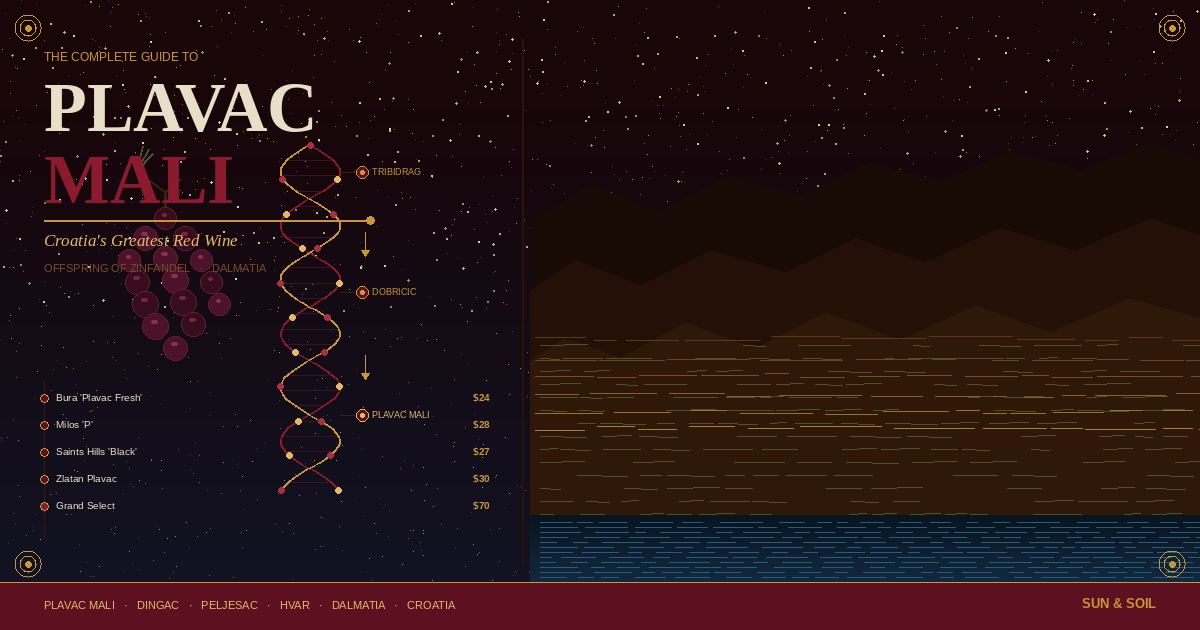
Plavac Mali: The Complete Guide to Croatia's Greatest Red Wine
March 2026 | Croatian Wine · Red Wine Guide · Dalmatia
If Zinfandel is the rock star, Plavac Mali (pronounced Plah-vatz Mah-lee) is the rock star's older, darker, more dangerous sibling.
It is Croatia's most planted red grape. It is the offspring of Zinfandel. It grows on some of the most brutally steep, sun-scorched terraces on the planet. And it produces wines of extraordinary power, depth, and age-worthiness — wines that regularly rival Amarone, Barolo, and great Rhône reds — yet remain largely unknown outside of wine circles.
That is about to change.
This is the complete guide to Plavac Mali: where it comes from, why it tastes the way it does, how to buy it, and why the most serious wine drinkers in 2026 are quietly stocking their cellars with it.
What Is Plavac Mali? The Name Tells the Story
The name is Croatian for "Small Blue" — plavo meaning blue, mali meaning small. It describes the grape exactly: tiny, thick-skinned, near-black berries that cluster tightly on the vine, concentrating sugars and tannins to extreme levels under the Adriatic sun.
Those small, thick skins are the entire story. They are why Plavac Mali wines reach alcohol levels of 14–17% naturally, without chaptalization. They are why the tannins are so structured. They are why a serious bottle of Dingač or Postup can age for 20 years or more. And they are why this grape demands — and rewards — your full attention.
The Family Tree: Plavac Mali, Zinfandel, and the Croatian Connection
To understand Plavac Mali, you need to know its parents. This is one of the most fascinating DNA detective stories in modern wine history.
For decades, wine lovers and scientists assumed that Zinfandel and Plavac Mali were the same grape. The leaf shape, the cluster structure, the berry size — nearly identical. Mike Grgich, the legendary Croatian-born winemaker who crafted the Chardonnay that won the famous 1976 Judgment of Paris, was one of the first to suspect a deep connection between his childhood grape from Dalmatia and the California variety he worked with every day.
He was right — but the relationship was more surprising than anyone expected.
In 2001, a team led by Professor Carole Meredith of UC Davis and Croatian researchers Ivan Pejić and Edi Maletić completed the definitive DNA analysis. Their findings rewrote the family tree entirely:
- Tribidrag / Crljenak Kaštelanski — the ancient Croatian grape, now confirmed as the genetic ancestor of Zinfandel. The "grandparent."
- Dobričić — an ancient, nearly-extinct inky-dark grape from the island of Šolta. The other "grandparent."
- Plavac Mali — the natural cross between the two. The offspring of Zinfandel. The "child."
Plavac Mali is not the same as Zinfandel. It is Zinfandel's descendant — and it inherited the best (and most challenging) traits from both parents: the dark fruit and sun-loving ripeness of Tribidrag, and the fierce tannins, deep color, and rugged structure of Dobričić.
If California Zinfandel is the fun, exuberant cousin, Plavac Mali is the intense, brooding older sibling who aged in better conditions and came out with far more depth.
Where Plavac Mali Grows: The Terroir of Extremes
Plavac Mali is grown almost exclusively on the Dalmatian coast of Croatia — a narrow strip of mainland and islands that runs along the eastern Adriatic. But not all Dalmatia is equal. The grape thrives in conditions of near-brutal intensity: maximum sunshine, minimal rainfall, rocky karst limestone soils, and steep south-facing slopes above the sea.
These are the appellations and regions that matter:
Dingač — The King of Croatian Red Wine
Dingač on the Pelješac Peninsula was the first wine appellation in Croatia to receive Protected Geographical Origin status, in 1961 — beating even some of the more famous Italian and Spanish appellations in terms of legal recognition. That alone tells you how seriously Croatia takes this wine.
The Dingač vineyards are among the most extreme in Europe. Vines cling to near-vertical limestone cliffs facing directly south over the Adriatic, receiving what local winemakers call "triple sun exposure" — direct sunlight from above, reflected light from the sea below, and radiated heat from the white quartz in the soil. All hand-harvested. No machinery can work these slopes.
The result: wines of extraordinary concentration, dark as night in the glass, with tannins that can take years to soften and a fruit intensity that borders on the overwhelming. Classic Dingač tastes of blackberry jam, dried figs, carob, leather, and dark chocolate, with a long, warming, spiced finish. These are cellar wines. Open them young and you'll miss the point.
One of our favorites: Skaramuča Dingač Plavac Mali 2021 — a textbook expression of everything described above. Dark, structured, and built for the cellar. Don't miss it.
Postup — Dingač's Elegant Neighbor
Also on the Pelješac Peninsula, Postup produces wines from the same grape but with a slightly different orientation — less extreme heat, slightly higher elevation. The result is Plavac Mali with a little more freshness, a little more red fruit, and tannins that integrate a few years sooner. Think of it as the "approachable" door into serious Croatian red wine.
Hvar, Brač & Vis — The Island Expressions
The Dalmatian islands produce Plavac Mali with a distinctly maritime character. Hvar — Croatia's sunniest island, famous for its lavender fields — gives wines that balance dark fruit with aromatic Mediterranean herbs. Brač, famed for its white limestone (the same stone used to build the White House), produces structured, mineral-driven bottles from producers like Stina Winery, who are pioneering extreme single-vineyard expressions. Vis, the most remote of the central Dalmatian islands, yields some of the most age-worthy and least-known Plavac Mali in Croatia.
Konavle — The Southern Frontier
South of Dubrovnik, the Konavle valley produces a somewhat lighter, more fruit-forward style of Plavac Mali — often the most approachable entry point for new drinkers and the ideal bottle for everyday drinking rather than cellaring.
Plavac Mali Tasting Notes: What to Expect in the Glass
The style varies significantly by region and producer, but here is the core flavor map:
| Element | Young Plavac Mali (1–5 years) | Aged Plavac Mali (8–15+ years) |
|---|---|---|
| Color | Deep ruby to near-opaque garnet | Garnet with brick/orange rim |
| Nose | Blackberry, blueberry, plum, dark cherry, black pepper | Dried figs, carob, leather, tobacco, cedar, dried herbs |
| Palate | Full-bodied, grippy tannins, high alcohol, dark fruit | Silky, complex, spiced, long mineral finish |
| Finish | Warm, peppery, firm | Long, saline, tobacco and dried fruit |
| Alcohol | 14–16% | 14–16% (better integrated) |
The most important thing to understand about Plavac Mali: it is a wine of patience. The best Dingač and Postup bottles need a minimum of 5–8 years before they begin to show their true complexity. If you open a serious Plavac Mali young and find it tight and tannic, that is correct. It is not a flaw — it is potential.
Plavac Mali vs. Zinfandel: The Head-to-Head
This comparison gets asked constantly, and the answer surprises most people.
| California Zinfandel | Plavac Mali (Dalmatia) | |
|---|---|---|
| Relationship | Parent variety (Tribidrag) | Offspring variety |
| Body | Full, jammy, exuberant | Full, structured, brooding |
| Tannins | Soft to medium | Firm to grippy — needs time |
| Fruit Profile | Blackberry jam, raspberry, ripe plum | Dark cherry, dried fig, carob, wild bramble |
| Other Notes | Vanilla, oak, spice | Leather, Mediterranean herbs, sea salt, minerality |
| Aging Potential | 5–10 years (select bottles) | 10–25 years (Dingač) |
| Price Range | $15–$60+ | $18–$55 at Sun & Soil |
The short answer: if you like Zinfandel for its dark fruit and power but wish it had more precision, more minerality, and more soul — Plavac Mali is your next wine.
The Winemaker Challenge: Why Plavac Mali Is So Difficult to Grow
This is a grape that demands respect — and punishes shortcuts.
Uneven ripening is Plavac Mali's signature challenge. A single cluster can contain both green, underripe berries and near-raisin-like overripe ones simultaneously. Left to ripen fully, sugars and tannins skyrocket but acidity collapses. Harvest too early and you lose the concentration. This is why the finest producers hand-sort not just cluster by cluster but berry by berry — as practiced at Dingač estates where double-sorting is standard.
Add in the terrain — vineyards so steep that all work is done on foot, with grapes sometimes transported to the winery by boat rather than road — and you begin to understand why serious Plavac Mali commands the price it does and deserves far more attention than it receives.
Producers to Know
Grgić Vina (Pelješac): Founded in 1996 by Mike Grgich himself — the man who started the DNA search that unlocked the Zinfandel story. His Plavac Mali from Trstenik is benchmark-quality, twice named the best Croatian red on the market. The historic connection alone makes it required tasting.
Matuško / Mato Violić (Dingač): One of Croatia's most celebrated and rebellious winemakers. His Dingač Reserve has attained near-iconic status as a symbol of what Dalmatian red wine can achieve at its ceiling.
Stina Winery (Brač): The most forward-thinking producer in the game. Stina makes extreme single-vineyard Plavac Mali from specific cliff-face parcels on Brač — wines like Stipančić and Murvica that are redefining what "terroir-expressive" means on the island.
Zlatan Otok (Hvar): The island benchmark. Zlatan produces Plavac Mali with that distinctive Hvar character — aromatic, herb-driven, slightly softer than the Pelješac giants but with exceptional balance and consistency.
Bedalov (Kaštela): A family estate on the highest slopes overlooking the Kaštela bay — the same bay where Tribidrag (Zinfandel's ancestor) was rediscovered. Their Plavac Mali is one of the most complex and savory expressions of the grape: carob, mint, sage, conifer resin, and an almost cold mineral presence that is unlike anything else in Dalmatia.
How to Serve Plavac Mali
Temperature: Serve at 17–19°C (63–66°F) — slightly below room temperature. Served too warm, the high alcohol becomes dominant and unbalanced.
Decanting: For any bottle under 10 years old, decant for at least 60 minutes. Dingač in particular opens dramatically with air — the tannins soften, the fruit emerges, and the aromatic complexity doubles. Do not skip this step.
Glassware: A large Bordeaux-style glass. This wine needs volume and surface area to breathe.
Aging: If you buy a serious Dingač or Postup, consider laying it down. These wines are genuinely built for the cellar. A bottle purchased today at $35 could be extraordinary at $0 in 2033 — you've already paid for it.
Plavac Mali Food Pairing Guide
This is a powerful, tannic, high-alcohol red — pair it accordingly.
The Perfect Match — Roasted Lamb: The classic Dalmatian pairing. Slow-roasted lamb (peka — cooked under a bell-shaped lid with embers) is the dish Plavac Mali was born alongside. The fat and char of the lamb soften the tannins perfectly. This is a match of almost absurd harmony.
Beef: Grilled ribeye, braised short ribs, osso buco. Any preparation with char, fat, and depth. The tannins love protein and fat.
Game: Venison, wild boar, duck breast. The savory, herbaceous notes in Plavac Mali mirror the gamey, earthy flavors of dark meats beautifully.
Hard Cheese: Aged Pag cheese (Croatia's own legendary sheep's milk cheese), Pecorino, aged Manchego. The saltiness of the cheese amplifies the wine's fruit and softens its tannins.
Rich Fish: This surprises people — but fatty fish like tuna, salmon, and grilled swordfish work with younger, lighter Plavac Mali. The fish fat tames the tannins while the wine's acidity cuts through the richness.
Avoid: Spicy dishes (clashes with the alcohol), citrus-based sauces (fights the tannins), light salads, creamy cheeses, and delicate seafood. This wine demands food with presence.
Plavac Mali in 2026: Why Now Is the Moment
Croatian wine has never had more momentum. Wine media, sommeliers, and collectors who have spent decades cycling through the classic French and Italian regions are actively hunting for what's next — and Dalmatia keeps coming up.
The value case is undeniable. A bottle of Dingač from a top producer sits at $30–$55 at Sun & Soil. A comparable expression of power, age-worthiness, and terroir specificity from Barolo, Châteauneuf-du-Pape, or Napa Valley would cost $80–$200. The gap will close. The only question is whether you're in the cellar before it does.
But beyond value, Plavac Mali earns its place on its own merits. It is a wine with 600 years of history, a DNA story that connects it directly to the most planted red grape in California, and a terroir — those steep limestone cliffs above the Adriatic — that is unlike anywhere else on earth.
It is not a Zinfandel substitute. It is not a "discovery" wine for people who haven't found Barolo yet. It is its own thing, entirely.
And it is very, very good.
Taste the Lineage: The Plavac Mali Collection at Sun & Soil
Understanding the history is one thing; tasting the evolution is another. At Sun & Soil, we have curated a selection of Plavac Malis that range from "fresh and accessible" to "monumental and age-worthy." Here are the five bottles you need to taste to understand the Zinfandel connection — arranged from lightest to most powerful.
1. Bura-Mrgudić "Plavac Fresh" — $24
The Vibe: If you love the bright, berry-forward profile of a Lodi Zinfandel, start here.
The Bura family are legends of the Pelješac Peninsula. While they make some of the world's heaviest reds, "Plavac Fresh" is fermented entirely in stainless steel — no oak, no extraction, no compromise. It captures the "Little Blue" grape in its youngest, most vibrant form. Expect wild blackberry, juicy plum, and a hint of Mediterranean shrubland on the finish.
Why it's a steal: High-character, low-intervention, and effortlessly drinkable. The best proof that Plavac Mali doesn't always have to be a serious occasion — sometimes it just needs to be delicious.
Best with: Pizza, grilled sausages, a Tuesday evening.
→ Shop Bura-Mrgudić "Plavac Fresh"
2. Skaramuča Dingač Plavac Mali 2021 — $35
The Vibe: The real Dingač experience. Pelješac at its most powerful.
Skaramuča farms some of the steepest, most sun-blasted parcels in the entire Dingač appellation. The 2021 vintage is a textbook expression of what makes this designation Croatia's most serious wine: near-opaque in the glass, with a nose of blackberry jam, dried figs, carob, and leather. On the palate it is dense, structured, and built for years in the cellar. This is the bottle that converts Zinfandel drinkers into Plavac Mali believers.
Why it matters: Dingač is the benchmark appellation. Skaramuča is one of its finest producers. This is the reference point for understanding why the Pelješac Peninsula is unlike anywhere else on earth.
Best with: Slow-roasted lamb, grilled ribeye, aged hard cheese. Decant for at least an hour.
→ Shop Skaramuča Dingač Plavac Mali 2021
3. Zlatan Otok "Zlatan Plavac" — $30
The Vibe: The benchmark for Island Plavac Mali.
Hailing from the sun-drenched cliffs of Hvar — Croatia's sunniest island — this wine comes from the winery founded by the late Zlatan Plenković, a pioneer of modern Croatian winemaking. These vines receive what locals call "triple insolation": direct sun from above, reflected light from the sea below, and radiated heat from the white limestone rocks. The result is a wine darker and more structured than any Zinfandel, with notes of dried figs, carob, and a distinct mineral salinity that is unmistakably Adriatic.
Why it matters: This is where the Old World power of the Plavac lineage fully announces itself. The concentration here is extraordinary for the price.
Best with: Grilled octopus, roasted lamb, hard cheeses.
→ Shop Zlatan Otok "Zlatan Plavac"
4. Saints Hills "Black" Dalmatian Red — $27
The Vibe: Sophisticated, modern, and polished.
Saints Hills works with legendary Bordeaux consultant Michel Rolland to create a Plavac Mali that bridges the gap between rugged Croatian tradition and international elegance. Sourced from both Dingač and Komarna, this is a medium-to-full-bodied red with silky, well-integrated tannins. It offers a sophisticated, approachable take on the grape's dark cherry and spice profile — the bottle to open when you want to convince a skeptic.
Why it matters: If Zinfandel trained you to expect polish and consistency, Saints Hills "Black" delivers that — with far more terroir underneath.
Best with: Braised short ribs, duck breast, a dinner party where you want to impress without explaining too much.
5. Zlatan Otok "Grand Select" Plavac — $70
The Vibe: The Grand Cru experience. The ceiling of the lineage.
This is Zlatan Otok's flagship expression — aged for a minimum of two years in French oak before release. It represents the absolute pinnacle of what the Zinfandel lineage can achieve when grown on the most extreme Hvar terroir, handled by a winery that has spent decades understanding this grape at its deepest level.
It is dense, opaque, and profoundly complex: layers of leather, tobacco leaf, baked plums, dark chocolate, and dried Mediterranean herbs. The tannins are massive but perfectly managed. The finish goes on and on.
Why it matters: This is the bottle you open to prove a point. It is the answer to anyone who thinks Croatian wine is a novelty. It demands a steak dinner, an hour of decanting, and your full, undivided attention.
Best with: Grilled ribeye, slow-roasted lamb, a long evening with no plans.
→ Shop Zlatan Otok "Grand Select"
| Bottle | Style | Price | Best For |
|---|---|---|---|
| Bura-Mrgudić "Plavac Fresh" | Light, bright, fruit-forward | $24 | Everyday drinking / Zinfandel fans |
| Skaramuča Dingač 2021 | Dense, structured, cellar-worthy | $35 | Serious drinkers / Dingač benchmark |
| Zlatan Otok "Zlatan Plavac" | Rich, structured, saline | $30 | Island terroir / Serious drinkers |
| Saints Hills "Black" | Polished, modern, accessible | $27 | Dinner parties / First-timers |
| Zlatan Otok "Grand Select" | Monumental, complex, age-worthy | $70 | Cellaring / Special occasions |
→ Shop the Full Plavac Mali Collection at Sun & Soil
Shop Plavac Mali at Sun & Soil
At Sun & Soil, we carry a hand-curated selection of Plavac Mali from the producers and appellations described above — Dingač, Postup, Hvar, Brač, and beyond. Every bottle is chosen for terroir expression, low-intervention farming, and the kind of authentic story that makes wine worth drinking.
→ Explore our full Croatian Wine Collection
→ Start here: 7 Best Croatian Wines Under $25
Related Reading:
7 Best Croatian Wines Under $25 · Pošip: The Best Sancerre Alternative You've Never Tried · The Ultimate Guide to Orange Wine · The Encyclopedia of Georgian Grapes

%20is%20the%20rock%20star's%20older,%20darker,%20more%20dangerous%20sibling.%0AIt%20...)