
French Natural Wine: Gamay, Chenin Blanc, Jura & the Movement That Started It All
The modern natural wine movement was born in France. This is not a romantic fiction — it is a provable historical fact. In the 1970s and 1980s, a small group of winemakers in Beaujolais, led by Marcel Lapierre, Jules Chauvet, and a handful of collaborators, began rejecting the industrialisation of their region and returning to farming and winemaking methods that their grandparents had used. They stopped using sulphur dioxide. They stopped inoculating with commercial yeasts. They farmed their vineyards without chemicals. They let the wine do what wine does when you get out of the way.
What they produced changed wine culture permanently. The wines were alive, individual, and expressive in ways that the conventionally made Beaujolais flooding the market at the time was not. Their example spread — first across France, then to Italy, Austria, Georgia, and eventually everywhere serious winemakers were asking the same question: what happens if we farm carefully and intervene as little as possible?
France remains, half a century later, the heart of global natural wine. Not the only country making it, not even necessarily the country making it best in every category, but the country where the ideas were first articulated, the country with the most producers committed to the philosophy, and the country that provides the most useful map for understanding what natural wine is and where it comes from.
Why France?
Several things about France made it the birthplace of the natural wine movement rather than somewhere else.
First, France already had a culture of terroir — of believing that wine expresses its place of origin, that soil, climate, and variety combine to produce something that could not be replicated elsewhere. This belief, which is the foundation of the entire Appellation d'Origine Contrôlée system, was exactly what industrial winemaking threatened to destroy. Natural wine is, among other things, a defence of terroir — a rejection of the idea that winemaking technology can produce a better result than the land itself.
Second, France had a critical mass of very old vines in marginal soils — particularly in Beaujolais, the Loire, and the Jura — where the economics of conventional winemaking barely worked anyway. Farming without chemicals, accepting lower yields, and spending more time in the cellar required a commitment to quality over volume that only made sense if the wine you were making was genuinely better. In these regions, it was.
Third, France had a restaurant culture — particularly in Paris and Lyon — that was willing to seek out and champion small-production, idiosyncratic wines from producers who had no marketing budget and no way of reaching customers except through sommeliers and wine buyers who understood what they were doing. The relationship between the natural wine movement and the bistrot culture of French cities is intimate and essential.
The founders and the philosophy
The names that matter most in the founding of French natural wine are Marcel Lapierre, Jules Chauvet, Jean Foillard, Guy Breton, and Jean-Paul Thévenet — the group that became known as the Gang of Four (plus Chauvet as their spiritual godfather). Chauvet was a négociant and chemist who spent his career studying the chemistry of fermentation, arriving at conclusions that were heretical for the time: that commercial yeasts flatten wine, that sulphur dioxide at high doses destroys complexity, and that the best wine was made by staying out of the way. He died in 1989 without ever having marketed his ideas commercially; his influence came through the small group of Beaujolais producers who took his teaching seriously.
Marcel Lapierre became the most visible of these — a Morgon producer whose wines, made without additions, became the template for what natural wine could taste like. His estate is now run by his children and remains one of the great reference points in Beaujolais. Jean Foillard, whose Morgon wines are among the most elegant expressions of Gamay anywhere, is another essential name. Together, these producers demonstrated in the 1980s and 1990s that it was possible to make wine in one of France's most industrialised regions with none of the tools that industrialisation had made standard.
One of the persistent tensions in French natural wine is the relationship between the movement and the AOC (Appellation d'Origine Contrôlée) system. The AOC is France's framework for protecting regional wine identities — defining which grapes can be grown where, what farming practices are permitted, and what minimum standards wines must meet. For natural wine producers, the AOC is a double-edged sword. It protects the regional identity that natural wine depends on — Beaujolais Gamay, Loire Chenin, Jura Savagnin — but it also enforces rules that sometimes conflict with low-intervention philosophy. Producers who want to work with non-approved varieties, unconventional methods, or wines that do not conform to the sensory profile expected by tasting panels are sometimes forced to declassify to Vin de France (VDF) — a designation that carries no appellation status but gives the producer total freedom to do what they want. The most defiant natural wine producers have made a virtue of this: some of the most interesting and sought-after French natural wine is labelled Vin de France simply because it does not fit the AOC's expectations.
The Key Regions and What They Produce
Beaujolais — where it all began
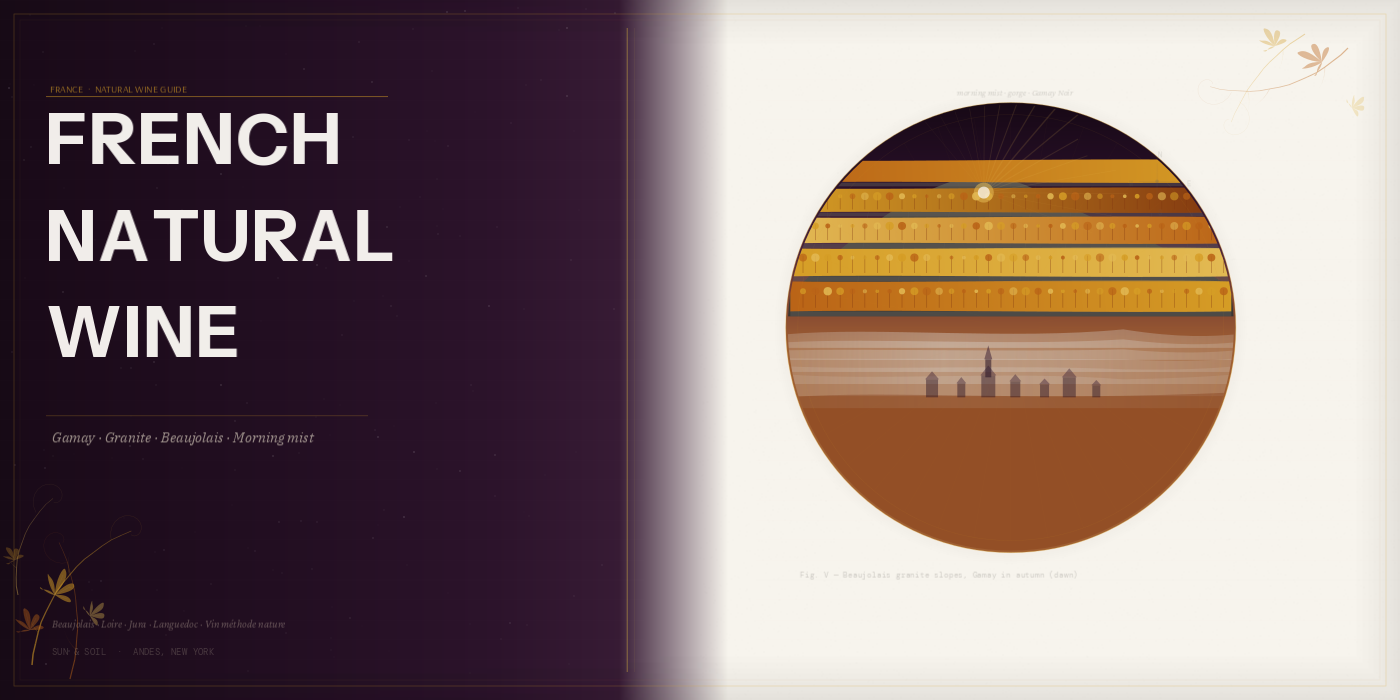
Beaujolais is the region where the modern natural wine movement was born, and it remains the most important terroir for understanding what the movement is about. The region sits south of Burgundy, planted almost entirely with one grape: Gamay. For most of the 20th century, Beaujolais was synonymous with Beaujolais Nouveau — a mass-produced, commercially made wine released every November to great fanfare and consumed quickly without thought. The natural wine producers of Beaujolais were a reaction against this: small estates, old vines, granite soils, and a commitment to making Gamay as seriously as the finest Burgundy winemakers made Pinot Noir.
The ten Crus of Beaujolais — Moulin-à-Vent, Morgon, Fleurie, Brouilly, Chénas, Chiroubles, Côte de Brouilly, Juliénas, Régnié, and Saint-Amour — each have distinct granite and schist soils and distinct wine characters. Morgon, in particular, produces Gamay of remarkable depth and age-worthiness — wines that develop in the bottle for ten years or more and challenge easy assumptions about what a "light" grape can become. The natural wine producers here — heirs to Marcel Lapierre's legacy — have proven that Beaujolais granite produces something genuinely profound when the land is treated with care.
Natural Beaujolais at its best is transparent, precise, and intensely minerally — a far cry from the banana-and-bubblegum character of carbonic maceration Nouveau. The wines have the tannin structure to age, the acidity to pair with food over a long meal, and the kind of earthy, crushed-granite character that speaks unmistakably of where they come from.
Loire Valley — the natural white wine heartland
The Loire Valley is a 300-kilometre river valley in western France that produces an extraordinary range of wines from half a dozen major regions and multiple indigenous grape varieties. For natural wine, it is arguably the most important region in France — the place where the natural wine philosophy has found its most complete expression across the full spectrum of styles, from bone-dry mineral whites to off-dry and sweet, from lean light reds to serious age-worthy Cabernet Francs.
Muscadet, at the western end of the Loire near the Atlantic coast, produces some of the most underrated white wine in France. Made from Melon de Bourgogne on ancient gneiss and granite soils, the best Muscadets — aged on their lees for extended periods — develop a toasty, saline complexity that makes them among the most food-friendly whites in the world. The natural wine movement has been transformative here: a generation of young producers farming organically and making Muscadet without additions has revealed what this misunderstood region is genuinely capable of.
Anjou is where Chenin Blanc — arguably the most versatile white grape in the world — finds some of its greatest expressions. Anjou Blanc (dry Chenin) from the black schist soils of the Savennières appellation and the surrounding communes produces wines of extraordinary mineral intensity and aging potential. The natural wine producers here — working with very old vines on some of the steepest and most marginal slopes in the valley — make Chenin that can age for twenty years or more and develops in the bottle with extraordinary complexity: beeswax, quince, fresh hay, and a honeyed depth that never crosses into sweetness. Jo Pithon, René Mosse, and the late Jo Landron are the names to know.
Chinon and Saumur-Champigny produce France's finest Cabernet Franc — the signature red grape of the Loire. Natural Cabernet Franc from the Loire is one of the most elegant and genuinely French things you can drink: bright red berry fruit, pencil shavings, dried herbs, and a structure that is all finesse rather than power. The natural wine producers of Chinon, farming the region's limestone and tufa soils organically, are making the most exciting Cabernet Franc in the world at prices that remain extraordinarily reasonable.
Vouvray and Montlouis-sur-Loire produce Chenin Blanc in a sweeter and more overtly aromatic register — from off-dry to lusciously sweet to sparkling — and the best pétillant naturel (naturally sparkling wine made by the ancestral method) from the Loire is produced here. Natural winemakers in these appellations have pushed the boundaries of what Chenin can express, making wines of real depth in every sweetness register.
Jura — the region the natural wine world discovered
The Jura is a small, isolated wine region in eastern France, between Burgundy and Switzerland, that the natural wine world discovered about fifteen years ago and has been obsessed with ever since. It is one of the most distinctive wine regions on earth: ancient limestone and clay soils with blue-grey marl, a damp continental climate, and grape varieties found almost nowhere else — Savagnin, Trousseau, Poulsard, and Ploussard among the most important.
What defines the Jura above all is ouillé and non-ouillé winemaking — the distinction between wines aged in sealed barrels (protected from oxygen) and wines aged in partially filled barrels (exposed to deliberate oxidation). The non-ouillé style produces Jura's most distinctive wines: whites aged under a film of yeast (the voile) that develops on the wine's surface, imparting walnut, curry spice, dried apple, and a savoury depth that is unlike anything else in French wine. The greatest expression of this style is Vin Jaune — aged in small barrels for a minimum of six years and three months, producing one of the most long-lived and extraordinary wines in the world.
Jura reds — from Trousseau, Poulsard, and Pinot Noir — are light, perfumed, and genuinely delicious: the red wine equivalent of Gamay in Beaujolais. The natural wine movement has found an unusually sympathetic home in the Jura, where the tradition of low-intervention winemaking never really died and where the local grape varieties reward organic and biodynamic farming with distinctive, place-specific wines that cannot be replicated anywhere else.
Languedoc-Roussillon — the wild south
The Languedoc is the largest wine region in France and for most of the 20th century was associated primarily with high-volume, low-quality table wine. That has changed dramatically. A generation of young producers — many of them natural wine converts who moved south from Burgundy or Alsace — have found extraordinarily good terroir in the rocky garrigue-covered hills of the Languedoc: ancient Grenache, Carignan, and Mourvèdre vines that have never been treated with chemicals simply because no one ever bothered with them. The natural wine movement has turned this into an asset rather than an oversight.
The best natural wines from the Languedoc are deeply earthy, savoury, and distinctly southern — full of the herbs, sun-baked rock, and dried fruit that define the landscape. Carignan, long dismissed as a workhorse variety, reveals extraordinary complexity from old vines in the right soils — schist in the Roussillon, limestone and sandstone in Corbières, clay in the Minervois. These are some of the most exciting and least expensive natural wines being produced in France today.
Alsace — aromatic wines at the natural frontier
Alsace, on France's border with Germany, produces some of the most aromatic white wines in the world from varieties including Riesling, Gewurztraminer, Pinot Gris, and Pinot Blanc. The region has a strong tradition of organic and biodynamic farming — some of the most celebrated biodynamic producers in France are Alsatian — and the natural wine movement has found a sympathetic home here among producers committed to expressing the distinctive volcanic and limestone soils of the Vosges mountain foothills.
Alsatian natural wine is often sweeter-seeming than Loire or Jura equivalents — the fuller body and aromatic richness of the varieties can read as sweetness even when the wines are technically dry. The best expressions are wines of profound complexity that pair beautifully with the rich, spiced cuisine of the region.
The Vin Méthode Nature Charter
In 2020, France established the Vin méthode nature charter — the world's first formal attempt to codify the standards of natural winemaking within a legal framework. The designation requires: grapes from certified organic vineyards, hand-harvesting, fermentation with only indigenous wild yeasts, and bottling with no additions except a maximum of 30mg/L of sulphur dioxide (with a zero-sulphur designation for wines bottled without any additions at all).
The charter is voluntary, covers only France, and has not resolved the fundamental debate about what natural wine is — but it represents a meaningful step toward giving consumers a reliable signal about what they are buying. Wines carrying the vin méthode nature label, whether with or without sulphur, meet a defined standard that goes significantly further than organic or biodynamic certification alone.
What to Drink: French Natural Wine Styles by Occasion
Aperitif / something light and fresh: Loire pétillant naturel (Vouvray or Montlouis), Muscadet sur lie, or a light Gamay from a Beaujolais village. These are wines that work as aperitif wine — energetic, food-friendly, and easy to enjoy without the distraction of food.
With seafood: Muscadet is the classic pairing — the saline, mineral character of the best expressions mirrors the sea itself. Anjou Blanc (dry Chenin) also works beautifully with fatty fish. For oysters specifically, very little in the world beats a good Muscadet.
With charcuterie and simple food: A light Beaujolais Gamay — something from the Crus, served slightly cool — is one of the great simple pleasures. Serve it at 14°C and drink it with a board of charcuterie, good bread, and aged cheese.
For a dinner party centrepiece: Loire Chenin Blanc — dry Savennières or Anjou Blanc — is one of the most impressive wines you can open at a dinner table. It pairs with almost everything and develops in the glass over the course of a meal in a way that holds the room's attention.
For serious wine drinkers: Morgon or Moulin-à-Vent from a natural Beaujolais producer reveals what Gamay can do with age on granite soils. Or a Jura Savagnin aged non-ouillé — one of the most intellectually interesting bottles in French wine.
From Our French Cellar
These are the bottles we carry that represent French natural wine at its most honest and compelling — one for each region and style the article covers.
The Loire Valley — natural wine royalty
La Famille Mosse La Joute 2021 — $55 · France (Anjou, Loire Valley)
René Mosse was one of the founding figures of the Loire natural wine movement — farming biodynamically in Anjou and making Chenin Blanc without additions at a time when almost nobody was. His children now run the estate with the same uncompromising philosophy. La Joute is a Chenin Blanc of real depth and mineral character — the living proof of what the article describes: old vines in black schist soil, wild yeast, nothing added, a wine that changes in the glass over the course of an evening. One of the great natural wine addresses in France.
The Rhône — serious natural Syrah
Matthieu Barret Rouge "Petit Ours" — $31 · France (Cornas, Northern Rhône)
Matthieu Barret is one of the most respected natural wine producers in the northern Rhône — a region better known for powerful, tannic Syrah than for low-intervention winemaking. "Petit Ours" (Little Bear) is his entry-level red: organic farming, wild yeast, no additions, and a lighter, more immediately enjoyable expression of Rhône Syrah than the region's blockbuster reputation might suggest. Dark fruit, smoked meat, white pepper, and a freshness that marks it out as genuinely natural.
The Languedoc — old vines at honest prices
Domaine Mont de Marie Salve Ager Grenache — $27 · France (Languedoc)
Everything the article says about the Languedoc renaissance is illustrated by this bottle — old Grenache vines in garrigue-covered schist, farmed with genuine care, made without technological intervention. Warm red fruit, earth, herbs, and a southern warmth that speaks unmistakably of the Midi. The Languedoc at its most honest: serious wine from a region still discovering what it is capable of.
When the AOC says no — a natural wine story
Fabien Jouves "You F*** My Wine?!" VDF Red — $24 · France (Cahors, Southwest)
The name is not a marketing gimmick. When French wine authorities told Jouves to pull up his old Jurançon Noir vines because the variety wasn't permitted under the Cahors AOC, he refused — and bottled the wine under the Vin de France designation as a declaration of intent. This is the AOC tension the article describes, in a bottle: a natural wine producer choosing freedom over appellation status because the grapes and the place matter more than the rules. Made with wild yeast, no additions, from vines that regulators wanted destroyed. Drink it and understand why the natural wine movement has always been, at its core, a political act.
The Rhône organic — accessible and immediate
Anne Pichon "Sauvage" Syrah/Grenache AOC Ventoux 2021 — $22 · France (Ventoux, Southern Rhône)
"Sauvage" means wild — and this is the most immediate and crowd-friendly expression of southern Rhône natural wine you can find at this price. Certified organic, wild yeast fermentation, no fining or filtering. Syrah and Grenache from the Ventoux appellation on the slopes of Mont Ventoux: red fruit, garrigue herbs, a savoury depth that makes it perfect at the table. The everyday bottle for someone exploring French natural wine for the first time.
Pét-nat — the ancestral method
Domaine Moutard Pet Mout Rosé Pét-Nat — $23 · France (Champagne region)
Pétillant naturel — wine that finishes its fermentation in the bottle, trapping its own natural carbon dioxide — is one of the oldest methods of making sparkling wine, predating the Champagne method by centuries. Moutard's "Pet Mout" is a Rosé pét-nat from the Champagne region: lively, slightly hazy, fruited, and entirely alive. This is how the Loire and the Champagne region make sparkling wine when they are not making it the conventional way — wild, fresh, and built to be drunk with food and pleasure.
Savoie — the alpine frontier
Charles Gonnet Roussette de Savoie Altesse 2024 — $24 · France (Savoie)
Savoie is the alpine wine region that connects France to the Jura and Switzerland — a world of ancient indigenous varieties, mountain soils, and wines that taste like nowhere else. Roussette (also known as Altesse) is Savoie's finest white grape: mineral, alpine-crisp, with floral aromatics and an earthy, almost herbal depth. Charles Gonnet farms organically and makes the wine with minimal intervention. One of the most genuinely distinctive and underrated white wines in France.
Roussillon — biodynamic precision at the frontier
Olivier Pithon D18 2021 — $56 · France (Roussillon)
Olivier Pithon — the brother of the more famous Jo Pithon of the Loire — farms biodynamically in the Roussillon, the southernmost wine region of France on the Spanish border, and makes wines of extraordinary mineral intensity and aging potential. The D18 is his flagship white: Grenache Blanc and Grenache Gris from old vines on schist, fermented with wild yeast, aged without additions. Complex, precise, and deeply southern in character without any of the heaviness that warm-climate whites can carry. Serious natural wine from one of France's most exciting estates.
Frequently Asked Questions
What is French natural wine?
French natural wine is wine made in France using organic or biodynamic farming, wild yeast fermentation, and minimal or no additions in the cellar. France is where the modern natural wine movement began — in Beaujolais in the 1970s and 1980s — and remains the most important single country for natural wine production, with significant concentrations of natural wine producers in Beaujolais, the Loire Valley, Jura, Alsace, and the Languedoc.
What is the best natural wine region in France?
It depends what you want to drink. Beaujolais is the historical home of the movement and produces the most recognisable natural wine style globally (Gamay, light and mineral). The Loire Valley is the most diverse region for natural wine, producing exceptional dry whites (Muscadet, Chenin Blanc), sparkling wines, and light reds. The Jura is the most distinctive and sought-after by serious natural wine collectors. The Languedoc offers the best value — serious natural wine from old vines at accessible prices.
What is Gamay wine?
Gamay is the primary red grape of Beaujolais in France. It produces wines that are light to medium-bodied, with bright red cherry fruit, high acidity, and relatively low tannins. Natural Beaujolais Gamay, made from old vines on granite soils with wild yeast and no additions, is among the most elegant and food-friendly red wine in France — a very different drink from the mass-produced Beaujolais Nouveau style.
What is Chenin Blanc wine?
Chenin Blanc is the signature white grape of the Loire Valley in France, capable of producing everything from bone-dry mineral whites to lusciously sweet dessert wines and sparkling wines. At its best — dry, from old vines in the black schist soils of Anjou — it produces wines of extraordinary mineral intensity and aging potential. Natural Loire Chenin Blanc is one of the finest and most food-versatile white wines in France.
How do you identify a natural wine from France?
Look for the Vin méthode nature designation on the label — this is France's official charter for natural wine, guaranteeing organic farming, wild yeast, and minimal additions. Beyond this certification, look for the names of established natural wine regions (Beaujolais, Loire, Jura) and the names of producers known for low-intervention work. A good natural wine specialist shop — like Sun & Soil — will be able to tell you specifically how each bottle was made.
Go deeper: What is natural wine? The complete beginner's guide · The complete guide to orange wine · Austrian wine — biodynamic estates and the natural wine tradition in Central Europe · The encyclopedia of natural wine — 20 key terms defined