
Austrian Wine: Grüner Veltliner, Riesling, Blaufränkisch & Beyond
Austria produces some of the finest white wines in the world. This is not a controversial statement among serious wine drinkers, but it remains one of the best-kept secrets in a wine market where French, Italian, and Spanish bottles still dominate the conversation. The country's flagship white grape — Grüner Veltliner — is one of the most food-friendly, terroir-transparent, and genuinely exciting varieties grown anywhere. And Austria's red varieties, particularly Blaufränkisch, are making a strong case that the country deserves the same level of attention for its reds as Burgundy receives for Pinot Noir.
More relevant to what we do at Sun & Soil: Austria is one of the spiritual homes of the biodynamic winemaking movement. Two of the most celebrated biodynamic estates in the world — Meinklang and Gut Oggau, both in Burgenland — are from Austria. The country has among the highest proportions of organically farmed vineyards in Europe, and the generation of winemakers now leading the Austrian wine renaissance are, to an unusual degree, committed to farming and winemaking philosophies that align with natural wine principles. This is not a coincidence. Austrian wine and natural wine share a core conviction: that the best wine comes from healthy land, farmed carefully, with as little interference as possible.
Austria's Wine Landscape
Austria is a small wine country — total vineyard area is roughly equal to the Bordeaux appellation alone — but it punches well above its weight in terms of quality and diversity. The vineyards are concentrated in the eastern part of the country, where the Alps give way to the Pannonian Plain and the climate shifts from cool and continental to warmer and drier. This transition between Alpine and Pannonian influences is one of the defining factors in Austrian wine's character: the cool nights preserve acidity and aromatic freshness even as the warm days enable full ripening.
The main wine regions are grouped into three broad zones. The Wachau, Kremstal, and Kamptal along the Danube produce the country's most celebrated whites — primarily Grüner Veltliner and Riesling from terraced vineyards of steep primary rock (gneiss, granite, amphibolite). Burgenland in the southeast, on the shores of the shallow Neusiedlersee lake, produces the country's most serious reds and some of the world's greatest botrytised sweet wines. Vienna — the only major European capital with significant vineyards within city limits — produces characterful Grüner Veltliner and Gemischter Satz (mixed field blends). Styria (Steiermark) in the south produces Austria's most aromatic whites, particularly Sauvignon Blanc and Muskateller.
The Grapes of Austria
Grüner Veltliner — the flagship
Grüner Veltliner is Austria's most planted grape and the variety that defines the country's wine identity internationally. It is grown nowhere else in the world at serious commercial scale — this is genuinely Austria's own. The wine is dry, high in acid, and famously peppery: a characteristic white pepper or radish spice on the finish that appears in almost every Grüner Veltliner from the lightest and most quotidian to the grandest single-vineyard expressions. Beyond that spice, the variety shows citrus, green apple, and mineral notes at lower ripeness levels; stone fruit, fresh herbs, and floral complexity as it ripens further; and honey, smoke, and white truffle in the finest examples with age.
The stylistic range is enormous. A simple Grüner Veltliner from the Weinviertel region (Austria's largest wine zone, producing everyday wines from the flat plains north of the Danube) is light, fresh, and best drunk within a year or two. A Smaragd-classified Grüner Veltliner from the steep terraces of the Wachau — the highest quality level in that appellation — is a wine of real depth and aging potential, capable of lasting twenty years or more and competing with the finest white Burgundy.
Biodynamic farming transforms Grüner Veltliner in a way that is immediately perceptible. The wines become more precise, more mineral, more alive — the characteristic pepper intensifies and the fruit takes on an extra dimension of complexity. This is what Meinklang demonstrates with their Grüner Veltliner: biodynamic farming from one of the great estates of Burgenland, producing a wine that shows clearly what this variety is capable of when the land is treated as a living system.
Try it: Meinklang Grüner Veltliner 2024 · Austria (Burgenland) — Certified biodynamic from one of Europe's most important biodynamic estates. Crisp white pepper, citrus zest, mineral precision. The benchmark for what biodynamic farming does to Austria's flagship variety.
Riesling — the intellectual
Austrian Riesling is different from German Riesling and from Alsatian Riesling, and the distinction matters. Austrian Riesling — grown primarily in the Wachau, Kremstal, and Kamptal — is almost always dry, with a steelier, more mineral character than the fruit-forward sweetness of many German expressions. The primary rock soils of the Wachau (gneiss and granite on the steep terraced slopes above the Danube) give the wine a distinctive flinty, mineral backbone that is unlike almost anything else in the world. White peach, apricot, and citrus on the fruit side; slate, granite, and river stone on the mineral side; and an acidity that can keep the wine alive for decades.
The Wachau uses its own classification system — Steinfeder (lightest), Federspiel (medium), and Smaragd (ripest and fullest, named after the local emerald green lizard) — that defines the style and quality level of each wine. Smaragd Riesling from top producers in the Wachau is among the most sought-after white wine in the world.
Blaufränkisch — the red to know
Blaufränkisch is Austria's most important red grape — a grape with thick blue-black skins, high acidity, and significant tannin that produces wines of real structure and aging potential. The name translates roughly as "blue Frankish" — it is the same grape known as Lemberger in Germany and as Kékfrankos in Hungary, where it is also widely planted. But it is in Austria's Burgenland that it finds its highest expression.
At its best, Blaufränkisch produces wines that combine dark cherry and plum fruit with a distinctly savoury, spiced character — black pepper, leather, earthy herbs — and enough acidity and tannin to age gracefully for a decade or more. The style is sometimes compared to a cross between Pinot Noir and Syrah, though it has a character entirely its own. The village of Deutschkreutz in Burgenland and the Eisenberg DAC appellation are particularly highly regarded for single-vineyard Blaufränkisch of real depth.
Zweigelt — the approachable red
Zweigelt is Austria's most planted red grape and its most accessible — a crossing of Blaufränkisch and St. Laurent created in 1922, with the dark fruit character of its parents softened into something rounder, fruitier, and more immediately enjoyable. It is Austria's everyday red — light to medium-bodied, with cherry fruit, herbs, and a slight pepper note — and at its best, made by good producers with low yields and minimal intervention, it is a genuinely delicious wine that drinks easily and pairs well with food. The best Zweigelt is rarely oaked or manipulated; it is designed to be drunk young and with pleasure.
St. Laurent — the hidden gem
St. Laurent is one of Austria's great undiscovered reds — a variety that produces wines of remarkable elegance and complexity, similar in weight and perfume to Pinot Noir but with a distinctively Austrian earthy, savoury character. It is relatively rare outside Austria, which makes it genuinely exciting to encounter: a sophisticated, food-friendly red that rewards attention and repays cellaring.
The Great Wine Regions
The Wachau
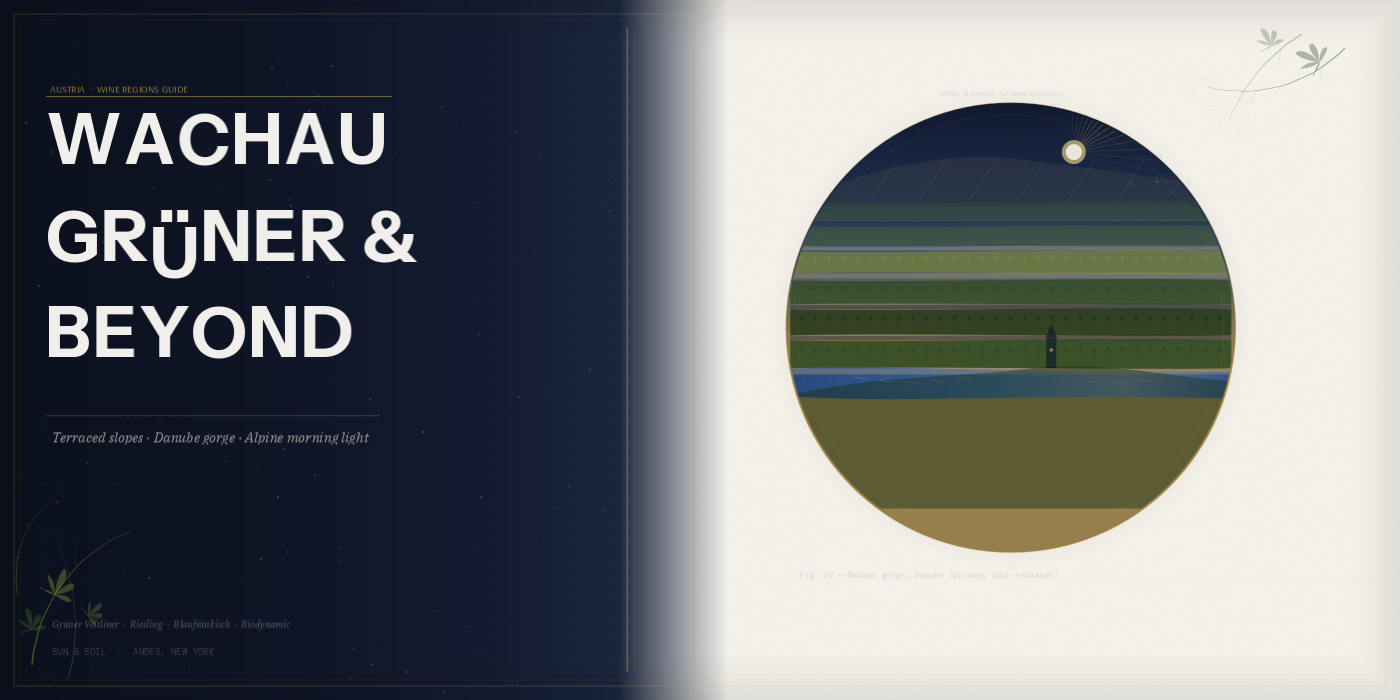
The Wachau is the most famous wine region in Austria and one of the most dramatic wine landscapes in Europe — a narrow gorge cut by the Danube river through ancient crystalline rock, with vineyards terraced on slopes so steep that all work must be done by hand. The primary rock soils (gneiss, granite, amphibolite) give the wines a mineral intensity found nowhere else. The region produces only white wine — Grüner Veltliner and Riesling — under its own classification system (Steinfeder, Federspiel, Smaragd). The top estates here — Prager, Knoll, F.X. Pichler, Emmerich Knoll — produce wines that age as well as the finest white Burgundy and at comparable prices.
Kremstal and Kamptal
Immediately east of the Wachau along the Danube, the Kremstal and Kamptal produce Grüner Veltliner and Riesling from a combination of loess terraces and primary rock. The style here is slightly fuller and more generous than the Wachau — the soils retain more warmth — and the wines are among the best values in Austrian white wine. Domäne Wachau, Bründlmayer, and Hirsch are key producers to know.
Burgenland
Burgenland is a different world from the Danube regions — flat, warm, and influenced by the shallow Neusiedlersee lake, which creates the humid conditions that allow botrytis fungus to develop on the grapes in autumn, producing some of the world's greatest sweet wines (Trockenbeerenauslese and Ausbruch). But Burgenland is equally important for dry wines: the region is the home of Austria's finest Blaufränkisch, serious Zweigelt, and some of the most important biodynamic farming in Central Europe.
The Michlits family of Meinklang farms a large estate on the shores of the Neusiedlersee with the whole land — crops, cattle, pigs, horses, and vines — managed as a single biodynamic ecosystem. No synthetic inputs, no commercial yeasts, no additions. The philosophy extends from the soil upward through the vine to the bottle, producing wines that are genuinely expressive of this particular place. Gut Oggau, the project of Eduard and Stephanie Tscheppe-Eselböck, takes a similarly radical approach in nearby Oggau — farming biodynamically and making wines under the personalities of a fictional family, each with a distinct character.
Try it: Meinklang Grüner Veltliner 2024 · Austria (Burgenland) — The biodynamic benchmark.
Try it: Gut Oggau Theodora 2023 · Austria (Burgenland) — One of the world's most beloved natural wine estates. Theodora is the fresh, playful white in their family range: wild yeast, no additions, unfiltered. The ideal introduction to what Austrian natural wine can be.
Vienna (Wien)
Vienna is a wine anomaly — one of the only major world capitals with active vineyards within city limits, producing around 700 hectares of wine in the hills and outskirts of the city. The traditional style is Gemischter Satz (literally "mixed set") — field blends of many different white grape varieties planted together and harvested together, producing wines of extraordinary complexity that could not be replicated from a single variety. The Viennese Heuriger (wine tavern) culture, where producers serve their own wines direct to customers in casual garden settings, is one of the great wine-drinking traditions in the world.
Styria (Steiermark)
Styria is Austria's southernmost wine region — warmer and more Mediterranean-influenced than the Danube valley — and produces wines of distinctive aromatic character. Sauvignon Blanc here is among the world's most serious examples of the variety: mineral, herb-driven, and age-worthy in a way that few other regions can claim. Muskateller (Muscat Blanc à Petits Grains) also thrives here, producing light, perfumed, dry whites of considerable charm. The South Styrian Wine Road is one of the most beautiful wine landscapes in Central Europe.
Why Austria and Natural Wine
Austria's relationship with organic and biodynamic farming is not a recent trend — it is built into the national wine culture. The country introduced one of the world's first comprehensive organic wine regulations in the 1980s, and the proportion of Austrian vineyards certified organic is among the highest in Europe. The generation of winemakers who came of age in the 1990s and 2000s — the same generation that built Austria's international reputation — did so by rejecting the over-ripe, over-oaked, over-extracted style that dominated world wine in that period and returning to a philosophy of minimal intervention and terroir expression.
Estates like Meinklang and Gut Oggau represent the fullest expression of this philosophy — not just organic or biodynamic in the vineyard, but genuinely minimal in the cellar, with wild yeast fermentation, no additions, no filtration, and a commitment to producing wine that speaks of its place rather than of winemaking technology. The result is wines that feel alive in a way that conventionally produced wine cannot — wines that change in the glass, evolve with food, and taste different from year to year because the living systems that produce them are different from year to year.
This is what biodynamic farming does at its best. It does not produce consistency — it produces authenticity. And Austrian wine, in the hands of its best producers, is among the most authentic wine being made anywhere in the world today.
From Our Austrian Selection
The biodynamic Grüner — Austria's flagship, properly farmed
Meinklang Grüner Veltliner 2024 · Austria (Burgenland)
The Michlits family at Meinklang have been farming their large Burgenland estate biodynamically for generations — vines, crops, animals, all managed as a single living system. The Grüner Veltliner captures everything the variety can do when the land is genuinely healthy: white pepper, citrus zest, mineral precision, and a freshness on the finish that only biodynamic farming seems to produce consistently. No additions, wild yeast, no filtration.
The iconic natural wine estate — Austria's most beloved
Gut Oggau Theodora 2023 · Austria (Burgenland)
Eduard and Stephanie Tscheppe-Eselböck created something genuinely unlike anything else in Austrian wine when they took over the Oggau estate and began farming it biodynamically with zero additions in the cellar. Each wine in their range is named after a fictional family member — Theodora is the light, fresh, playful one — a white blend that drinks beautifully on its own or with food. Wild yeast, unfiltered, alive. The wine that made Gut Oggau a cult name in natural wine circles worldwide.
Frequently Asked Questions
What is Grüner Veltliner?
Grüner Veltliner is Austria's flagship white grape — dry, high in acid, with a distinctive white pepper or radish spice on the finish. It is grown primarily in Austria and nowhere else at serious commercial scale. The style ranges from light, everyday drinking wines to profound, age-worthy single-vineyard expressions from the steep slopes of the Wachau. It is one of the most food-friendly white wines in the world.
What does Austrian wine taste like?
Austrian white wine is generally dry, high in acidity, and distinctly mineral — shaped by the cool continental climate and the ancient rock soils of the Danube valley regions. Grüner Veltliner has a characteristic white pepper spice; Riesling is steelier and more mineral than German expressions. Austrian reds, particularly Blaufränkisch, are structured, savoury, and built for aging — not the fruity, extracted style of warmer climate reds.
Is Austrian wine natural wine?
Not automatically, but Austria has a higher proportion of organically and biodynamically farmed vineyards than almost any other wine country in Europe. Some of the world's most celebrated biodynamic wine estates — Meinklang and Gut Oggau in Burgenland — are Austrian. The country's wine culture has a strong natural wine tradition, and the generation of winemakers who built Austria's modern reputation largely did so by rejecting over-manipulation in favour of terroir expression.
What is Blaufränkisch wine?
Blaufränkisch is Austria's most important red grape, producing structured, savoury, age-worthy reds with dark fruit, black pepper, leather, and earthy herb notes. It is grown primarily in Burgenland and is the same grape as Lemberger (Germany) and Kékfrankos (Hungary). At its best — from single vineyards in Deutschkreutz or the Eisenberg DAC — it produces wines of real depth that can age a decade or more.
How should you serve Austrian white wine?
Grüner Veltliner and Austrian Riesling are best served at 10–12°C — cooler than a full-bodied white Burgundy but not as cold as a basic Sauvignon Blanc. They are food wines by nature; serve them at the table rather than as aperitifs if you want to understand what they do. A wider glass than you would use for a delicate white will help open up the aromatics.
Go deeper: What is natural wine? The complete beginner's guide · Slovenian wine — Austria's neighbour and natural wine's other home · Biodynamic wine explained — what it means and why it matters