
Biodynamic Wine: The Complete Guide to What It Is, How It Works & Why It Matters
Biodynamic wine is the most misunderstood category in the wine world. It is simultaneously more radical and more practical than its reputation suggests — not a marketing term, not a certification that can be bought, and not a synonym for organic, though it includes everything organic farming does and goes considerably further. At its core, biodynamic farming is a philosophy about the relationship between a farm and the living systems that sustain it, and the wines it produces are, consistently and perceptibly, different from wines made by any other method.
The difference is not subtle in the best examples. When you drink a biodynamic wine from a producer who has farmed this way for a generation — Meinklang in Austria, La Famille Mosse in the Loire, Gut Oggau in Burgenland — there is a quality of precision and aliveness in the glass that is immediately perceptible and genuinely difficult to explain through conventional winemaking logic. The wines taste more specifically of their place. The fruit is more vivid and more precise. The mineral character is sharper. The finish is longer and more complex. Whether or not you accept the philosophical framework behind biodynamic farming, these are real, consistent, repeatable differences — and they are the reason the natural wine world has embraced biodynamic producers so enthusiastically.
This guide explains what biodynamic farming actually is, how it differs from organic, what the certifications mean, which producers are doing it seriously, and why it matters for the wines we choose to carry at Sun & Soil.
What Is Biodynamic Farming?
Biodynamic farming originates with Rudolf Steiner, an Austrian philosopher who in 1924 gave a series of eight lectures to farmers in Silesia (now Poland) who were concerned about the declining health of their soil and animals. Steiner's response — later published as the "Agriculture Course" — proposed a radically different understanding of the farm: not as a collection of fields producing individual crops, but as a single, self-sustaining organism in which soil, plants, animals, humans, and the broader cosmos were understood as an interconnected whole.
The core principles that Steiner outlined remain the foundation of biodynamic farming a century later. The farm should be as self-sufficient as possible — producing its own fertility through composting and animal manure rather than importing synthetic inputs. The vine (or crop) should be understood as part of a living system, not an isolated production unit. Farming decisions should be informed by natural rhythms — the lunar calendar, the positions of planets, the seasonal cycle — rather than imposed on the land by calendar or chemical schedule. And the farm should work with microbial life rather than sterilizing it: healthy soil contains billions of microorganisms per teaspoon, and biodynamic farming treats this invisible community as the foundation of everything above ground.
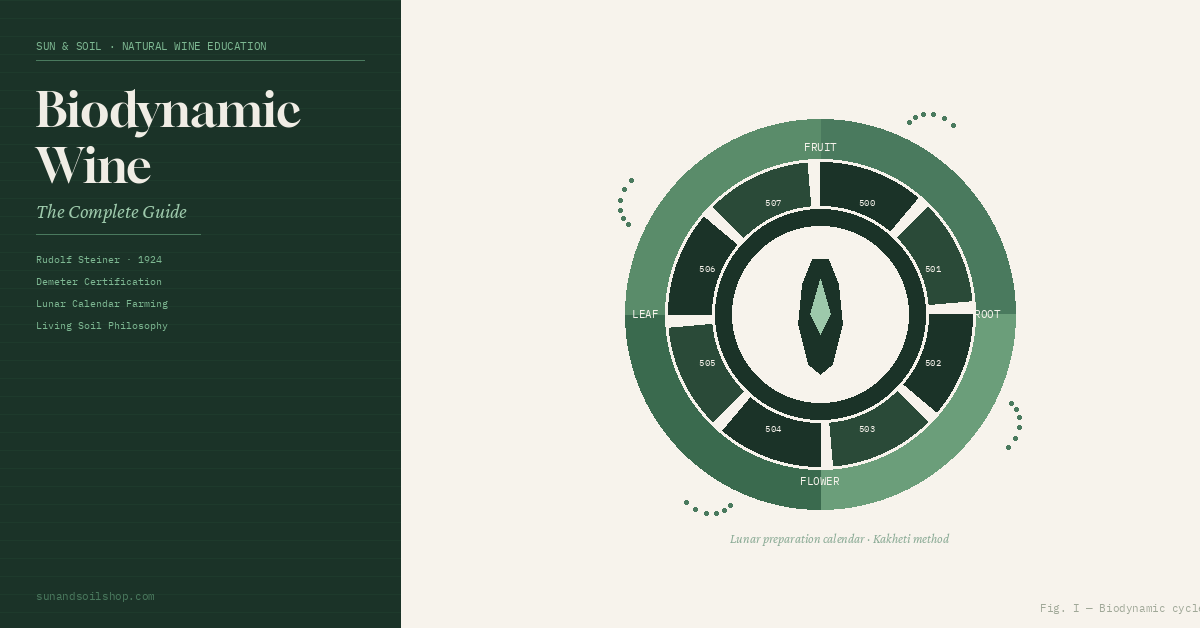
What makes biodynamic farming distinctive is not the absence of synthetic inputs (organic farming achieves this) but the addition of a set of specific preparations — numbered 500 through 508 — that are applied to the soil, compost, and plants in tiny quantities. These preparations, made from substances including fermented cow manure packed into a cow horn and buried over winter, silica powder, and a range of medicinal herbs including yarrow, chamomile, and valerian, are understood by Steiner's system to stimulate microbial activity, regulate growth rhythms, and strengthen the plant's own vitality. The quantities involved are homeopathic — a single gram of Preparation 500 is diluted in 35 liters of water and stirred vigorously for an hour before being sprayed across a hectare of vineyard. To conventional agronomy, this is somewhere between mystical and nonsensical. To biodynamic producers who have used these preparations for decades, the results in soil health and wine quality are empirically demonstrable.
Biodynamic vs Organic: What's the Difference?
Every biodynamic vineyard is also organic — the prohibition on synthetic pesticides, herbicides, and fertilizers is the minimum baseline of biodynamic farming, not an achievement in itself. But organic farming stops there: it defines what you cannot do (spray with synthetic chemicals) without prescribing what you must do to replace them. Biodynamic farming specifies both.
The farm as ecosystem: Organic certification requires no synthetic inputs. Biodynamic certification requires that the farm function as a self-sustaining ecosystem — composting its own fertility, maintaining biodiversity, integrating animals where possible. A monoculture vineyard treated only with permitted copper and sulphur is technically organic. A biodynamic vineyard must be ecologically richer than this.
The preparations: Biodynamic farming uses a specific set of preparations (500–508) that have no organic equivalent. These are applied in tiny quantities to stimulate soil microbial activity and plant vitality. There is no scientific consensus on the mechanism by which they work, but there is substantial evidence — from independent soil scientists as well as from the producers themselves — that soils farmed biodynamically for extended periods develop significantly richer microbial communities than conventionally or even organically farmed soils.
The lunar calendar: Biodynamic farming uses the lunar and astrological calendar to schedule farming and cellar operations. The calendar divides days into four categories — root, flower, fruit, and leaf — each associated with different elements and understood to be more or less auspicious for different activities. Many biodynamic producers schedule tastings, bottling, and even which days they open particular wines according to this calendar.
Certification: Organic certification is administered by national and regional bodies under EU or USDA regulations. Biodynamic certification is administered primarily by Demeter International, a non-governmental organization founded in 1928 that has its own standards — more demanding than organic — and its own inspection regime. Biodyvin is a smaller biodynamic wine certification focused specifically on viticulture. Both certifications require independent inspection and a transition period of several years.
What the Certifications Mean
Demeter
Demeter is the most widely recognized biodynamic certification and the most rigorous. Founded in Germany in 1928, Demeter International now certifies farms in more than 50 countries. Demeter certification requires not just the prohibition of synthetic inputs but the active implementation of biodynamic preparations, a minimum percentage of the farm's fertility coming from on-site composting, and regular independent inspection. The Demeter seal on a wine label is a reliable signal that the vineyard has been farmed according to Steiner's principles, verified by a third party. Meinklang, whose wines we carry, carries Demeter certification for its entire agricultural operation — not just the vineyards but the cattle, crops, and orchards that make up the biodynamic whole.
Biodyvin
Biodyvin is a French association of biodynamic wine producers founded in 1995, with around 200 member estates primarily in France, Germany, Switzerland, and Austria. Its standards are comparable to Demeter but focused specifically on viticulture and winemaking, with additional requirements around cellar practices including limits on sulphur additions. Biodyvin membership is voluntary and peer-monitored, with regular tastings and farm visits as part of the certification process.
Practicing biodynamics without certification
Many producers farm biodynamically without carrying formal certification — either because the cost and administrative burden of certification is prohibitive for small estates, or because they object philosophically to seeking external validation for what they consider a personal farming commitment. Some of the most respected biodynamic producers in the world are uncertified. When we describe a producer as biodynamic, we mean they follow biodynamic principles in practice, whether or not they carry a formal certification.
Why Does Biodynamic Farming Produce Better Wine?
The most credible explanation — the one that aligns most closely with what soil scientists actually observe in biodynamic vineyards — is that biodynamic farming produces wine that tastes better primarily because it produces dramatically healthier soil.
Healthy soil is microbially rich soil. A single teaspoon of healthy vineyard soil contains billions of bacteria, fungi, protozoa, nematodes, and other microorganisms that form an intricate web of relationships — breaking down organic matter, making nutrients available to plant roots, protecting roots from pathogens, and producing compounds that the vine absorbs and expresses in its fruit. When soil is treated with synthetic fertilizers, herbicides, and pesticides, this microbial community is simplified and damaged over time.
Biodynamic farming — by prohibiting synthetic inputs, by adding the specific preparations that stimulate microbial activity, and by composting organic matter back into the soil — rebuilds this ecosystem over years and decades. The result, consistently observed in independent soil analyses, is that biodynamic vineyard soils contain more diverse and more abundant microbial communities than conventionally farmed soils. And this difference in soil biology expresses itself in the wine: in the mineral precision, in the complexity of the fruit, in the specificity of the terroir character. This is not mysticism. It is soil science.
The Great Biodynamic Wine Regions
Austria — biodynamic farming's most concentrated heartland
Austria has the highest concentration of certified biodynamic vineyards of any wine country in Europe, and arguably produces the most consistently compelling biodynamic wine in the world. The tradition runs deep: Nikolaihof in the Wachau has been biodynamic since the 1970s. Meinklang in Burgenland and Gut Oggau, also in Burgenland, represent the next generation — farms that have taken the biodynamic philosophy further than almost anyone else, farming the entire agricultural system as a single biodynamic organism. Austria's flagship grape, Grüner Veltliner, is perhaps the variety that most visibly benefits from biodynamic farming: the characteristic white pepper and mineral precision becomes more intense and more specific in biodynamic examples.
France — the philosophical birthplace
France has more Demeter-certified vineyards than any other country. The Loire Valley has become one of the great biodynamic wine regions: producers like La Famille Mosse in Anjou and Nicolas Joly in Savennières are farming biodynamically and producing wines of extraordinary mineral precision. In Burgundy, Domaine Leflaive's conversion to biodynamics in the 1990s — systematically documented by Anne-Claude Leflaive over a decade — became one of the most cited case studies for biodynamic viticulture, with measurable improvements in soil health translating directly into wine quality.
Georgia — the ancient tradition
Georgia's qvevri winemaking tradition predates Steiner's biodynamic philosophy by 8,000 years. Georgian small-scale family producers who make wine in buried clay vessels with indigenous varieties on chemical-free land are practising something that is functionally biodynamic by design rather than doctrine. The philosophy maps exactly: the farm as ecosystem, the land as living system, the wine as an expression of place rather than technique.
Germany, Alsace, and beyond
Germany and Alsace have strong biodynamic traditions in Riesling — the steep slate soils of the Mosel and the volcanic soils of Alsace produce biodynamic Riesling of extraordinary mineral precision. Biodynamic viticulture has also spread globally: to Italy, Spain, California, New Zealand, and South Africa, adapted to different climates and grape varieties while consistent in its underlying principles.
From Our Cellar — Biodynamic Wines We Stock
Austria — biodynamic at its most rigorous
Meinklang Grüner Veltliner 2024 · Austria (Burgenland)
The Michlits family farm around 250 hectares of mixed agriculture — cattle, horses, pigs, crops, orchards, and vines — as a single Demeter-certified biodynamic system. No synthetic inputs anywhere on the property. All fertility from on-site composting and animal manure. The Grüner Veltliner is the most direct expression of what this approach does to wine: vivid white pepper, precise mineral character, and a freshness that conventionally farmed Grüner rarely achieves. The reference bottle for understanding biodynamic wine.
Gut Oggau Theodora 2023 · Austria (Burgenland)
Eduard and Stephanie Tscheppe-Eselböck rebuilt a derelict Burgenland estate from the ground up as a biodynamic farm and natural wine cellar. Every wine is fermented with wild yeasts, aged without additions, bottled unfiltered. Theodora is the lightest, freshest wine in their range — a white blend showing the precision and energy that biodynamic farming delivers. One of the most celebrated natural wine addresses in the world.
France — the Loire biodynamic tradition
La Famille Mosse La Joute 2021 · France (Anjou, Loire)
René Mosse was one of the founding figures of the Loire natural wine movement and one of the earliest adopters of biodynamic farming in Anjou. His estate, now run by his children, farms biodynamically on black schist soils, making Chenin Blanc without additions and with wild yeasts. La Joute shows the Anjou terroir with the precision that only biodynamic farming consistently delivers.
Georgia — the ancient tradition
Casreli "Erekle's Wine" Qvevri Dry Amber, Kakheti 2021 · Georgia (Kakheti)
Georgia's qvevri tradition predates biodynamic philosophy by millennia. Casreli represents it at its most honest: family-run, fermenting in buried clay vessels, no additions, wild yeast, land managed without chemicals. Wine that tastes of its specific place with a precision no winemaking technique can replicate.
Slovenia — natural wine's biodynamic heartland
Rodica Malvasia 2023 · Slovenia (Slovenian Istria)
Rodica farms the limestone and red clay soils of Slovenian Istria with a commitment to soil health and minimal intervention that aligns closely with biodynamic principles. The Malvasia is a wine of sea-salt minerality and floral precision — one of the most elegant natural whites in our range.
Browse our full natural wine selection →
Frequently Asked Questions
What is biodynamic wine?
Biodynamic wine is made from grapes grown using biodynamic farming — a holistic agricultural philosophy developed by Rudolf Steiner in 1924 that treats the farm as a self-sustaining ecosystem. It prohibits all synthetic inputs and adds specific preparations to stimulate soil microbial life, along with a commitment to farming in harmony with natural rhythms. Biodynamic wines typically show greater mineral precision, more vivid fruit, and more specific terroir character than conventionally or organically farmed wines.
Is biodynamic wine the same as organic wine?
No. Every biodynamic vineyard is organic, but not every organic vineyard is biodynamic. Organic farming defines what you cannot do — no synthetic inputs. Biodynamic farming also specifies what you must do: apply specific preparations to the soil, build farm-generated fertility, manage the farm as an integrated ecosystem, and schedule operations according to natural rhythms. The two certifications have different standards and different inspection regimes.
Does biodynamic wine taste different?
In the best examples, yes — perceptibly so. Wines from producers who have farmed biodynamically for a generation consistently show greater mineral precision, more vivid fruit, and longer finishes than conventionally farmed equivalents. Whether this is attributable to the biodynamic preparations specifically or to the overall soil health that biodynamic farming promotes remains contested. The perceptible difference in the glass is real and consistent.
What does Demeter certified mean?
Demeter is the oldest and most widely recognized biodynamic certification body, founded in Germany in 1928. Demeter certification requires implementation of the full biodynamic system — including the Steiner preparations, on-farm composting, and farm ecosystem integration — verified by regular independent inspection. A Demeter seal on a wine label is a reliable third-party guarantee of biodynamic farming.
Is biodynamic wine better for you?
Biodynamic wines typically contain lower pesticide residues (synthetic pesticides are prohibited) and are often made with lower or no sulphur additions. Whether this translates to measurable health benefits has not been rigorously studied. Many people report less of the headache and fatigue sometimes associated with conventional wine — whether attributable to lower sulphur, lower histamines, or simply better wine is unclear.
How do I find biodynamic wine?
Look for the Demeter or Biodyvin certification marks on the label. Beyond certification, shop from retailers who can explain how each wine was farmed and who have direct relationships with their producers. The most reliable route to biodynamic wine is a wine shop whose buyers visit producers and verify farming practices firsthand — which is exactly how we curate the Sun & Soil selection.
Go deeper: Austrian wine — Meinklang, Gut Oggau, and the biodynamic heartland · French natural wine — the Loire biodynamic tradition · Georgian wine — the ancient qvevri tradition · What is natural wine? The complete beginner's guide · Grüner Veltliner — the biodynamic benchmark grape