
Lebanese Wine: The Complete Guide to Bekaa Valley, Merweh & the Levant's Natural Wine Story
Lebanese wine is one of the great undiscovered stories in the natural wine world. A country the size of Connecticut, ravaged by civil war, economic collapse, and a catastrophic port explosion, yet producing some of the most distinctive, terroir-driven wines in the Middle East — wines made from indigenous grape varieties that have grown in the Bekaa Valley for thousands of years, by producers who have chosen to stay and make wine against every conceivable reason to leave.
The story of Lebanese wine is inseparable from the country's story: the extraordinary resilience of people who love what they make, working in conditions that would have shut down vineyards anywhere else. When we carry Lebanese wine at Sun & Soil, we are carrying that story. We are also carrying wines that are genuinely excellent on their own terms — the Bekaa Valley's altitude, limestone soils, and continental climate produce grapes of remarkable concentration and aromatic freshness, and the natural winemakers working there are doing things with indigenous varieties that no one else in the world is doing.
This guide covers everything: Lebanon's wine history, the Bekaa Valley, the indigenous varieties that make Lebanese wine distinctive, and the three bottles we currently carry that represent this small but extraordinary wine country.
Lebanon's Wine History
Wine has been made in Lebanon for at least 5,000 years. The Phoenicians — the seafaring civilization that inhabited the Lebanese coast from roughly 1500 BCE — were among the most important wine traders in the ancient world, carrying amphorae of Lebanese wine to Greece, Egypt, and the western Mediterranean. The Bekaa Valley's fertile soils and reliable sun made it one of the most productive agricultural regions of the ancient world, and viticulture was central to its economy. By the time of the Roman Empire, the Bekaa was already one of the most famous wine-producing regions in the eastern Mediterranean.
The modern Lebanese wine industry begins in the late 19th century, when Jesuit missionaries established Château Ksara in the Bekaa Valley in 1857. Ksara remains the largest winery in Lebanon today and the anchor of the country's conventional wine industry. Through the 20th century, Lebanese wine developed quietly — constrained by a market dominated by French imports, the social conventions of a country with significant Muslim and Christian populations, and the devastating civil war (1975–1990) that shut down much of the wine industry entirely.
The post-civil war recovery of the 1990s saw Lebanese wine expand rapidly. Producers like Château Musar — which had somehow continued producing wine even through the worst years of the conflict, with founder Serge Hochar memorably describing the challenges of harvesting grapes under shellfire — became international cult objects, their extraordinary aged blends introducing Lebanese wine to a global audience. A generation of new wineries followed: Château Kefraya, Clos St. Thomas, Domaine Wardy, and dozens of others, mostly in the Bekaa Valley.
The natural wine movement arrived more recently. A small number of producers — primarily in the Bekaa Valley — began farming organically, working with indigenous varieties rather than international ones, and applying minimal intervention in the cellar. The Mersel project is the most prominent of these: a winery dedicated entirely to indigenous Lebanese varieties, particularly the ancient Merweh grape, made with the principles of skin contact and non-intervention that characterize the best natural wine from anywhere in the world.
The Bekaa Valley
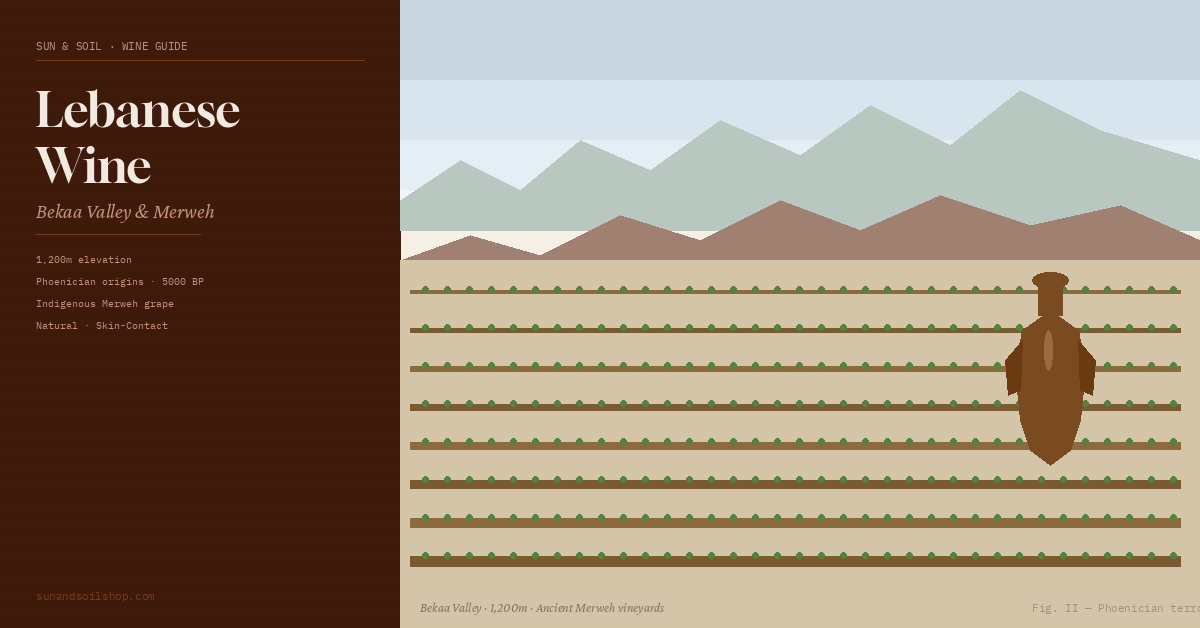
Almost all quality Lebanese wine — and all of the wine we carry — comes from the Bekaa Valley, a high-altitude plateau in eastern Lebanon between the Lebanon and Anti-Lebanon mountain ranges. The valley sits at an average elevation of around 900 to 1,100 meters above sea level, with some vineyards (including those producing the Lebnani Ahmar we carry) reaching 1,200 meters. This altitude is the defining factor in Lebanese wine quality.
At 1,200 meters, the Bekaa Valley has a continental climate that would surprise anyone who associates Lebanon only with Mediterranean heat. Summers are hot during the day — intense sun and low rainfall encourage natural concentration of sugars and aromatics in the grapes — but nights are dramatically cool, often dropping 15 to 20 degrees Celsius from daytime highs. This diurnal temperature variation is the condition that winemakers seek the world over: it slows ripening, preserves natural acidity, and allows aromatic compounds to develop fully before the grapes accumulate excessive sugar. The result is wines of surprising freshness and energy for a country at this latitude.
The soils of the Bekaa are predominantly limestone and clay — the same base that underlies the great wine regions of Burgundy and Champagne — with varying proportions of gravel and alluvial material depending on location. The altitude, combined with low rainfall and these well-drained soils, stresses the vines naturally, concentrating flavors in the fruit without irrigation. Organic farming is feasible here partly because the dry climate limits the fungal pressure that forces conventional viticulture in wetter regions.
The Bekaa is also the home of Baalbek, one of the great ancient Roman cities, whose temples were built in part as tributes to the god of wine. The valley has been producing wine for so long that archaeologists have found Phoenician wine amphorae at sites throughout it. The vines being farmed today — including the 150-year-old Merweh vines in the Mersel vineyards — are the living continuation of a winemaking tradition that predates most European wine regions by millennia.
Lebanon's Indigenous Grape Varieties
Merweh — the great lost white of the Levant
Merweh is Lebanon's most important indigenous white grape and one of the least known great wine varieties in the world. Genetic studies have identified Merweh as one of the ancestors of Sauvignon Blanc — specifically a parent of the Savagnin grape from which Sauvignon Blanc is descended — making it one of the oldest continuously cultivated wine grapes in the world. Old-vine Merweh in Lebanon, some of it planted more than a century ago, produces wines of extraordinary character: rich and textural when made with skin contact, with notes of peach, quince, preserved lemon, and a saline mineral finish that speaks clearly of limestone terroir at altitude.
Merweh is extraordinarily rare. Outside of Lebanon — and within Lebanon, outside of a tiny number of producers committed to indigenous varieties — it is almost impossible to find. The Mersel project is the most important producer working with old-vine Merweh today, and the two Mersel bottles we carry represent some of the most distinctive wine in our entire range.
Obaideh — Merweh's partner
Obaideh is the second major indigenous white variety of the Bekaa Valley, often planted alongside Merweh and sometimes co-fermented with it. Like Merweh, it has ancient roots and was for much of the 20th century used primarily as a base for Arak — the anise-flavored grape spirit that is Lebanon's national drink — rather than as a table wine grape. The natural wine movement has revived interest in Obaideh as a variety capable of producing serious dry white wine in its own right, with flavors of white peach, citrus, and a distinctive herbal, aromatic quality.
Cinsaut — the red of the Levant
Cinsaut (also spelled Cinsault) is not indigenous to Lebanon — it originated in southern France and is widely grown in the Languedoc and Roussillon — but it has been grown in the Bekaa Valley long enough that it has adapted to the terroir in interesting ways. In Lebanon, Cinsaut produces wines of unusual freshness and delicacy for a hot-climate red: lighter in body than Cabernet or Syrah, with red fruit aromatics (cherry, pomegranate), a characteristic florality, and the kind of bright acidity that makes it genuinely chillable. It is the ideal red for Lebanese food — and one of the most charming red wines in our range.
The Natural Wine Movement in Lebanon
Lebanon's conventional wine industry — anchored by large producers like Château Ksara, Château Musar, and Château Kefraya — has existed for over a century. The natural wine movement is much newer, and operates in more difficult conditions: access to equipment is harder, the market for low-intervention wine in Lebanon itself is limited, and the economic crises of recent years (Lebanon's currency effectively collapsed in 2019, and the Beirut port explosion in 2020 devastated the country's infrastructure and economy) have made importing any inputs extremely difficult.
The producers working in this space have chosen to interpret those constraints as creative parameters rather than insurmountable obstacles. Working with indigenous varieties means not importing French or Italian clones. Working with organic farming means not importing synthetic inputs. Working with native yeasts and minimal intervention means the cellar requires less equipment, not more. The result is wine that is genuinely of its place — wines you could only taste in Lebanon, made from grapes that grow nowhere else, on ancient limestone terraces that have been farmed for millennia.
From Our Lebanese Cellar
We carry three wines from Lebanon — all from the Bekaa Valley, all natural, all working with indigenous varieties. Together they give a comprehensive picture of what natural Lebanese wine looks like at its most exciting.
The indigenous red — Cinsaut at altitude
Lebnani Ahmar Natural Red 2023 1L · Lebanon (Bekaa Valley, Deir El Ahmar)
Lebnani Ahmar means "Lebanese Red" — the name is as direct as the wine. 100% Cinsaut from Deir El Ahmar in the northern Bekaa Valley, grown at 1,200 meters elevation on 10-year-old vines farmed organically. Hand-harvested in September, destemmed into a concrete tank, sealed, and left to ferment spontaneously with native yeasts for up to two weeks at 25°C. The skins are pressed off and fermentation continues for an additional week, followed by malolactic fermentation. No additions, no fining. Pomegranate, red cherry, dried herbs, and the floral lift that good Cinsaut always brings — with enough acidity to serve slightly chilled and enough personality to hold its own at the table. One of the most interesting litre bottles in our range.
The ancient white — Merweh with skin contact
Lebnani Abyad, Mersel Wine 2023 1L · Lebanon (Bekaa Valley)
Lebnani Abyad means "Lebanese White." The Mersel project is the most important producer working with Lebanon's ancient indigenous white varieties. This wine blends 150-year-old vine Merweh — one of the oldest documented wine grapes in the world and a genetic ancestor of Sauvignon Blanc — with young Sauvignon Blanc, both vinified on the skins for two to three weeks before blending. Fresh peach and white flowers on the nose, juicy yellow plum on the palate, moderate acidity, and a skin-contact texture that makes it genuinely food-friendly. The 150-year-old Merweh vines are among the oldest producing vines in the Levant. Also a litre bottle — extraordinary value for a wine of this rarity.
The pure expression — 100% Merweh, North Lebanon
Mersel Phoenix Merwah Skin-Contact White 2022 · Lebanon (Qannoubine Valley, North Lebanon)
100% Merweh from the Qannoubine Valley in the mountains of North Lebanon, made by Mersel's Eddie Chami with three weeks of skin contact, natural cold settling, unrefined, unfiltered. This is the pure expression of Merweh — the grape given maximum skin contact and minimal intervention. Peach and quince on the nose, textural presence from the extended maceration, long and specific on the finish. The Qannoubine Valley — a dramatic gorge carved through the limestone mountains of North Lebanon, home to one of the oldest Christian monasteries in the world — gives this wine a distinct austerity compared to the Bekaa bottles: more structured, more mineral, more demanding and ultimately more complex. The flagship Mersel expression.
Browse our full natural wine selection →
Frequently Asked Questions
Is Lebanese wine good?
Yes — and it is seriously undervalued. The Bekaa Valley's altitude (900 to 1,200 meters), limestone soils, and dramatic diurnal temperature variation produce wines of genuine freshness, aromatic complexity, and character. Lebanon has ancient indigenous grape varieties — particularly the white Merweh and Obaideh — that exist nowhere else in the world. The best Lebanese natural wine is as distinctive and interesting as the best natural wine from anywhere.
What grapes are used in Lebanese wine?
Lebanese wine is made from both indigenous and international varieties. The most important indigenous varieties are Merweh and Obaideh (whites) and Cinsaut (adapted to Lebanon from France). International varieties planted in Lebanon include Cabernet Sauvignon, Syrah, Merlot, and Chardonnay. The natural wine movement focuses almost exclusively on indigenous varieties — particularly Merweh, which is among the oldest documented wine grapes in the world.
Where is Lebanese wine made?
Almost all quality Lebanese wine comes from the Bekaa Valley, a high-altitude plateau in eastern Lebanon at 900 to 1,200 metres elevation. A smaller amount is produced in the mountains of North Lebanon (including the Qannoubine Valley, home of the Mersel Phoenix) and near the coast.
What is Merweh wine?
Merweh is Lebanon's most important indigenous white grape — an ancient variety that genetic studies have identified as an ancestor of Sauvignon Blanc. Old-vine Merweh produces wines of extraordinary character when made with skin contact: rich, textural, with notes of peach, quince, and preserved lemon. It is almost impossible to find outside of Lebanon. The Mersel project is the most important producer working with Merweh today.
Is Lebanese wine affected by the country's political situation?
Lebanon's economic crisis (2019 onwards) and the Beirut port explosion (2020) severely disrupted the wine industry. Natural wine producers, who rely less on imported inputs and focus on indigenous varieties, have been more resilient than the conventional industry. The wines we carry are made with extraordinary commitment under genuinely difficult conditions — which makes them all the more worth supporting.
Go deeper: What is natural wine? The complete beginner's guide · Orange wine food pairing — the complete guide · Georgian wine — the 8,000-year tradition · Iranian wine — the birthplace of viticulture, Molana, and the Rasheh grape