
Iranian Wine: The Birthplace of Viticulture, the 40-Year Silence, and the Return of Persian Wine
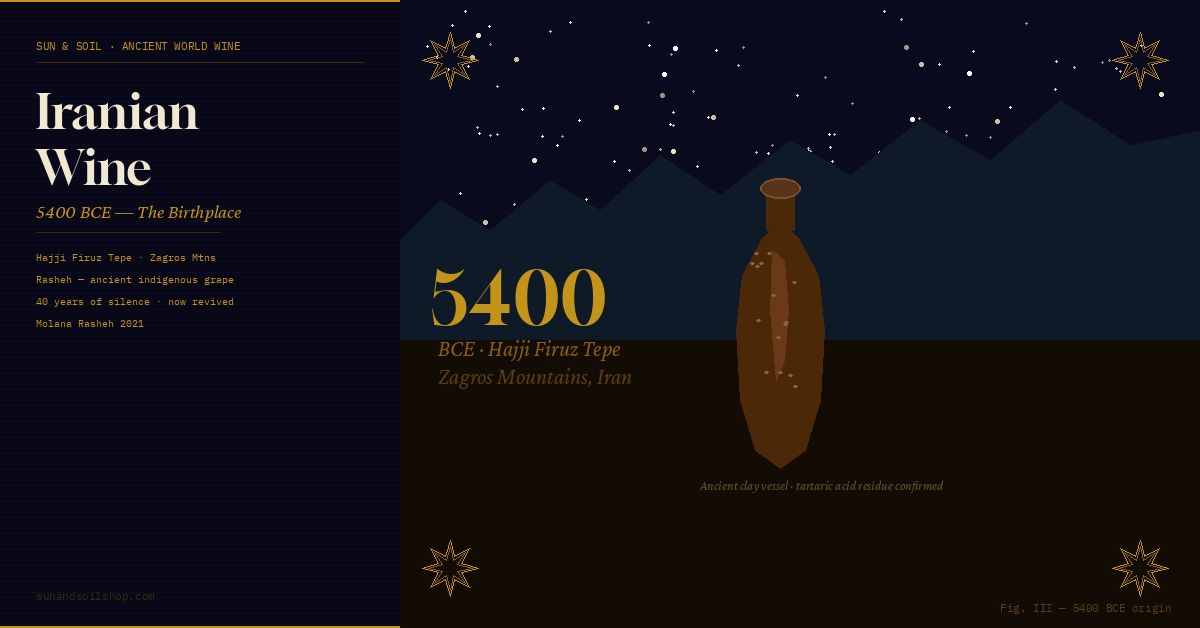
Iran is the birthplace of wine. Not one of the birthplaces — the birthplace. The oldest confirmed evidence of intentional winemaking anywhere in the world was found in the Zagros Mountains of western Iran: clay jars from the Neolithic settlement of Hajji Firuz Tepe, dated to around 5400 BCE, containing tartaric acid residue and resin from the terebinth tree used as a preservative. The wine being made in those jars predates the earliest Egyptian wine evidence by more than a thousand years, and the earliest Greek wine evidence by two millennia. Iran did not learn to make wine from anyone. Everyone, in some sense, learned to make wine from Iran.
And then, in 1979, it stopped. The Islamic Revolution prohibited alcohol across the country. Vineyards were converted to raisin and table grape production. The wine industry — which had been producing millions of liters a year before the Revolution, including internationally exported wines of genuine quality — disappeared almost overnight. For forty years, the country that invented wine made none.
The story of Molana Rasheh 2021 is the story of what happens when that forty-year silence ends. A small group of Iranian winemakers, working with indigenous grape varieties that survived the prohibition years as table grapes, are making wine again — not in Iran, where it remains illegal, but for the international market, drawing on the memory of Persian viticulture and the genetic heritage of varieties that have been growing in Iran for eight thousand years. The result is wine of genuine character and extraordinary historical weight. There is nothing else like it.
Iran and the Origins of Wine
The connection between Iran and wine is not ancient in a vague, general sense — it is specific, archaeological, and well-documented. The Zagros Mountain region of western Iran sits at the intersection of wild Vitis vinifera sylvestris (the ancestor of all cultivated wine grapes) and the earliest human settlements complex enough to have developed fermentation technology. The conditions were right: grapes grew wild on the mountain slopes, humans were developing pottery capable of holding liquid, and the Mediterranean climate of the mountain foothills produced summer heat followed by cool, wet winters that would have concentrated grape sugars naturally.
The Hajji Firuz Tepe jars — found in a Neolithic village kitchen, dated to approximately 5400 BCE — are the smoking gun. But they are not isolated. Wine jar residues have been found throughout the Zagros region from this period and later: at Godin Tepe (3500–2900 BCE), where the jars show resin lining suggesting deliberate wine preservation; at numerous Bronze Age sites in the region; in the palace storerooms of the Achaemenid Persian Empire (550–330 BCE), where Greek historians recorded the consumption of Persian wine by Xerxes and Darius. The word for wine in Persian — and through it, in English, French, Italian, German, and most European languages — derives from an Old Iranian root that spread with the vine across the ancient world.
Persian wine culture at its peak was sophisticated and extensive. The Achaemenid Persians cultivated vineyards across their empire, which stretched from Egypt to India. The great Persian poets — Hafez, Rumi, Omar Khayyám — are saturated with wine imagery. The Rubáiyát of Omar Khayyám, one of the most widely read poems in the English-speaking world, is fundamentally a meditation on wine, impermanence, and the fullness of life. This is not metaphor: it is the literary expression of a culture that had been drinking wine for five thousand years.
The Forty-Year Silence
Before 1979, Iran had a wine industry. The country exported wine to Europe. Persian varietals had been cultivated continuously for millennia. The Islamic Revolution changed this overnight. The new government declared alcohol haram, prohibited its production and consumption, and ordered vineyards converted to non-wine uses. Most were repurposed for raisins and table grapes — the same varieties that make wine also produce excellent raisins, and the grape-growing infrastructure could be preserved even as its wine-producing purpose was extinguished.
What survived was the vine. The old indigenous varieties — Rasheh, Rkatsiteli (shared with Georgia), Shara, Ghezel Uzum, and dozens of others — continued to be cultivated as table and raisin grapes throughout the prohibition period. The genetic heritage of Persian viticulture was not lost. It was just waiting.
The Rasheh Grape
Rasheh is an indigenous Iranian grape variety grown in the wine-producing regions of northwestern Iran, particularly around Lake Urmia and the province of East Azerbaijan. It is a red-skinned variety that produces wines of deep color, significant tannin, and a distinctive fruit profile centered on blackberry, black cassis, and dark dried fruit, with an earthy, mineral quality that speaks of its high-altitude plateau terroir.
During the prohibition years, Rasheh continued to be grown as a table and raisin grape — its thick skins and concentrated sugars made it well-suited to drying — preserving the variety's genetic integrity even as its wine-producing purpose was suppressed. The vines that survive today are genuinely old: ungrafted, dry-farmed, grown at elevation in conditions that have changed very little since ancient times. The Molana project sources Rasheh from these old vines, using them as the foundation of a modern wine made with contemporary techniques but drawing on a grape that is, in the most literal sense, as ancient as winemaking itself.
The Molana Project
Molana is the most important project currently working to revive Iranian viticulture for the international market. The wine is not made inside Iran, where production remains illegal, but it draws entirely on Iranian grape varieties sourced from old vineyards in northwestern Iran, and it is made with a stated commitment to recovering and documenting Iran's indigenous grape heritage.
The project is, in some sense, archaeological as well as vinous: recovering varieties, vinification knowledge, and terroir understanding that had no living tradition to draw on after forty years of prohibition. The winemakers working on Molana had to reconstruct from scratch what Iranian wine should taste like — what happens when Rasheh is fermented dry with native yeasts and bottled without additions, rather than dried into raisins or pressed into grape juice. The answers are, as the wine makes clear, very good.
The Molana Rasheh 2021 is made with modern natural wine techniques — wild yeast fermentation, minimal intervention — applied to a grape variety that has probably not been vinified as a serious dry red wine since before the Revolution. The result is a wine of considerable character: the blackberry and cassis fruit that Rasheh naturally produces, given structure by the variety's tannin and freshness by the high-altitude terroir, with an earthy depth that feels genuinely Persian. It is also a collectible object: a document of a moment in the recovery of one of the world's oldest wine cultures.
Iran, Armenia, and the Ancient World
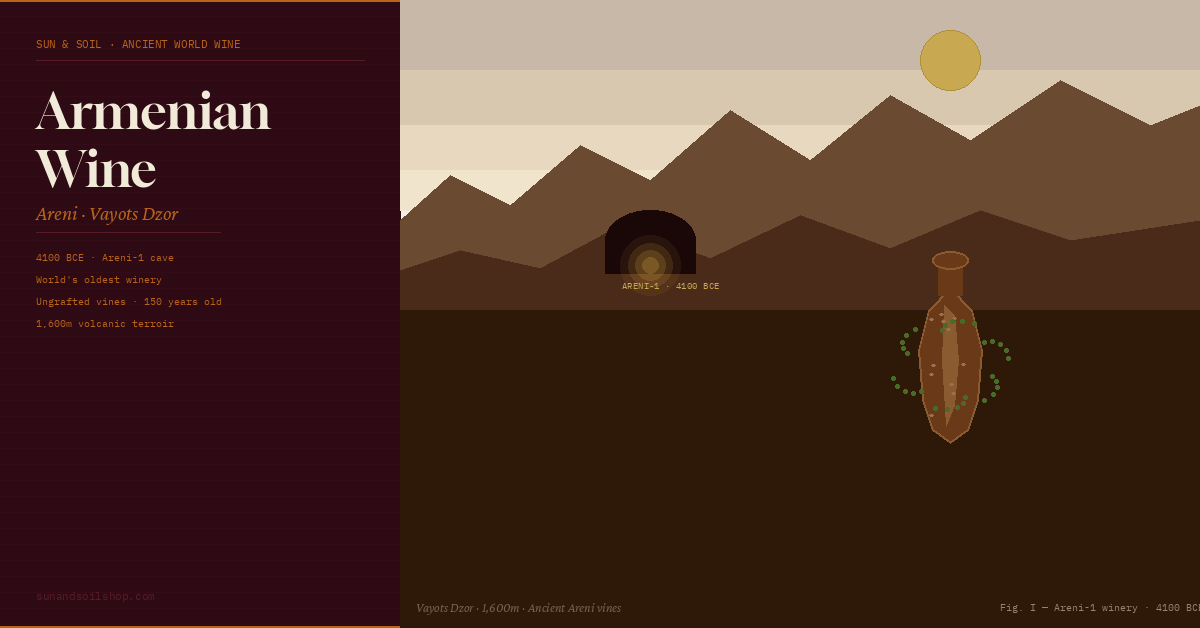
The Molana Rasheh carries both an Iranian wine and Armenian wine classification in our system — a detail that opens an interesting historical window. The wine-producing regions of northwestern Iran (around Lake Urmia) and the wine-producing regions of Armenia (the Vayots Dzor valley, home to the world's oldest known winery at Areni-1, dated to 4100 BCE) are geographically and historically contiguous. The ancient kingdoms of Urartu and later the various empires that controlled this region did not observe modern national boundaries. The grape varieties that grow in northwestern Iran and in Armenia share genetic heritage — and in some cases may be the same variety, cultivated continuously on both sides of what are now international borders.
We also carry Armenian wine: the Tarllc "061" and Zulal Areni, both made from Areni — the indigenous Armenian red grape grown in the same ancient wine corridor. Drinking Molana Rasheh and Zulal Areni together is an instructive exercise: two wines from adjacent ancient cultures, both drawing on indigenous varieties preserved through tumultuous political histories, both made by producers committed to recovering what was almost lost. They taste different — Rasheh is darker and more tannic, Areni is more delicate and aromatic — but they speak a related language. The language of the oldest wine in the world.
From Our Cellar
Molana Rasheh 2021 · Iran (Northwestern Iran)
There is no other wine in our range — and very few wines anywhere — with a story like this one. One hundred percent Rasheh, an indigenous Iranian grape variety grown in the wine regions of northwestern Iran near Lake Urmia, vinified with modern natural wine technique into a wine of genuine complexity and historical significance. Deep blackberry and black cassis on the nose, with an earthy mineral quality that speaks of high-altitude plateau terroir. Elegant and rich on the palate, with a tannin structure from the thick-skinned Rasheh variety that gives the wine real presence and aging potential. This is Iranian wine — one of the first serious bottlings available in the United States — made from grapes that have been growing in this region since before the Achaemenid Persian Empire. It is a collector's item, a piece of wine history, and also just a very good red wine. Drink it with the awareness that you are participating in the recovery of eight thousand years of winemaking tradition.
Browse our full ancient world wine selection →
Frequently Asked Questions
Does Iran make wine?
Iran was one of the world's oldest wine-producing countries — the earliest evidence of intentional winemaking in the world, from Hajji Firuz Tepe in western Iran, dates to approximately 5400 BCE. The Islamic Revolution in 1979 prohibited alcohol production and consumption in Iran. Some Iranian winemakers now produce wine outside Iran using indigenous Iranian grape varieties for the international market — Molana is the most prominent example. Wine production inside Iran remains illegal.
What is Rasheh wine?
Rasheh is an indigenous Iranian grape variety grown primarily in northwestern Iran around Lake Urmia. It is a red-skinned variety producing wines of deep color, significant tannin, and concentrated dark fruit — blackberry, cassis, dried plum — with an earthy, mineral quality from its high-altitude terroir. During Iran's prohibition era, Rasheh survived as a table and raisin grape. The Molana project is the first serious producer working with Rasheh as a wine grape for the international market.
Is Iran the birthplace of wine?
The archaeological evidence strongly suggests yes. The oldest confirmed evidence of intentional winemaking anywhere in the world was found at Hajji Firuz Tepe in the Zagros Mountains of western Iran, dated to approximately 5400 BCE. This predates the earliest Egyptian wine evidence by over a thousand years. The words for wine across European and Middle Eastern languages derive from an Old Iranian root that spread with the vine across the ancient world.
Is Shiraz wine from Iran?
No — despite the widespread claim, the Syrah grape (marketed as Shiraz in Australia and South Africa) has no proven connection to the Iranian city of Shiraz. DNA analysis has traced Syrah's origins to the Rhône Valley of France, where it is a natural crossing of two obscure French varieties. The city of Shiraz in southern Iran was an important wine-producing centre before the Revolution, but the Syrah/Shiraz grape did not originate there. The name similarity is coincidental.
How does Iranian wine taste?
The Molana Rasheh shows deep blackberry and cassis fruit with an earthy, mineral depth and significant but elegant tannin. It is a full-bodied red wine of real presence, comparable in structure to other ancient-variety reds like Georgian Saperavi or Armenian Areni, but with its own distinct character. The high-altitude terroir of northwestern Iran gives it freshness that prevents the fruit from becoming heavy.
Go deeper: Georgian wine — the 8,000-year qvevri tradition · Lebanese wine — Merweh, Bekaa Valley, and the Levant's natural wine story · Saperavi — Georgia's greatest red grape · What is natural wine?