
Wine Without Sulfites: The Complete Guide to SO2, Headaches & Low-Intervention Wine
If you have ever avoided wine because of headaches, read a label that said "contains sulfites" and wondered what it meant, or been told that natural wine is better for you because it has no sulfites, this guide is for you. Sulfites in wine are one of the most misunderstood topics in the entire world of food and drink.
The truth is both simpler and more interesting than the myths suggest. All wine contains sulfites, including wine labelled "sulfite-free." The headaches that many people blame on sulfites are almost certainly caused by something else entirely. Natural wine is genuinely lower in sulfites than conventional wine, and this matters, but not for the reasons most people assume. Understanding the role of sulfur dioxide in winemaking is the key to understanding what separates a natural wine philosophy from a conventional one.
What Are Sulfites in Wine?
Sulfites is the common term for sulfur dioxide (SO2) and related sulfur compounds that are used in winemaking as a preservative and antioxidant. The term covers a family of related compounds: sulfur dioxide gas, bisulfite ions, and sulfite ions, all measured together as "total SO2."
Sulfur dioxide has been used in winemaking for centuries. The Romans burned sulfur candles inside wine vessels to preserve them, a practice documented by Pliny the Elder in the first century CE. In modern winemaking, SO2 is added at multiple stages: to the grapes at harvest to prevent oxidation and wild yeast activity, during fermentation in some cases, after fermentation and at racking, and at bottling. The total across all additions is the "total SO2" number that determines labelling requirements.
Sulfur dioxide works in two distinct ways. As an antioxidant, it reacts with oxygen before oxygen can react with the wine, preventing the oxidation that would otherwise turn white wine brown and flat. As an antimicrobial agent, it inhibits the growth of spoilage bacteria and unwanted wild yeasts. It is the most effective, most widely studied, and most economical preservative available to winemakers, which is why conventional winemaking has come to rely on it heavily.
All Wine Contains Sulfites, Including "Natural" Wine
This is the most important fact to understand about sulfites in wine, and the one most frequently misrepresented: all wine contains sulfites, even wine labelled "no sulfites added" or "sulfite-free."
Sulfites are a natural by-product of fermentation. When yeast converts grape sugar to alcohol, it produces SO2 as a metabolic by-product, typically between 10 and 40 mg/L, depending on the yeast strain and fermentation conditions. A wine made with zero sulfur additions still contains sulfites from the fermentation process itself.
When a label says "no added sulfites," it means no sulfur dioxide has been added at any stage of winemaking. The wine still contains naturally occurring sulfites from fermentation at much lower levels, typically 10-40 mg/L, than conventionally made wine, which may contain 100-200 mg/L or more in whites, and 80-150 mg/L in reds.
When a label says "contains sulfites," in the United States it means the wine contains more than 10 mg/L of total SO2, a threshold that virtually all wine exceeds purely from fermentation. This means the "contains sulfites" warning on a label tells you almost nothing about how much SO2 the wine actually contains.
Sulfite levels in context
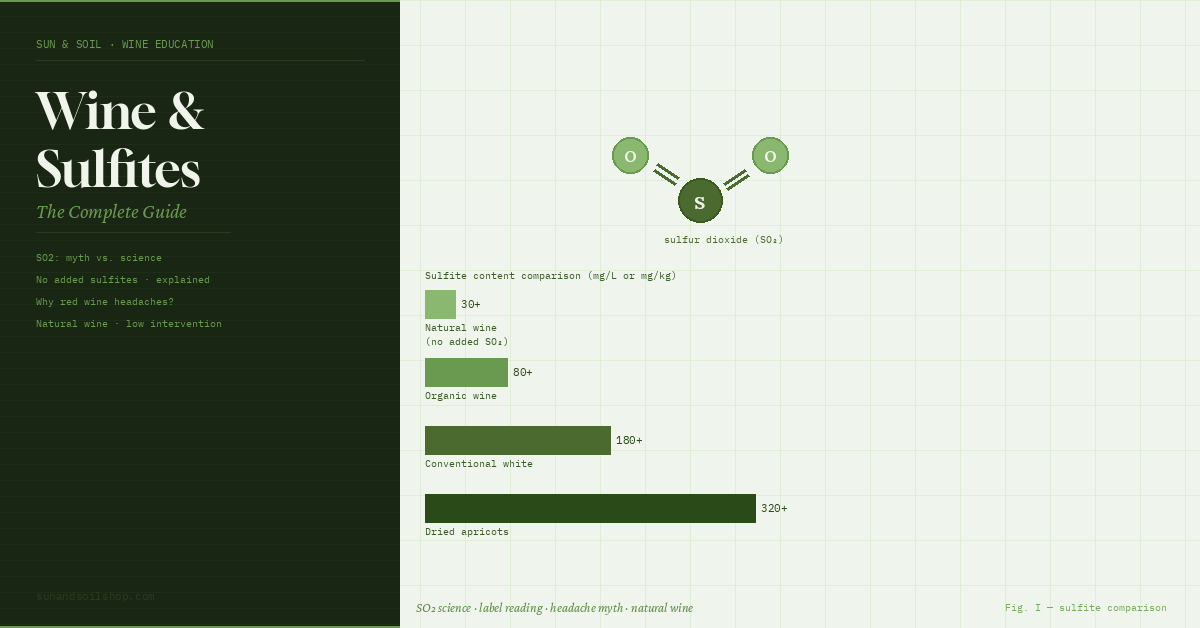
Conventional white wine: 100-200 mg/L total SO2
Conventional red wine: 70-150 mg/L total SO2
Organic wine (EU certification): maximum 100 mg/L for reds, 150 mg/L for whites
Biodynamic wine (Demeter certified): maximum 70 mg/L for reds, 90 mg/L for whites
Natural wine (low intervention): typically 20-50 mg/L, often less
Natural wine (zero-zero, no added SO2): 10-30 mg/L from fermentation only
For comparison: dried apricots contain approximately 1,500-3,000 mg/kg of sulfites. Dried figs contain around 500-1,000 mg/kg. A glass of conventional white wine at 150 mg/L contains a fraction of the sulfites in a small handful of dried fruit. If sulfites caused the symptoms commonly attributed to them, dried fruit would be far more problematic than wine.
Do Sulfites Really Cause Wine Headaches?
Almost certainly not, or at least not in the vast majority of cases. The "sulfite headache" is one of the most persistent myths in the wine world, and the scientific evidence does not support it for most people.
Sulfite sensitivity exists as a genuine medical condition, affecting approximately 1% of the general population and up to 5% of people with asthma. In these individuals, sulfites can trigger asthma-like symptoms: wheezing, difficulty breathing, skin flushing. Headaches are not typically a primary symptom of sulfite sensitivity. The condition is primarily respiratory.
The symptoms that wine drinkers commonly attribute to sulfites are more likely caused by one or more of the following:
Histamines: Wine contains histamines produced by bacteria during malolactic fermentation. Red wine contains significantly more histamines than white. People with low levels of diamine oxidase (DAO), the enzyme that breaks down histamines in the gut, are particularly susceptible. Histamine responses include headache, flushing, nasal congestion, and skin reactions, exactly the symptoms people blame on sulfites.
Tannins: Tannins in red wine stimulate the release of serotonin in some people, which can trigger headaches. Since red wine typically contains less SO2 than white wine, tannin sensitivity is a more plausible explanation for many red wine headaches than sulfites.
Tyramine: Tyramine, another biogenic amine found in fermented foods including wine, can trigger migraines in sensitive individuals by affecting blood pressure and serotonin levels.
Alcohol itself: Ethanol is a vasodilator and diuretic. Dehydration and vasodilation are both migraine triggers. Most "wine headaches" are at least partly attributable to the alcohol, regardless of other factors.
The red wine paradox: The most compelling argument against the sulfite-headache theory is that white wine typically contains significantly more added SO2 than red wine, yet the "wine headache" is disproportionately associated with red. If sulfites were the primary cause, white wine drinkers should be more affected. The reverse pattern strongly suggests that tannins, histamines, or other red-wine-specific compounds are the more likely culprits.
Why Winemakers Add Sulfites, and Why Natural Winemakers Avoid Them
In conventional winemaking, sulfur dioxide serves as an insurance policy. It allows winemakers to process large quantities of grapes without worrying about microbial stability. It protects wine through long shipping chains, temperature fluctuations, and extended warehouse storage. It gives wine a predictable shelf life that can be guaranteed to retailers globally.
The cost of that insurance is that SO2, at higher concentrations, masks the expression of terroir. Wine molecules, the esters, aldehydes, terpenes, and other aromatic compounds that carry the flavor and character of a specific grape, vineyard, and vintage, are affected by SO2 at winemaking concentrations. High-SO2 wine tends to taste cleaner, more uniform, and more predictable, but less specific, less complex, and less interesting.
Natural winemakers argue that reducing or eliminating SO2 additions allows wine to express its terroir more clearly and completely. A zero-addition Areni from Armenia tastes more specifically of the volcanic basalt soil and the Vayots Dzor valley than the same wine with 80 mg/L of added SO2. A no-addition Gruner Veltliner from Meinklang's biodynamic Burgenland estate tastes more alive, more mineral, and more specific than a conventionally stabilized Gruner from the same region. This is the consequence of a straightforward trade-off: stability versus expressiveness. Natural winemakers choose expressiveness.
How to Read Sulfite Labels
"Contains sulfites": Mandatory in the US and EU if total SO2 exceeds 10 mg/L. Tells you almost nothing about actual SO2 levels. Most wine exceeds 10 mg/L from fermentation alone.
"No added sulfites": Means no SO2 has been added at any stage of production. The wine will still contain naturally occurring sulfites from fermentation, typically 10-30 mg/L. This is a meaningful claim that distinguishes low-intervention natural wine from conventional wine.
Organic wine labelling: In the EU, certified organic wine may contain added SO2 up to 100 mg/L for reds and 150 mg/L for whites, meaningfully less than conventional wine but far more than no-addition natural wine.
Biodynamic (Demeter) labelling: Demeter certification imposes tighter SO2 limits: 70 mg/L maximum for reds, 90 mg/L for whites. Demeter-certified wine is consistently lower in SO2 than both conventional and standard organic wine.
Natural Wine and Sulfites: The Low-Intervention Philosophy
Natural wine does not have a single universally agreed definition, but the approach to SO2 is one of its most consistent features. Most serious natural winemakers target either no added SO2 or very small protective additions at bottling only.
The reasoning is philosophical as much as health-related. Natural winemakers argue that SO2, even at moderate levels, changes the wine in ways that are not a natural consequence of fermentation and terroir expression. They are committed to wines that express what actually happened in the vineyard and the cellar with as little manipulation as possible.
The wines that result from this approach can behave differently from conventional wine. Some natural wines, particularly whites made without added SO2, are best drunk young and kept cold. Some show slight spritz from continued fermentation. Some have a cloudy appearance from unfined, unfiltered production. None of these are defects; they are the natural consequences of making wine without industrial preservation.
Low-Sulfite Wines from Our Cellar
All of the wines we carry at Sun & Soil are lower in sulfites than their conventional equivalents. A selection of those with the most explicit zero-addition or no-SO2 commitments:
Zero-zero: no additions whatsoever
Tarllc "061" Vayots Dzor Red · Armenia (Vayots Dzor) · $30
The most explicit zero-zero wine in our range. Aaron Rawlins and Maral Sarian add nothing and remove nothing: no SO2 at any stage, no fining, no filtration. 150-year-old ungrafted Areni vines at 1,600 meters. As close to fermented grape juice as wine can be.
Calalta Syrah Sehnsucht 2021 · Italy (Veneto) · $29
Certified organic with biodynamic practices. Unfiltered, without added SO2. Zero-zero. A Syrah that demonstrates what the grape tastes like without sulfur masking its expression.
Robb de Matt Ezechiele 2022 · Italy (Campania) · $29
65% Falanghina, 20% Trebbiano, 15% Coda di Volpe. No added sulfites. Semi-carbonic maceration 13 days, bottled without filtering or clarification. One of the most interesting no-SO2 Italian whites in our range.
Demeter certified: verified low sulfites
Meinklang Gruner Veltliner 2024 · Austria (Burgenland)
Demeter-certified biodynamic across the entire farm. SO2 within Demeter's strict limits. The reference bottle for understanding what minimal-intervention farming does to Gruner Veltliner's mineral character.
Gut Oggau Theodora 2023 · Austria (Burgenland)
Biodynamic, wild yeast, no additions, unfiltered. One of the most respected natural wine estates in the world, with a commitment to minimal SO2 central to their philosophy.
Traditional method: naturally low sulfites
Casreli "Erekle's Wine" Qvevri Dry Amber, Kakheti 2021 · Georgia
Georgian qvevri winemaking predates the use of sulfur as a preservative. Fermented and aged in buried clay vessels with no additions. The clay vessel provides a gentle micro-oxidative environment that stabilises the wine naturally, without SO2.
Browse our full low-intervention wine selection
Frequently Asked Questions About Sulfites in Wine
Do sulfites in wine cause headaches?
Almost certainly not for most people. Sulfite sensitivity is a real medical condition affecting approximately 1% of the population, but its primary symptom is respiratory, not headaches. The headaches most commonly attributed to wine are more likely caused by histamines, tannins, tyramine, alcohol, or dehydration. The fact that red wine, which typically contains less SO2 than white, is disproportionately associated with headaches undermines the sulfite explanation.
Does all wine contain sulfites?
Yes. Sulfites are a natural by-product of fermentation, produced by yeast as it converts sugar to alcohol. Even wine labelled "no added sulfites" contains naturally occurring sulfites from fermentation, typically 10-30 mg/L. The "contains sulfites" label required in the US and EU indicates only that total SO2 exceeds 10 mg/L, a threshold that virtually all wine exceeds regardless of whether sulfur has been added.
What does "no added sulfites" mean on a wine label?
It means no SO2 has been added at any stage of winemaking: not at harvest, not during fermentation, not after fermentation, not at bottling. The wine will still contain naturally occurring sulfites from fermentation, typically 10-30 mg/L. This is a genuine and meaningful claim that distinguishes minimal-intervention natural wine from conventional wine, which typically contains 70-200 mg/L of total SO2 including additions.
Is natural wine sulfite-free?
Natural wine is lower in sulfites than conventional wine, often dramatically so. Many natural winemakers add no SO2 at any stage of production. But no wine is genuinely sulfite-free: fermentation always produces some SO2 naturally. "No added sulfites" is a more accurate term than "sulfite-free" for wines made without sulfur additions.
What foods have more sulfites than wine?
Many common foods contain more sulfites than even conventional wine. Dried apricots typically contain 1,500-3,000 mg/kg of SO2. Dried figs, raisins, and other dried fruit contain 500-2,000 mg/kg. Preserved meats, certain condiments, and commercial grape juice also contain significant quantities. If you eat dried fruit without issue, sulfites are unlikely to be the cause of your wine-related symptoms.
Is organic wine lower in sulfites?
Yes, but only somewhat. EU-certified organic wine allows SO2 additions up to 100 mg/L for reds and 150 mg/L for whites, meaningfully less than conventional wine but far more than most genuine natural wine. Biodynamic (Demeter-certified) wine has tighter limits: 70 mg/L for reds, 90 mg/L for whites. The lowest-sulfite wines are typically natural wines made by producers who add little or no SO2.
Which wine has the least sulfites?
Wines made without any SO2 additions have the least sulfites, typically 10-30 mg/L from fermentation only. Among certified categories, Demeter biodynamic wine has the strictest limits. Among wine styles, qvevri-fermented Georgian wines, which predate the use of sulfur preservatives, are among the most traditionally low-sulfite wines in the world. At Sun & Soil, we can identify the specific SO2 approach of every wine we carry.
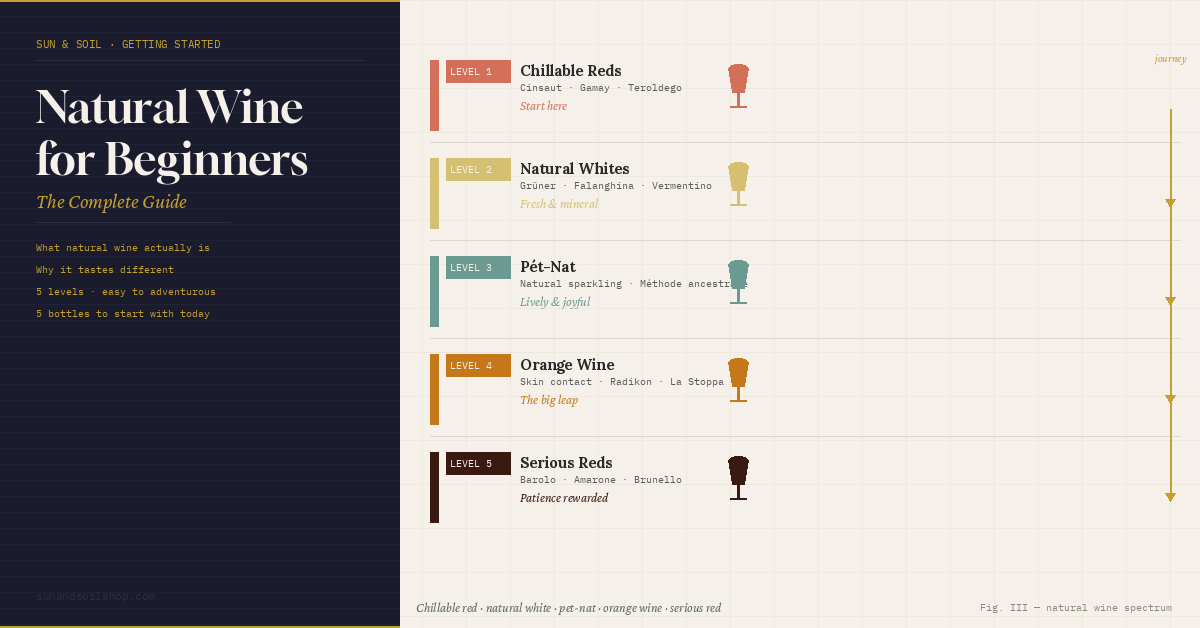
Go deeper: What is natural wine? The complete guide · Biodynamic wine: the complete guide · Georgian wine: the 8,000-year qvevri tradition · Natural wine for beginners