
Pétillant Naturel (Pet-Nat): The Complete Guide to Natural Sparkling Wine
Pétillant naturel — almost always shortened to pet-nat — is the sparkling wine that the natural wine world made its own. Light, hazy, often bottled under a crown cap rather than a cork, sometimes slightly funky, always alive in the glass, pet-nat has become the house sparkling of natural wine bars and the first sparkling wine that many drinkers reach for who have grown tired of industrial Prosecco and Champagne facsimiles. It is also, by a considerable margin, the oldest method of making sparkling wine in the world.
The appeal is not hard to understand. Where Champagne is a product of industrial precision — disgorgement, dosage, gyropalettes, years of riddling in carefully temperature-controlled cellars — pet-nat is the product of a single, almost accidental process: bottling wine before fermentation is complete and letting the residual carbon dioxide do its work in the bottle. No additions. No riddling. No second yeast. Just wine, wild yeast, and whatever gas is still in the liquid when the winemaker decides to bottle. The result is a wine that fizzes rather than sparkles, that is often cloudy with yeast sediment, that tastes of its fruit and fermentation rather than its dosage, and that varies from vintage to vintage in ways that Champagne by design cannot.
What Is Pétillant Naturel?
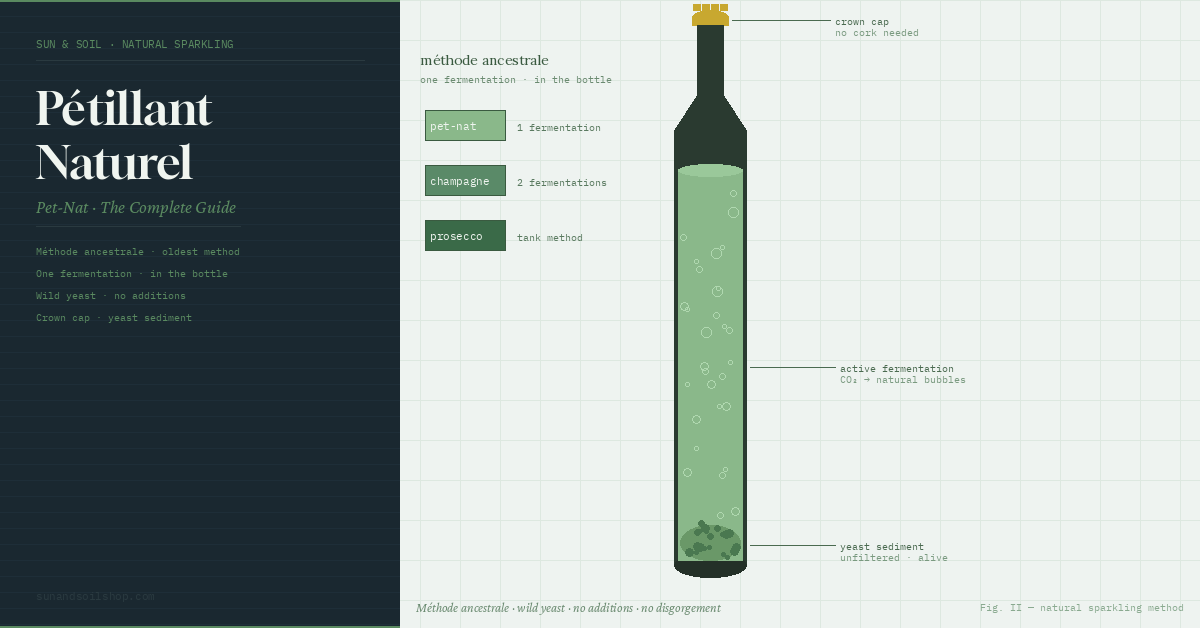
Pétillant naturel is French for “naturally sparkling.” It refers to wine made using the méthode ancestrale — the ancestral method — in which wine is bottled mid-fermentation, before all the grape sugars have been converted to alcohol. The fermentation continues in the sealed bottle. The carbon dioxide that fermentation produces dissolves into the wine. When the bottle is opened, that dissolved CO₂ comes out of solution as bubbles.
This is the simplest possible way to make sparkling wine, and it is the original one. The méthode ancestrale predates the development of Champagne by centuries. The Champagne method was a refinement of this observation: a way to control the secondary fermentation, remove the yeast sediment through riddling and disgorgement, and add precise amounts of sugar (dosage) to achieve a consistent, clear, calibrated sparkling wine. Pet-nat skips all of that. The yeast sediment stays in the bottle, making the wine cloudy. The CO₂ level is not precisely controlled, making the wine’s effervescence variable. No dosage is added. The result is a wine that feels alive and unpolished in a way that precisely dosed Champagne cannot replicate.
Pet-Nat vs Champagne vs Prosecco
Méthode ancestrale (pet-nat): Wine bottled mid-fermentation. One fermentation, in the bottle. No additions. No riddling. No disgorgement. Cloudy, variable, fruit-forward, typically lower in alcohol. The oldest method.
Méthode champenoise / traditionnelle (Champagne, Cava, Crémant): Wine fully fermented, then a second fermentation is triggered in the bottle by adding sugar and yeast. Yeast sediment removed by riddling and disgorgement. Dosage added to calibrate sweetness. Clear, consistent, complex, higher in pressure. The most technically demanding method.
Charmat / tank method (Prosecco, most Cava): Second fermentation in a pressurized tank rather than individual bottles. Wine filtered and bottled under pressure. Clear, consistent, fruit-forward. The fastest and most cost-effective industrial method.
Pet-nat is not attempting to be Champagne and failing — it is doing something different, with different priorities. Its cloudiness is evidence that the wine is alive and unfiltered. Its variability is the natural expression of a process that has not been controlled into uniformity. Its fruit-forward freshness is the direct expression of the grape without the complexity added by extended lees aging in Champagne.
Why Natural Winemakers Love Pet-Nat
Pet-nat became the sparkling wine of the natural wine world for philosophically coherent reasons. Natural winemakers are committed to minimal intervention — and pet-nat, as a method, requires less intervention than any other sparkling wine technique. There is no second yeast addition, no disgorgement, no dosage, no additional sulfur at bottling. The winemaker simply decides when to bottle and lets the process run.
This means that a natural winemaker who has spent months carefully cultivating wild yeast fermentation, avoiding additions, and working with minimal sulfur does not have to abandon those principles to make a sparkling wine. Pet-nat is the natural sparkling wine in the most literal sense: wine that became sparkling through its own natural fermentation, without external addition or manipulation.
The other appeal is practical: pet-nat does not require the expensive equipment or the time investment of the Champagne method. A small natural wine producer with limited capital can make excellent pet-nat without a major cellar investment. This has made it genuinely democratic — the sparkling wine that small, quality-focused producers can actually afford to make well.
How to Drink Pet-Nat
Serve cold — between 6°C and 8°C. The cold suppresses the bubbles slightly and keeps the wine fresh.
Open carefully — pet-nat is under less pressure than Champagne but more than still wine. Hold the crown cap firmly, tilt the bottle at 45 degrees and rotate slowly. Have a glass ready.
The sediment is fine — the cloudy appearance comes from yeast sediment. It is entirely harmless and often adds a pleasant textural quality. The sediment is not a flaw.
Drink young — most pet-nat is designed for immediate pleasure. The freshness that makes it delicious at release fades with time. Drink within one to two years of vintage as a general rule.
Food pairing — pet-nat’s versatility at the table is one of its most underrated qualities. The combination of acidity, bubbles, and moderate alcohol makes it a superb aperitif and companion to fried food, seafood, charcuterie, and fresh cheeses. Chenin Blanc pet-nat with oysters is one of the great natural wine pairings.
From Our Natural Sparkling Cellar
The classic rosé pet-nat
Domaine Moutard Pet Mout Rosé Pét-Nat · France (Champagne region) · $23
One of the most beautifully made pet-nats in our range. Domaine Moutard is a multigenerational Champagne house — four centuries of sparkling wine knowledge applied to the simplest possible method. Méthode ancestrale: bottled mid-fermentation, wild yeast, no additions, no disgorgement. Lively, hazy, fruit-forward, with the acidity and finesse that Champagne’s chalk soils always provide. The pet-nat to open first: immediately approachable, genuinely delicious, and a perfect illustration of why the ancestral method has had such a resurgence.
Chenin Blanc pétillant — Loire Valley
Clos de L’Epinay Chaflorie Pétillant 2023 · France (Loire Valley)
100% Chenin Blanc pétillant from the Loire — plump, vivacious, with bright citrus fruits and a toasty backbone. The bubbles are ancestral, the acidity is real Loire Chenin acidity, and the wine has a genuine elegance that makes it the most serious expression in our natural sparkling range. One of the most beautiful pet-nats available anywhere.
German Muscat pet-nat
Weingut Idler Pet Nat Muscat 2022 · Germany
Muscat fermented in the ancestral style — the grape’s characteristic floral aromatics (rose, lychee, orange blossom) meeting the lively freshness of in-bottle fermentation. German Muscat pet-nat is still a rare style, and this is a compelling example: aromatic, joyful, and best drunk as cold as possible on a warm evening.
Italian pet-nat — Montepulciano and Moscato
Tressette Col Morto Pet Nat 2022 · Italy
A fascinating co-fermentation of Montepulciano and Moscato in the ancestral style — the dark, tannic structure of Montepulciano softened and lifted by the aromatic sweetness of Moscato, both caught in the bottle mid-fermentation. Unlike any other pet-nat in our range: structured but joyful, dark-fruited but floral.
Extended lees — Slovenian natural sparkling
Guerila Blanc de Nature NV · Slovenia (Vipava Valley)
A step beyond pet-nat: traditional method (secondary fermentation in bottle) without disgorgement, aged on lees for 36 months. Made from 100% Merlot in a blanc de noir style from Demeter-certified biodynamic vines in the Vipava Valley. Pie crust, sweet cherry, nectarine, and lemon cream, with exquisitely fine bubbles and a long mineral finish. What happens when natural wine philosophy meets serious sparkling wine production.
Browse all natural sparkling wines →
Frequently Asked Questions
What is pet-nat wine?
Pet-nat is short for pétillant naturel — French for “naturally sparkling.” It refers to wine made using the méthode ancestrale, in which wine is bottled mid-fermentation. The fermentation continues in the sealed bottle, and the CO₂ produced creates natural bubbles. Pet-nat is typically cloudy (from yeast sediment), lower in pressure than Champagne, fruit-forward, and made without additions or disgorgement. It is the oldest method of making sparkling wine.
How is pet-nat different from Champagne?
Champagne uses the méthode champenoise: a fully fermented still wine has a second fermentation triggered in the bottle, then yeast sediment is removed (disgorgement), and sugar is added (dosage) to calibrate the sweetness. Pet-nat skips all of this — one fermentation, in the bottle, no additions, no riddling, no disgorgement. The result is cloudier, less consistent, more fruit-forward, and more variable than Champagne. It is not an inferior version of Champagne; it is a different thing entirely.
Is pet-nat sweet or dry?
Pet-nat can be either, depending on when the winemaker chose to bottle. If bottled very early in fermentation, the wine will be sweeter and lower in alcohol. If bottled later, it will be drier and higher in alcohol. Most natural wine pet-nats lean toward dry or off-dry. The lack of added dosage means no additional sweetness is introduced.
Should pet-nat be chilled?
Yes — serve pet-nat well chilled, between 6°C and 8°C. Serving too warm increases the effervescence and can cause the wine to overflow when opened. Open slowly, tilting the bottle and rotating the cap rather than pulling it off abruptly.
What food goes with pet-nat?
Pet-nat is one of the most food-versatile sparkling wines. Its acidity and bubbles make it an excellent aperitif and a natural companion to fried food, seafood, charcuterie, and fresh cheeses. Chenin Blanc pet-nat with oysters is a classic pairing. The key is that pet-nat’s freshness and lower alcohol make it food-friendly across a wider range of dishes than many still wines.
Go deeper: What is natural wine? The complete beginner’s guide · Orange wine food pairing — the complete guide · Biodynamic wine — the complete guide · French natural wine — the complete guide